
SLIDE 1
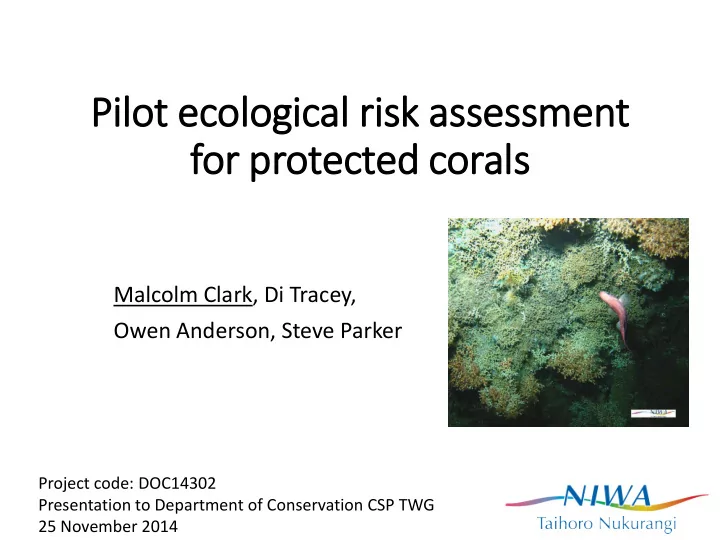
Pilot ecological risk assessment for protected corals
Malcolm Clark, Di Tracey, Owen Anderson, Steve Parker
Project code: DOC14302 Presentation to Department of Conservation CSP TWG 25 November 2014
Pilot ecological risk assessment for protected corals Malcolm - - PowerPoint PPT Presentation
Pilot ecological risk assessment for protected corals Malcolm Clark, Di Tracey, Owen Anderson, Steve Parker Project code: DOC14302 Presentation to Department of Conservation CSP TWG 25 November 2014 Objectives The project has two
Project code: DOC14302 Presentation to Department of Conservation CSP TWG 25 November 2014
may produce,
limit the ERA, and
corals relevant for developing management options to reduce impacts from trawling.
SCOPING Establish scope and context Identify and document objectives Hazard identification Risk Assessment Level 1 Qualitative assessment (SICA) Uncertainty analysis Medium, high or extreme risk Negligible or low risk Risk Assessment Level 2 Semi-quantitative (PSA) Uncertainty analysis Medium, high or extreme risk Negligible or low risk Risk Assessment Level 3 Quantitative assessment Uncertainty analysis Risk management reponse Medium, high or extreme risk Negligible or low risk
Analysis: Fishery/subfishery Analysis: most vulnerable element in each component (species, habitat, community) Screen out: low consequence activities and (potentially) low risk components Analysis: selected elements (species, habitat, community); spatial and temporal dynmaics Analysis: full set of elements for each component Screen out: low risk elements
recovery
Aspect Concept and Rationale Ranks Attribute (s) 1 (low risk) 2 (medium) 3 (high risk) Availability A1 Spatial overlap (geographical and depth range) Spatial overlap of the general geographic area with the geographical and depth range of the coral taxon. Very little
its distribution in NZ is located in the region of focus) Partial overlap (10-50% )with its distribution range around NZ Considerable
with species distribution (e.g., Chatham Rise endemic)
Aspect Concept and Rationale Ranks Attribute (s) 1 (low risk) 2 (medium) 3 (high risk) Encounterability E1 Depth zone The depth distribution of the coral species relative to the depth at which fishing activity occurs Depth overlap <10% (generally <500 m
Depth overlap 10- 50% (generally 500- 800 m) Depth overlap > 50% (800-1200 m) E2 Geographical area Encounters driven by expectation of finding target fish species. Overlap of the trawl footprint and modelled distribution <10% overlap between trawl footprint and species distribution 10-50% overlap between trawl footprint and species distribution >50% overlap between trawl footprint and species distribution E3 Ruggedness Relief, rugosity, hardness and seabed slope influence accessibility to bottom trawling and coral occurrence Predominantly high relief (>1.0 m), rugged, difficult to trawl (crevices,
boulders); > 30° slope. Predominantly low relief (<1.0 m), rough surface but trawlable (rubble, small boulders); <30° slope. No relief to impede trawling, smooth simple surface; < 30° slope. E4 Level of disturbance The degree of impact that an encounter will have on individual colonies of a taxon Many encounters needed for a significant impact on individual colonies Several encounters needed to damage individual colonies Single trawl will cause significant damage to individual colonies
roughy fisheries (primarily 800–1200 m) with frequency distribution plots of coral depth records compiled for habitat suitability modelling (Tracey et al. 2013) (see Section 2.6.1).
generated for the Chatham Rise for the fishing years 1990–91 to 2012–13 was used (based on Black et al. 2013).
values of the likelihood of coral presence from the predictive model distributions (Anderson et al. 2014).
with trawling grounds in the region, and knowledge of coral habitat from seafloor photographs.
trawling impacts where the frequency or number of trawls had been studied (section 2.6.2).
species
coral distribution from habitat suitability modelling work
Aspect Concept and Rationale Rank Attribute (s) 1 (low risk) 2 (medium) 3 (high risk) Selectivity S1 Removability/ mortality of morphotypes Erect, large, rugose, inflexible, delicate forms incur higher impacts Low, robust or small (<5 cm), smooth or flexible types. Erect or medium sized (5-30 cm), moderately robust/inflexible. Tall, delicate or large (> 30 cm high), rugose or inflexible. S2 Associated faunal diversity Diversity/species richness associated with the coral species or biogenic habitat, including relative ecological importance for other species. Diversity low. Few, if any, species grow on
Diversity medium. Some species grow or live on or in the coral Diversity high. Many species utilize the matrix
S3 Areal extent Proportion of predicted coral distribution relative to total area considered. Larger areal extent means less risk for maintaining biodiversity and community function. Common (> 10%) within the area) Moderately common (1-10%) within the area Rare (<1%) within the area. Small impacts may affect a large proportion of the taxon
Aspect
Concept and Rationale
Ranks
Attribute (s) 1 (low risk) 2 (medium) 3 (high risk) Productivity P1 Regeneration of fauna Accumulation/ recovery of coral habitat to a mature successional
and reproductive rates that vary with temperature, nutrient, productivity. < Decadal > Decadal >100 years P2 Natural disturbance Level of natural disturbance affects how organisms or communities are adapted to being disturbed, and their intrinsic ability to recover. High disturbance (e.g.,volcanism, earthquakes, landslides) Intermediate Little natural disturbance P3 Naturalness The historical level of trawl impact determines present status of benthic habitat High trawling effort Medium effort Low effort P4 Connectivity The dispersal distance or connectedness of coral habitats is important for recruitment to trawled areas or patches of coral habitat. High connectivity (able to disperse large distance, or distance between coral patches <25 km) Moderate (25- 100 km) Low connectivity (limited dispersal ability, or isolated patches (>100 km)
species from the literature (see section 2.6.4).
(no active volcanism, apart from the northwest corner with the Hikurangi Trough no landslide potential) and the depth distribution of coral species (depths >100 m will not be affected by surface weather events).
levels of effort (50-100 trawls), or been lightly trawled<50 tows) over the duration of the fishery.
patchiness of coral distribution (high density) and their reproductive capacity from the literature.
A1 av E1 E2 E3 E4 av S1 S2 S3 av P1 P2 P3 P4 av Solenosmilia 2.00 2.00 3.00 2.00 2.00 3.00 2.50 3.00 3.00 1.00 2.33 3.00 3.00 1.00 2.00 2.25 Goniocorella 2.00 2.00 1.00 1.00 3.00 2.00 1.75 2.00 3.00 1.00 2.00 2.00 3.00 3.00 2.00 2.50 Madrepora 2.00 2.00 3.00 2.00 2.00 3.00 2.50 3.00 3.00 1.00 2.33 3.00 3.00 1.00 2.00 2.25 Oculina 3.00 3.00 1.00 1.00 2.00 2.00 1.50 2.00 2.00 3.00 2.33 2.00 2.00 3.00 2.00 2.25 Enallopsammia 2.00 2.00 3.00 2.00 2.00 3.00 2.50 3.00 3.00 1.00 2.33 3.00 3.00 1.00 2.00 2.25 Black corals 2.00 2.00 3.00 2.00 2.00 3.00 2.50 3.00 2.00 1.00 2.00 3.00 3.00 2.00 3.00 2.75 Bathypathes 2.00 2.00 2.00 2.00 2.00 3.00 2.25 3.00 2.00 2.00 2.33 3.00 3.00 2.00 3.00 2.75 Gorgonians 2.00 2.00 2.00 2.00 2.00 3.00 2.25 3.00 2.00 1.00 2.00 2.00 3.00 2.00 3.00 2.50 Paragorgia 3.00 3.00 3.00 1.00 2.00 3.00 2.25 3.00 2.00 2.00 2.33 2.00 3.00 2.00 3.00 2.50 Primnoa 2.00 2.00 2.00 1.00 2.00 2.00 1.75 2.00 2.00 2.00 2.00 2.00 3.00 2.00 2.00 2.25 Bamboo corals 2.00 2.00 2.00 2.00 2.00 3.00 2.25 3.00 2.00 1.00 2.00 2.00 3.00 2.00 2.00 2.25 Metallogorgia 2.00 2.00 2.00 2.00 2.00 2.00 2.00 1.00 1.00 2.00 1.33 2.00 3.00 2.00 3.00 2.50 Cup corals COF 2.00 2.00 2.00 1.00 3.00 2.00 2.00 1.00 1.00 1.00 1.00 2.00 3.00 2.00 2.00 2.25 Cup corals CAY 2.00 2.00 3.00 2.00 2.00 2.00 2.25 1.00 1.00 1.00 1.00 2.00 3.00 1.00 2.00 2.00 Hydrocorals 2.00 2.00 2.00 2.00 2.00 2.00 2.00 2.00 1.00 1.00 1.33 1.00 3.00 2.00 2.00 2.00
Attribute Score Rationale A1 Spatial overlap (regional) 2 Distributed throughout much of NZ E1 Depth zone 3 Depth range in middle of ORH zone, overlap >50% E2 Geographical area 2 Geographical overlap with footprint about 35% E3 Ruggedness 2 Occurs mainly in trawlable areas, some seamounts too rough E4 Disturbance 3 Colonies easily damaged by single bottom trawl S1 Removability 3 Tall (m), rigid, fragile S2 Faunal diversity 3 Matrix forming, many species inside and on surface S3 Areal extent 1 Common on Chatham Rise (40%) P1 Regeneration 3 High longevity (reefs >100s yr), slow growth (mm/yr) P2 Natural disturbance 3 No non-human disturbance P3 Naturalness 1 High trawling effort in many SVA habitats (e.g., seamounts) P4 Connectivity 2 Moderate dispersal capability (25-100km), widespread patchy distribution
Coral species Code Productivity score (Average) Susceptibility score (Multiplicative) Overall Risk Value Overall Risk Ranking Solenosmilia SVA 2.25 1.86 2.92 Med Goniocorella GDU 2.50 1.52 2.93 Med Madrepora MOC 2.25 1.86 2.92 Med Oculina OVI 2.25 1.78 2.87 Med Enallopsammia ERO 2.25 1.86 2.92 Med Black corals COB 2.75 1.74 3.25 High Bathypathes BTP 2.75 1.78 3.27 High Gorgonians GOC 2.50 1.67 3.00 Med Paragorgia PAB 2.50 2.17 3.31 High Primnoa PRI 2.25 1.52 2.71 Med Bamboo corals KER-LEP 2.25 1.67 2.80 Med Metallogorgia MTL 2.50 1.40 2.86 Med Cup corals COF 2.25 1.30 2.60 Low Cup corals CAY 2.00 1.33 2.40 Low Hydrocorals COR 2.00 1.40 2.44 Low
Zealand deep-sea coral species.
gorgonian coral genus Paragorgia, were classified as high risk, due to their very low productivity, and moderate-high susceptibility. Most reef- building scleractinian corals, as well as other gorgonian coral taxa, were medium risk, and cup corals and hydrocorals (small bodied, low susceptibility to bottom trawling, fast growing) were relatively low risk
biology of the corals, and knowledge of trawling impacts.
available data were adequate
for some species, more generally little known about dispersal capability, and knowledge of colonisation/settlement
investigate whether such a semi-quantitative level 2 approach could be carried out given the data available, and whether it produced sensible results in terms of relative risk.
where and how certain attribute scores affect results, and wherever possible is based on data, and not subjective scoring.
scientists and managers a better understanding of this type of ERA methodology, as well as the various aspects and characteristics of coral species and the fishery that contribute to risk determination. This can lead to further evaluation of risk, target areas where more data are necessary, and also stimulate discussion about potential management approaches or methods that could reduce risk where it is high.
assessment and deep-sea corals that have provided much of the basic data and insights into the suitability of the core methodology.
Chatham Rise orange roughy trawl footprint data.
and Threats, Department of Conservation — Te Papa Atawhai.
improve the manuscript.