
SLIDE 1
New project I dentification of protected corals DOC1 1 0 / I - - PowerPoint PPT Presentation
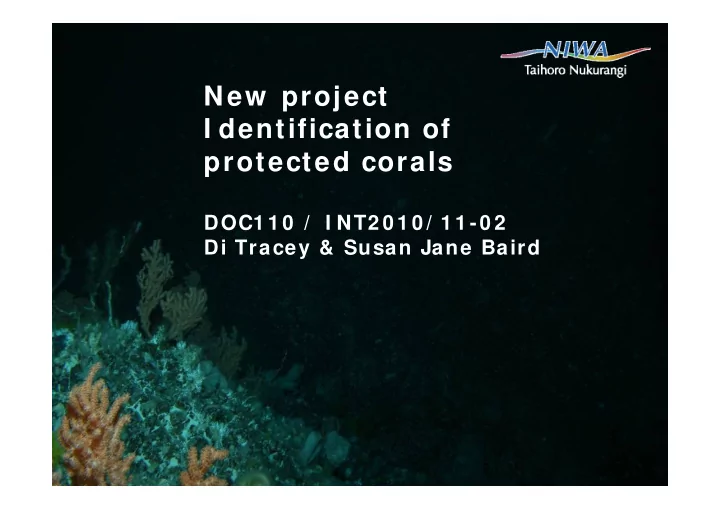
New project I dentification of protected corals DOC1 1 0 / I NT2 0 1 0 / 1 1 -0 2 Di Tracey & Susan Jane Baird Overall Objective To analyse the spatial distribution of coral sub-samples returned through the CSP observer programme in
To analyse the spatial distribution of coral sub-samples returned through the CSP observer programme in relation to fishing effort (2007/ 08 – 2009/ 10) Specific Objectives: 1) To identify areas where deep sea corals are at highest risk of interactions with fishing gear 2) To assess the value of identifying sub- samples of corals returned by
there is an ongoing need to monitor and quantify the level of interaction between fisheries and protected corals
I dentify areas identify target fisheries with coral bycatch Data sources COD data 2007 - 2010
Spatial distribution Plot distribution of bycatch of each coral taxon, or group of corals in relation to the observed fishing effort. Groom ing grouping of certain codes to a higher level taxon (e.g., black coral, bamboo corals grouped)
Note: numerous data sources, from Consalvey et al., 2006; from Tracey et al., in prep.
Observed coral bycatch overlaid on the deepsea trawl fishing effort in ½ degree squares on the Chatham Rise
(from Tracey et al 2008)
Assess value of carrying out ID’s Data groom ing verify observed codes, level of taxon identified (family or genus) Data exclusion multiple taxa in a bag mismatch of number of corals (> or < samples found by expert taxonomist) Groom ing exercise m ay highlight need for further training or additional descriptors in the coral guide Quantitative analysis compare allocated MFish species codes (Observers) with NIWA expert allocated code (follow method of (Parker et al., 2009; Tracey et al., 2010) measure level of agreement & proportion of difficult-to-identify species
Table 4: Comparison of NIWA versus scientific observer classification of VME bycatch in the 2009-10 Ross Sea longline fishery. For each specimen retained by an
Observer Classification NIWA Classification Actiniaria Adamussium colbecki Alcyonacea Anthoathecatae Antipatharia Ascidiacea Bathylasmatidae Brachiopoda Bryozoans Chemosynthetic Cidaroida Cnidaria Demospongiae Euryalida Gorgonacea Hexactinellida Holothurian Pennatulacea Polychaeta Porifera Scleractinia Serpulidae Stylasteridae Zoanthidea unidentified not a code
nothing in log Grand Total Actiniaria 131 2 1 3 5 6 3 151 Adamussium colbecki 1 1 Alcyonacea 1 5 4 1 5 1 5 22 Anthoathecatae 2 3 3 1 9 Antipatharia 3 3 Ascidiacea 1 61 3 2 1 3 8 79 Bathylasmatidae 3 1 4 Brachiopoda Bivalvia 1 1 Bryozoans 1 3 1 3 5 13 Chemosynthetic Cidaroida 10 1 1 12 Demospongiae 1 17 60 16 3 3 4 104 Echinoidea 3 3 Euryalida 31 6 37 Gorgonacea 10 2 109 1 6 9 6 1 10 10 164 Hexactinellida 2 44 58 1 1 3 6 115 Holothurian 1 1 5 7 Ophiuroidea 9 9 Pennatulacea 42 4 46 Polychaeta 1 1 2 Scleractinia 2 127 2 3 1 135 Serpulidae 1 1 Stalked crinoid 5 5 Stylasteridae 2 7 71 70 5 6 161 Zoanthidea 6 3 1 7 2 1 20 Zoarcidae 1 1 Jellyfish 1 1 2 Unstalked crinoid 2 2 Grand Total 135 1 6 13 3 88 3 1 5 7 13 1 112 40 132 75 5 45 1 4 208 1 88 19 1 1 56 45 1109 Percent correct 0.97 1.00 0.83 0.38 1.00 0.69 1.00 0.00 0.60 0.00 0.77 0.00 0.54 0.78 0.83 0.77 0.20 0.93 1.00 0.00 0.61 1.00 0.80 0.37
Request COD data extract Groom the data (observer catch effort & coral catch) Map the coral species (or coral groups where appropriate) against the
target species Prepare Final Report for DOC which will show & discuss
sampling of protected corals
interaction between fisheries and protected corals