Do Eagles Make Flies Ready for Love? Quinn Langdon: - - PowerPoint PPT Presentation

do eagles make flies ready for love
SMART_READER_LITE
LIVE PREVIEW

Do Eagles Make Flies Ready for Love? Quinn Langdon: - - PowerPoint PPT Presentation

Do Eagles Make Flies Ready for Love? Quinn Langdon: langdonq@reed.edu Katherine Thomas: thomaska@reed.edu Reed College Bio342 How does the expression of eagle (eg) change with Drosophila mating status? What are the cellular functions of the


slide-1
SLIDE 1

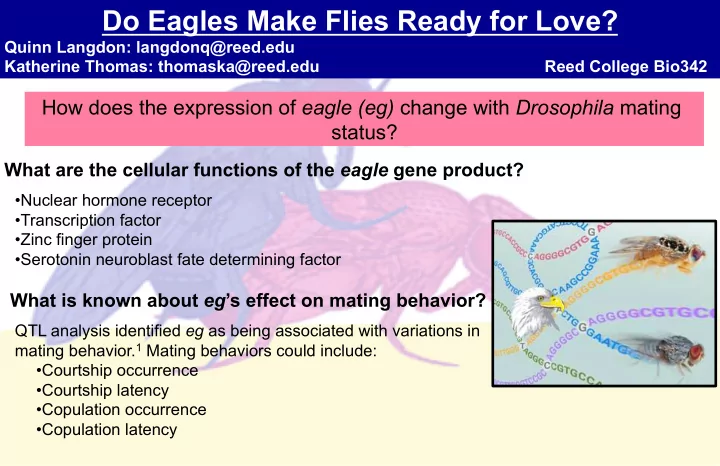
Do Eagles Make Flies Ready for Love?

Quinn Langdon: langdonq@reed.edu Katherine Thomas: thomaska@reed.edu Reed College Bio342

How does the expression of eagle (eg) change with Drosophila mating status?

What are the cellular functions of the eagle gene product?

  • Nuclear hormone receptor
  • Transcription factor
  • Zinc finger protein
  • Serotonin neuroblast fate determining factor

What is known about eg’s effect on mating behavior?

QTL analysis identified eg as being associated with variations in mating behavior.1 Mating behaviors could include:

  • Courtship occurrence
  • Courtship latency
  • Copulation occurrence
  • Copulation latency
slide-2
SLIDE 2

Hypothesis: eg is upregulated in mated male flies compared to courting and virgin males

Behavioral Assay, RNA Isolation, and Reverse Transcription

  • 1. 3-day-old virgin male

Drosophila were put in eppendorf tubes with 3-day old virgin females and either mated (left), remained unmated (center), or remained virgins (right).

  • 2. RNA was isolated from 3 flies in

each condition (mated, unmated and virgin). The isolated RNA was then treated with DNase I to eliminate contaminant DNA from the samples.

  • 3. RNA isolated in 2. was then

reversed transcribed into cDNA.

slide-3
SLIDE 3

Hypothesis: eg is upregulated in mated male flies compared to courting and virgin males Quantitative PCR

  • 4. cDNA transcripts from 3.

were used to perform Q-PCR to determine eg expression. Actin isoform B was used to normalize the samples. Ct values were determined from the raw Q-PCR data graph (bottom right) and averaged in each of the 3 different conditions to determine eg expression.

slide-4
SLIDE 4

Conclusion: eg is upregulated in male flies who court or mate with females as compared to isolated virgin males Analysis of Q-PCR Results

∆∆Ct values for 3 mated, 3 unmated, and 3 virgin male flies indicated that eg is expressed significantly more in males exposed to females as compared to isolated virgin males (ANOVA, F=11.4, df = 1,7, P= 0.0118). Note: * indicates significant difference from other conditions.

Future Directions

  • We achieved amplification in Q-PCR with DNase

I treated RNA samples, which indicates DNA

  • contamination. Would these same results be
  • bserved if our samples hadn’t been

contaminated?

  • We only tested 3-day-old males. Would

expression be different in males of different ages

  • r in females?
  • Very few of our male flies mated. What conditions

could be established to optimize mating?

Acknowledgements & References

We would like to thank Suzy Renn, Kelsey Wood, Maryanne McClellan & the Biology Stockroom Staff for helping us with this project.

  • 1. Moehring, A.J., Mackay, T. F.C. “The Quantitative Genetic Basis of Male Mating

Behavior in Drosophila Melanogaster.” Genetics. 2004; 167 (3): 1249-1263.

  • 2. Benson, D.A., Karsch-Mizrachi I, Lipman DJ, Ostell J, Wheeler DL. “GenBank.” Nul

Acids Res. 2005; 1 (33): D34-D38.