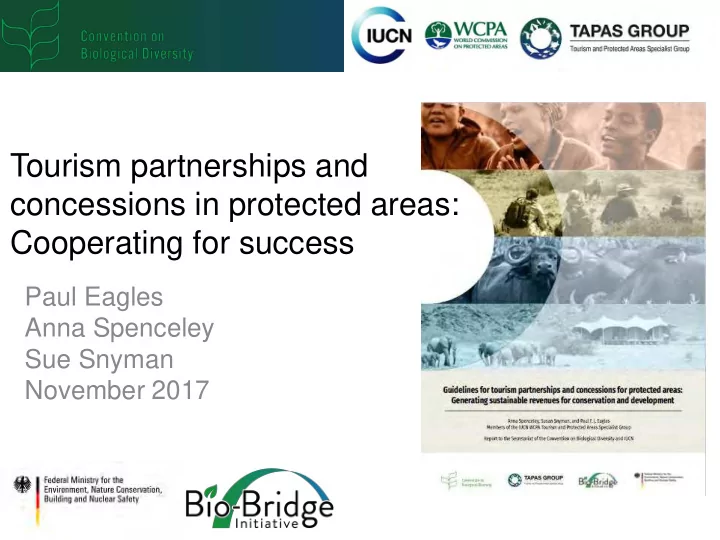
SLIDE 1
Paul Eagles Anna Spenceley Sue Snyman November 2017
Tourism partnerships and concessions in protected areas: Cooperating for success
SLIDE 2
Paul Eagles, Anna Spenceley, Sue Snyman
SLIDE 3 The why of the project
- Secretariat of the Convention on
Biological Diversity work on biodiversity and tourism
- Under-use of tourism to finance
conservation in protected areas
- Need identified for guidelines, better
capacity, networks, and sharing of technical information
SLIDE 4
IUCN World Commission on Protected Areas (WCPA) Specialist Group Voluntary technical network (500+) Specialists on tourism and protected areas and areas of particular importance to biodiversity
Who ran the project:
SLIDE 5
Two complementary components:
1) Capacity building initiatives evaluating and promoting tourism concessions and partnerships in protected areas – German Ministry of Environment (BMUB) 2) Cooperation for development of tourism concession guidelines and policies within southern African protected area systems – Bio-Bridge Initiative (BBI) financed by the Government of the Republic of Korea
SLIDE 6 Our process
Better concessions and partnerships
Needs assessment Guidelines – sharing of technical and scientific knowledge & best practices Networking – promoting and supporting technical & scientific cooperation Capacity development
scientific knowledge Planning additional actions – sustaining technical & scientific cooperation
SLIDE 7
Promoting technical and scientific cooperation
A survey of delegates allowed for an effective information basis for presentations and discussions Group learning and cooperation (experienced with non-experienced) Personal relationships useful for future cooperation, technical support and shared learning Group speed dating allowed for one-on-one discussions and sharing On-site activities Ability to propose follow-up activities ensured future cooperation as involved in creation of ideas TAPAS Group and email groups ensure extensive sharing of technical and scientific knowledge Improved understanding of tourism concessions and partnerships among 37 protected area representatives from 13 countries in southern Africa
SLIDE 8 iSimangaliso meeting participants Field trip Working group session
SLIDE 9 Enhancing technical and scientific cooperation between the parties:
- ‘Speed-dating’ - creating a relatively informal and enjoyable atmosphere for
networking
- Host-country presentations: A structured format was provided to
participants, drafts reviewed prior to the meeting to ensure learning
- Flexibility: Accommodating additional presentations offered by the participants,
and sharing their materials.
- Varying the style of sessions (e.g. presentations, plenary discussion, field
trips, invited speakers) to enhance cooperation
- Facilitators with varied backgrounds and different skills
- Delegate to delegate discussions on the lessons learned, the strengths
and weaknesses of various approaches, and problems to be avoided.
- On-site visits involving sharing of technical and scientific knowledge
SLIDE 10 Namibia meeting participants Mozambique meeting participants Working group in Namibia Field trip to Anvil Bay in Mozambique
SLIDE 11 Sustaining technical and scientific cooperation:
- Countries already reporting policy and policy instrument adaptation:
- Malawi – developing a concession monitoring framework, using discussions
and tools shared. Proposal to review concession submissions anticipated based
- n learnings from the workshops.
- Zimbabwe - pursuing an auction for “photographic” tourism concession sites
and working on an auction brochure to try and include a screening process.
- Mozambique – use of materials to work on the harmonization of concessions in
protected areas.
- Madagascar – adaptation of the legal framework for tourism concessions.
- Creation of a collaborative network due to the comradely ‘spirit’ of the workshop and
‘buddy’ system
- Numerous countries mentioned follow-up initiatives, including collaborating with
- ther countries & further sharing technical and scientific knowledge and experience
SLIDE 12 Draft components requiring funding for Phase 2 to foster sustained TSC
- Component 1: Capacity building on tourism concessions and partnerships
in protected areas in other regions
- Component 2: Scaled-up country-specific capacity building and networking
in southern Africa
- Component 3: Online training modules to support tourism concessioning
internationally
- Component 4: Research on protected area financing from tourism
- Component 5: Exchange visit of African and Latin American delegates to
Canada
- Component 6: Online tourism concession investment promotion platform
SLIDE 13
Thank you to all who were involved in, and supported, the project:
All country participants and Mozambican, Namibian, and South African authorities for logistical, technical and scientific support
SLIDE 14 THANK YOU FOR YOUR TIME
IUCN WCPA Tourism and Protected Areas Specialist Group Distinguished Professor Emeritus, University of Waterloo, Canada Email: eagles@uwaterloo.ca