Corals & Climate Adaptation Planning (CCAP) Project Climate - - PowerPoint PPT Presentation

corals amp climate adaptation planning ccap project
SMART_READER_LITE
LIVE PREVIEW

Corals & Climate Adaptation Planning (CCAP) Project Climate - - PowerPoint PPT Presentation

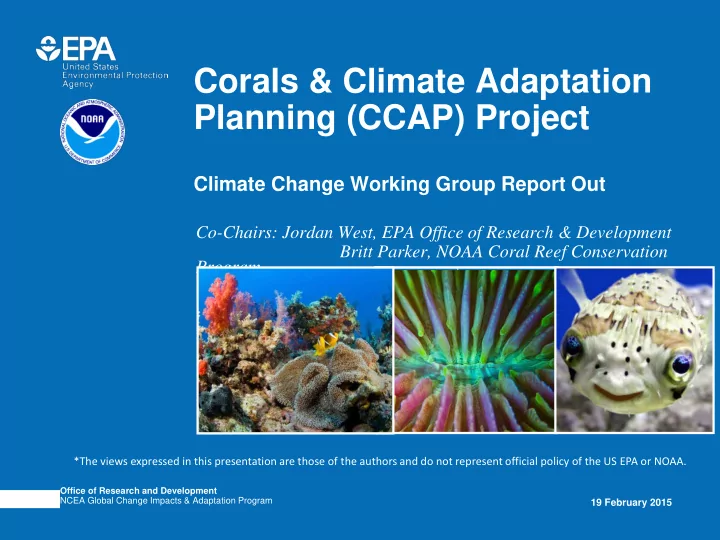
Corals & Climate Adaptation Planning (CCAP) Project Climate Change Working Group Report Out Co-Chairs: Jordan West, EPA Office of Research & Development Britt Parker, NOAA Coral Reef Conservation Program Photo image area measures 2


slide-1
SLIDE 1

Photo image area measures 2” H x 6.93” W and can be masked by a collage strip of one, two or three images. The photo image area is located 3.19” from left and 3.81” from top of page. Each image used in collage should be reduced or cropped to a maximum of 2” high, stroked with a 1.5 pt white frame and positioned edge-to-edge with accompanying images.

Co-Chairs: Jordan West, EPA Office of Research & Development Britt Parker, NOAA Coral Reef Conservation Program

Corals & Climate Adaptation Planning (CCAP) Project

Climate Change Working Group Report Out

Office of Research and Development NCEA Global Change Impacts & Adaptation Program

19 February 2015

*The views expressed in this presentation are those of the authors and do not represent official policy of the US EPA or NOAA.

slide-2
SLIDE 2

1

A Collaborative Effort of the Climate Change Working Group

  • Co-funded by EPA, NOAA, DOI
  • Guidance and steering from the CCWG
  • Technical team expertise from EPA, NOAA, DOI, TNC, EcoAdapt and

Tetra Tech

  • Partnering with practitioners/managers and scientists from 13

Federal, State, Territory agencies, local and national NGOs, academia

  • Methods and tools to be hosted on the toolkit website of The Nature

Conservancy’s Reef Resilience Program

slide-3
SLIDE 3
  • General principles for adaptation to

climate change (theoretical frameworks)

  • Ongoing advances in assessment and

planning by coral reef practitioners (real-world explorations)

2

Project Inception

  • Presidential Executive Order 13653 -- Preparing the United States for

the Impacts of Climate Change (2013)

  • President’s State, Local, and Tribal Leaders Task Force on Climate

Preparedness and Resilience (2014)

Goal: tailor and test recent adaptation planning frameworks and methods specifically for coral reef management

slide-4
SLIDE 4

3

Climate-Smart Approach

  • Comprehensive review and

synthesis of adaptation principles for ecosystem management

  • Framework for integrating climate

change information into every step

  • f the management planning cycle
  • General adaptation strategies to aid

in brainstorming specific actions

  • Rules for designing management

actions to be “climate-smart”

Stein et al. (2014) http://www.nwf.org/ ClimateSmartGuide

slide-5
SLIDE 5

4

CCAP Framework

  • 1. Define planning

purpose & objectives

  • 2. Assess climate

impacts & vulnerabilities

  • 3. Review & revise

goals & objectives

  • 4. Identify adaptation
  • ptions
  • 5. Evaluate & select

adaption actions

  • 6. Implement priority

adaptation actions

  • 7. Track & evaluate

adaptation actions General Adaptation Strategies Specific Adaptation Options Climate-Smart Design Considerations

slide-6
SLIDE 6

5

CCAP Framework: Coral Reef Adaptation Options

CLIMATE SMART STRATEGIES, OPTIONS AND DESIGN CONSIDERATIONS FOR CORAL REEF MANAGEMENT General Strategies/Specific Management Options Climate Smart Design Considerations REDUCE NON-CLIMATE STRESSES - Minimize localized human stressors that hinder the ability of species or ecosystems to withstand or adjust to climatic events

  • i. Remove existing

structures that harden the coastlines to allow inland migration of sand and vegetation

  • How will sea level rise and changes in the intensity and frequency of large

storms affect coastal hydrology and erosion?

  • Given the above, which structures should be the highest priority for removal

in order to allow more natural migration of sand and vegetation?

slide-7
SLIDE 7

Rules for Climate-Smart Design

Two types of design considerations are required:

  • How will climate change directly or indirectly

affect how stressors impact the system?

  • What are the implications of this information

for the location, timing, or engineering design

  • f the management action?
slide-8
SLIDE 8

CCAP Framework

CLIMATE SMART STRATEGIES, OPTIONS AND DESIGN CONSIDERATIONS FOR CORAL REEF MANAGEMENT General Strategies/Specific Management Options Climate Smart Design Considerations REDUCE NON-CLIMATE STRESSES - Minimize localized human stressors that hinder the ability of species or ecosystems to withstand or adjust to climatic events

  • i. Remove existing structures

that harden the coastlines to allow inland migration

  • f sand and vegetation
  • How will sea level rise and changes in the intensity and frequency of large storms

affect coastal hydrology and erosion?

  • Given the above, which structures should be the highest priority for removal in order

to allow more natural migration of sand and vegetation? PROTECT KEY ECOSYSTEM FEATURES - Focus management on structural characteristics, organisms, or areas that represent important “underpinnings” or “keystones” of the current or future system of interest

  • i. Manage functional

species and groups necessary for maintaining the health of reefs and other ecosystems

  • What is the vulnerability of functional species and groups to the interaction of

climate change with other human and natural stressors, and in what locations are they most vulnerable?

  • What management options can be employed, and in which locations, to

minimize impacts on the most vulnerable species and groups? ENSURE CONNECTIVITY - Protect, restore, and create landscape features that facilitate movement of water, energy, nutrients and organisms among resource patches i. Identify and manage networks of resilient reefs connected by currents

  • Which areas are historically or projected to be less exposed to climate

change impacts such as increased sea surface temperature or increased surface water runoff and/or demonstrably better able to recover after exposure to these impacts?

  • How will climate change affect currents that provide connectivity among

these areas and the benefits connectivity provides (e.g., recruitment to reefs)?

  • What are the implications of this information for design of managed area

networks to maximize connectivity and maintain it into the future?
slide-9
SLIDE 9

8

West Maui Case Study & Workshop

Why West Maui:

  • Priority watershed of

the State of Hawaii, NOAA CRCP and USCRTF

  • Well organized

management in place

  • Existing plans provide

good examples

  • Climate change

concerns have been identified

Purpose: to explore methods for Climate-Smart adaptation within the context of existing management planning

slide-10
SLIDE 10

West Maui Case Study

Categories = Option Types from Table 4B (associated objectives in parentheses - see Appendix B for key). Run-off controls Water treatment upgrades Non-indigenous spp. removal Fishing restrictions Area based management Artificial shading Transplantation Install water bars, terraces, microbasins, in dirt roads in agricultural areas (WMP1, WMP2) Treat stormwater using a constructed wetland (WMP1, WMP2) Remove non- indigenous algal species to preserve the integrity of coral reef communities with the super-sucker (H2, H4) Improve enforcement of fishing regulations (H1, H3) Protect/promote recovery of areas of high coral species diversity and cover using temporally flexible no- use zones after extreme events (H4) Use artificial shading when corals are exposed to thermal stress, to protect coral sites of specific importance from coral bleaching (H4) Transplant coral reef organisms among locations that are no longer connected by currents (H4) Establish vegetative cover, filter strips in agricultural fields (WMP1, WMP2) Install curb-inlet baskets to filter hydrocarbon and debris from the storm drains (WMP1, WMP2) Enhance natural recovery processes through replenishment of native grazers that control algal growth

  • n damaged reefs

(H1, H3) Protect adjacent or nearby coral reef areas that are hydrodynamically connected and can serve as recruitment sources for coral reefs in West Maui (H4) Retrofit in-stream dams to collect fine sediment (WMP1, WMP2 Reduce the volume

  • f treated

wastewater injected into groundwater through reuse (WMP3) Promote adherence to State of Hawaii catch sizes and bag limits[CAP] (H1, H3) Identify and protect species with ecological traits characteristic of low sensitivity and high adaptive capacity to climate impacts (H4) Manage watershed inputs to reef areas upstream of target reef within the dominant current flow (WMP1, WMP2) Reduce the volume

  • f treated

wastewater injected into groundwater through treatment upgrades (WMP3) Support fishing rules and regulations on fishing based on target species ecology and life history [CAP] (H1, H3) Replicate habitat types in multiple, designated managed areas to spread risks associated with coral bleaching (H4) Reduce nutrient loads from soil runoff using timed and quantified amounts of fertilizers from agricultural and landscaped areas (WMP1, WMP2) Protect spawning aggregation sites of herbivorous fisheries through seasonal fishing restrictions (H1, H3) Identify and protect current and future areas that are resistant to climate change effects due to localized upwelling (H4) Reduce sediment loads from soil runoff using rain gardens (WMP1, Protect aquarium fish species through species or catch Protect areas of high coral species diversity and cover using no-

slide-11
SLIDE 11

10

Climate-Smart Design Tool

Option Type Option Stressor being addressed with

  • ption

Specific climate change impact

  • n stressor

Direction of CC impact

  • n stressor

Magnitude of CC impact on stressor (1, 2, 3) How/when/wh ere do we need to adapt

  • ption?

Adaptation potential of

  • ption (1, 2, 3)

Time constraint (longer or shorter term) Notes Run-off controls Install water bars, terraces, microbasins, in dirt roads in agricultural areas sediment/ nutrients Due to storm events after dry period variable 2 Need to adapt the option spatially (but may never be possible?); need to evaluate the extreme scenarios 3 short term

  • ption/urgency
  • uncertain of

increase-need to think about mechanism Life of these practices is only about 5-10 yrs. Rainfall in WM generally expect to increas, but John Marra thinks it might decrease Water treatment upgrades Address Eliminate cesspools and upgrade septic systems tanks nutrients SLR modified by storm regime (inundation); interaction with groundwater table up 1 Upgrade

  • ccurs at time
  • f sale

1 Septic just chipping away at the problem, no 1 silver bullet (a synergy issue, needs lots of little actions), i.e. a composite solution needed Life cycle is 30 years; climate change concerns with SLR go into design considerations; problem should go down with time; this alone would not solve problem, will have to be a composite with other things Area based management Protect and manage adjacent (olowalu) or nearby coral reef areas that are connected hydrodynamically and can serve as recruitment sources for coral reefs in West Maui hydrodyna mically connected areas sea surface temps; acidification; disease; changes in currents up 1 Need to further prioritize, replicate, represent and increase level

  • f protection;

at greater scale 3 Reef deterioration; a great deal will hinge

  • n research as to

sources and sinks

slide-12
SLIDE 12

11

Grand Challenges

  • Spatial and temporal scales
  • Synergies,

interdependencies, and conflicts among options

  • Multiple levels of

management planning

slide-13
SLIDE 13

12

Next Steps

  • Refinement of Climate-Smart Design Tool and expansion

to include temporal scale and synergies

  • Technical team meeting (March 2015), presentation at

National Adaptation Forum (May 2015), webinar for workshop participants/ other stakeholders (June 2015)

  • Case study write-up and tool to be posted on The Nature

Conservancy’s Reef Resilience website (Late 2015)

slide-14
SLIDE 14

13

Special Thanks

Wendy Wiltse (EPA Region 9) Hudson Slay (EPA Region 9) Karen Koltes (DOI) Tova Callender (West Maui R2R Initiative) Emma Anders (Hawaii DLNR) Rob Parsons (Maui County Office of the Mayor)