Physics 2D Lecture Slides Lecture 4: Jan 9th 2004 Vivek Sharma - - PDF document

physics 2d lecture slides lecture 4 jan 9th 2004
SMART_READER_LITE
LIVE PREVIEW

Physics 2D Lecture Slides Lecture 4: Jan 9th 2004 Vivek Sharma - - PDF document

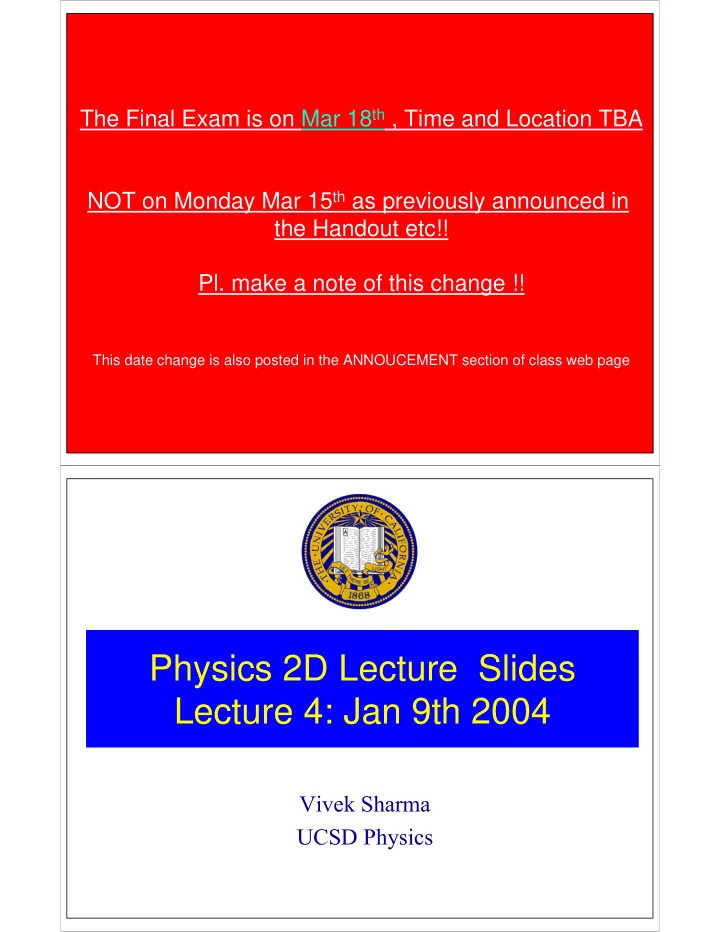
The Final Exam is on Mar 18 th , Time and Location TBA NOT on Monday Mar 15 th as previously announced in the Handout etc!! Pl. make a note of this change !! This date change is also posted in the ANNOUCEMENT section of class web page Physics 2D


slide-1
SLIDE 1

The Final Exam is on Mar 18th , Time and Location TBA NOT on Monday Mar 15th as previously announced in the Handout etc!!

  • Pl. make a note of this change !!

This date change is also posted in the ANNOUCEMENT section of class web page

Physics 2D Lecture Slides Lecture 4: Jan 9th 2004

Vivek Sharma UCSD Physics

slide-2
SLIDE 2

Time Dilation and Proper Time

Watching a time interval (between 2 events) with a simple clock

( ) ( ) ( ) ( )

' ' 2 2 2 2 2 2 2 2 2 2

2 Observer O : t ' , but Observer O : A 2 2 2 pply Pyt ' = = ', 1 hogoras Theorem ' > ' d c c t v t c t d c t c t v d t t t v c t t t γ ∆ = ∆ ∆ ∆ ⎛ ⎞ ⎛ ⎞ ⎛ ⎞ = + = ⎜ ⎟ ⎜ ⎟ ⎜ ⎟ ⎝ ⎠ ⎝ ⎠ ⎝ ⎠ ∴ ∆ ∆ ∆ ∆ = ∆ + ∆ ∴ ∆ ⎛ − ⎜ ⎟ ⎝ ∆ ⎞ ⎠

2 2

0, as a 1 1 / 1 s , v v c v c γ γ γ = → → → − → ∞

Speed of light barrier

The γ factor

slide-3
SLIDE 3

Offsetting Penalty : Length Contraction

Star A Star B

∆t’

Observer O

∆t = L’/V

Observer O’ At rest w.r.t stars A & B Watches rocketship cross from Star A to Star B in time ∆t Observer O

V

  • L = ∆t’ . V

Rocketman Vs The Earthling

  • Earth Observer saw rocketman

take time ∆t = (L’/ V)

  • Rocketman says he is at rest,

Star B moving towards him with speed V from right passed him by in time ∆t’, so

– L = ∆t’. V – But ∆t’ = ∆t / γ (time dilation) – => L = V. (∆t/ γ )

= L’/γ

2 2

V

L = L'. 1- L ' c L ≤

Moving Rods Contract in direction Of relative motion L’ Proper Length Some Length

slide-4
SLIDE 4

Immediate Consequences of Einstein’s Postulates: Recap

  • Events that are simultaneous for one Observer are not

simultaneous for another Observer in relative motion

  • Time Dilation : Clocks in motion relative to an Observer

appear to slow down by factor γ

  • Length Contraction : Lengths of Objects in motion appear

to be contracted in the direction of motion by factor γ –1

  • New Definitions :

– Proper Time (who measures this ?) – Proper Length (who measures this ?) – Different clocks for different folks !

  • …But Which observer is “Right”? Every one if they are

always in an inertial frame of reference (constant velocity)

Contrived Paradoxes of Relativity

``A paradox is not a conflict within reality. It is a conflict between reality and your feeling of what reality should be like.'' - Richard Feynman A paradox is an apparently self-contradictory statement, the underlying meaning of which is revealed only by careful scrutiny. The purpose of a paradox is to arrest attention and provoke fresh thought

Construct a few paradoxes in Relativity & analyze them

slide-5
SLIDE 5

Jack and Jill’s Excellent Adventure: Twin Paradox

Jack & Jill are 20 yr old twins, with same heartbeat Jack takes off with V = 0.8c = (4/5)c to a star 20 light years Away. Jill stays behind, watches Jack by telescope. They Eventually compare notes Jill sees Jack’s heart slow down Compared to her by the factor :

2 2

1 ( / ) 1 (0.8 / ) 0.6 v c c c − = − =

For every 5 beats of her heart She sees Jack’s beat only 3 ! Finally Jack returns after 50 yrs gone by according to Jill’s calendar Only 30 years have gone by Jack’s calendar SO Jack is 50 years old but Jane is 70 ! Jack has only 3 thoughts for 5 that Jill has ! …..Every things slows! Where is the paradox ??

Twin Paradox ?

  • Paradox : Turn argument around, motion is
  • relative. Look at Jack’s point of view !
  • Jack claims he at rest, Jill is moving v=0.8c
  • Should not Jill be 50 years old when 70

year old Jack returns from space Odyssey?

Non-symmetric aging verified with atomic clocks taken on airplane trip around world and compared with identical clock left behind. Observer who departs from an inertial system will always find its clock slow compared with clocks that stayed in the system

No ! …because Jack is not always traveling in a inertial frame of reference TO GET BACK TO EARTH HE HAS TO TURN AROUND => decelerate/accelerate But Jill always remained in Inertial frame Time dilation formula valid for Jill’s

  • bservation of Jack but not to Jack’s
  • bservation of Jill !!....remember this always
slide-6
SLIDE 6

Fitting a 5m pole in a 4m Barnhouse ?

Think Simultaneity !

Sequence of Events A: Arrival of right end of pole at left end of barn B: Arrival of left end of pole at left end of barn C: Arrival of right end of pole at right end of barn 2D Student (UCSD Triton !) farmboy V = (3/5)c Student attends 2D lecture (but does no HW) …banished to a farm in Iowa ! Meets a farmboy who is watching 2D lecture videos online. He does not do HW either! There is a Barn with 2 doors 4m apart ; There is a pole with proper length = 5m Farm boy goads the student to run fast and fit the 5m pole within 4m barn The student tells the farmboy: “Dude you are nuts!” …who is right and why ?

Fitting a 5m pole in a 4m Barnhouse ?!!

2

farmboy sees pole contraction factor 1 (3 Student with pole runs /5 ) 4/5 says pole just fits i with v=(3/5) n the barn fully! c c c − =

2D Student farmboy

2

Student sees barn contraction factor 1 (3 /5 ) 4/5 says barn is only 3.2m long Stud , to ent with pole runs

  • short

to contain entire 5m pole ! with v=(3/5) c c c − =

Farmboy says “You can do it” Student says “Dude, you are nuts” V = (3/5)c Is there a contradiction ? Is Relativity wrong? Homework: You figure out who is right, if any and why. Hint: Think in terms of observing three events

slide-7
SLIDE 7

Fitting a 5m pole in a 4m Barnhouse?

' ' 2 '

L = proper length of pole in S' Event A : arrival of right end of pole at = length of barn in S < L left end of barn: (t =0, t'=0) is reference In frame L =L 1 S: leng ( / th of pol ) The t e imes in l v c −

' 2 2 B ' ' C 2 2

' t 1 ( / ) 1 ( / ) ' 1 t 1 ( / ) two frames are related: Time gap in S' by which events B and C fail to be simult 1 ( aneou / s )

BC BC

l l v c t v c v v L t l v v v c v c = = − = − = = ⇒ = − −

Simultaneity Required !

Events B: Arrival of left end of pole at left end of barn C: Arrival of right end of pole at right end of barn

S = Barn frame, S' = student f Let rame

2D Student S’ Frame Farmboy S Frame V = (3/5)c Farmboy sees two events as simultaneous 2D student can not agree Fitting of the pole in barn is relative ! Farmboy Vs 2D Student Pole and barn are in relative motion u such that lorentz contracted length of pole = Proper length of barn In rest frame of pole, Event B precedes C

slide-8
SLIDE 8

Doppler Effect In Sound : Reminder from 2A

Observed Frequency of sound INCREASES if emitter moves towards the Observer Observed Wavelength of sound DECREASES if emitter moves towards the Observer

v = f λ

Time Dilation Example: Relativistic Doppler Shift

  • Light : velocity c = f λ, f=1/T
  • A source of light S at rest
  • Observer S’approches S with

velocity v

  • S’ measures f’ or λ’, c = f’λ’
  • Expect f’ > f since more wave

crests are being crossed by Observer S’due to its approach direction than if it were at rest w.r.t source S

slide-9
SLIDE 9

Relativistic Doppler Shift

Examine two successive wavefronts emitted by S at location 1 and 2 In S’ frame, T’ = time between two wavefronts In time T’, the Source moves by cT’ w.r.t 1 Meanwhile Light Source moves a distance vT’ Distance between successive wavefront λ’ = cT’ – vT’

2 2

  • bs

source

  • bs

λ'=cT'-vT', c T f ' = , T ' = (c-v)T' 1- (v/c) Substituting for T', use f=1/T 1- (v/c) f ' = f 1 1+(v/c) f ' = f 1-(v/c) better remembered a 1+(v/c) f = f 1-(v/ use / c) f Fre

  • (v/c)

s a : q me f c λ = = ⇒ ⇒ sured by

  • bserver approching

light source

  • bs

source

1+(v/c) f = f 1-(v/c)

Relativistic Doppler Shift