First measurements of the antiproton-nucleus annihilation cross - - PowerPoint PPT Presentation

first measurements of the antiproton nucleus annihilation
SMART_READER_LITE
LIVE PREVIEW

First measurements of the antiproton-nucleus annihilation cross - - PowerPoint PPT Presentation

First measurements of the antiproton-nucleus annihilation cross section at 125 keV Luca Venturelli for for H. Aghai-Khozani 1;2 , D. Barna 3;4 , M. Corradini 5;6 , R. Hayano 4 , M. Hori 1;4 , T. Kobayashi 4 , M.Leali 5;6 , E. Lodi-Rizzini 5;6 ,


slide-1
SLIDE 1

First measurements of the antiproton-nucleus annihilation cross section at 125 keV

Luca Venturelli

for for

  • H. Aghai-Khozani1;2, D. Barna3;4, M. Corradini5;6, R. Hayano4, M. Hori1;4,
  • T. Kobayashi4, M.Leali5;6, E. Lodi-Rizzini5;6, V. Mascagna5, M. Prest7;8,
  • A. Soter1, K. Todoroki4, E. Vallazza9, L. Venturelli5;6, N. Zurlo5;6

1 Max-Planck-Institut für Quantenoptik, Hans-Kopfermann-Strasse 1, D-85748 Garching, Germany 2 Physics Department, CERN, 1211 Geneva 23, Switzerland 3 Wigner Institute for Particle and Nuclear Physics, H-1525 Budapest, Hungary 4 Department of Physics, University of Tokyo. Tokyo 113-0033, Japan 5 Dipartimento di Ingegneria dell’Informazione, Università di Brescia, I-25123 Brescia, Italy 6 Istituto Nazionale di Fisica Nucleare, Gruppo Collegato di Brescia, I-25123 Brescia, Italy

1

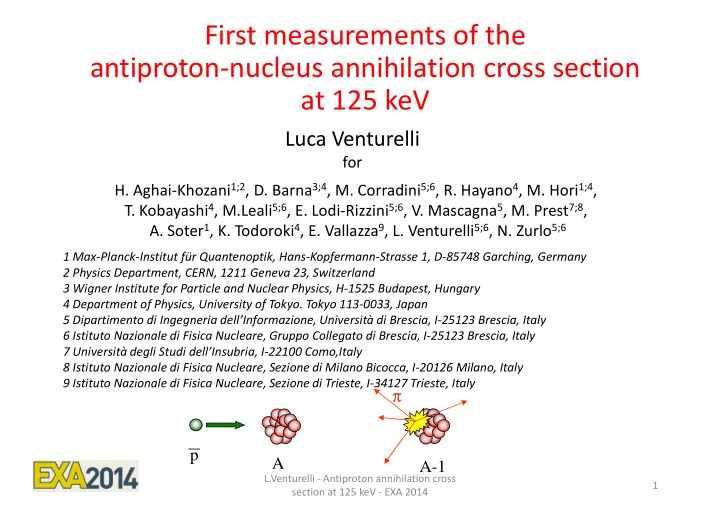
p A A-1 π

6 Istituto Nazionale di Fisica Nucleare, Gruppo Collegato di Brescia, I-25123 Brescia, Italy 7 Università degli Studi dell’Insubria, I-22100 Como,Italy 8 Istituto Nazionale di Fisica Nucleare, Sezione di Milano Bicocca, I-20126 Milano, Italy 9 Istituto Nazionale di Fisica Nucleare, Sezione di Trieste, I-34127 Trieste, Italy

L.Venturelli - Antiproton annihilation cross section at 125 keV - EXA 2014

slide-2
SLIDE 2

ASACUSA Collaboration @ CERN-AD

Atomic Spectroscopy And Collisions Using Slow Antiprotons

Spokesman: R.S. Hayano, Tokyo University

~ 40 members

R.S. Hayano, Tokyo University

HORI’s talk MURTAGH’s talk DIERMAIER’s talk SAUERZOPF’s posters

1) Spectroscopy of p̄He 2) Antihydrogen production and spectroscopy

2

MASCAGNA’s poster

L.Venturelli - Antiproton annihilation cross section at 125 keV - EXA 2014

3) p̄ annihilation cross-section

slide-3
SLIDE 3

ASACUSA Nuclear Program

  • @ 5.3 MeV

done (Ni, Sn, Pt) PLB 2011 & NIMA 2013

p-A annihilations σ

  • @ ~ 100 keV

in progress

EPJ+ 2012

@ ~ 100 keV

in progress

3 L.Venturelli - Antiproton annihilation cross section at 125 keV - EXA 2014

slide-4
SLIDE 4
  • Cosmology: matter-antimatter asymmetry in the Universe

(One possibility is that antimatter is distributed non-homogeneously in the Universe within the so-called “islands” of antimatter . In the border region between matter and antimatter, the role of annihilation is important.)

  • Search of resonances

Physics motivations

  • Search of resonances
  • Determine the potential parameters
  • Probe the external region of nucleus

(both potential models and phenomenological analyses state that the annihilations occur in a thin region placed just outside the nuclear volume: neutron/proton ratio or the extraction energy of the peripheral nucleons can be determined)

  • Saturation: σann (pbarA) does not increase with A

as naively expected

  • Reversed nbar to pbar behavior for σann at 5 MeV on Sn
  • …the region below 0.5-1 MeV is completly unexplored

4 L.Venturelli - Antiproton annihilation cross section at 125 keV - EXA 2014

FRIEDMAN’s talk

slide-5
SLIDE 5

Antiproton Decelerator (AD) - CERN

AD is the only source of low-energy antiprotons AD delivers to the experiments :

  • 2-4 107 antiprotons per bunch

(150-300 ns length)

All-in-one machine: antiproton capture , deceleration & cooling

(150-300 ns length)

  • 1 bunch/ 100 s
  • Energy = 5.3 MeV (100 MeV/c)

Experiments (2014):

  • ALPHA, ATRAP, ASACUSA,

ACE, AEgIS, BASE

5 L.Venturelli - Antiproton annihilation cross section at 125 keV - EXA 2014

5.3 MeV RFQD

DOG-LEG

AD

CERN ASACUSA

130 keV Further deceleration in ASACUSA

slide-6
SLIDE 6

Technique of the annihilation σ measurement

p

( )

beam events

N N ÷ A p

ann

σ

counted by Vertex detector counted by Beam monitor &

time

p p p

To separate signal from background:

  • Long & large vessel (L=1.7 m, φ=1.2 m)

counted by Beam monitor & by Rutherford annihilations

Main problem:

  • Antiproton beam from AD is pulsed :

a) several coincident annihilations saturate the acquisition; b) overlapping of target signal and annihilations on the walls p p

  • Beam chopper to reduce the pbar bunch length
  • Slits along the beam-line to reduce beam halo
  • Long & large vessel (L=1.7 m, φ=1.2 m)

6

  • Ultra-thin targets
  • Thick wall to screen detector from π−>µ−>e

L.Venturelli - Antiproton annihilation cross section at 125 keV - EXA 2014

slide-7
SLIDE 7

Why ultra-thin targets?

antiprotons scattered at will stop in the target

  • 90

Scale dimensions:

Not only to reduce the in-flight annihilations and to avoid pbar EK degradation, but especially for …

µm R ≈

Target thickness Target radius antiproton range (@100keV)

cm D ≈ nm 10 ≈ ∆x

target

π p

@ rest (from MC) in-flight

(from BD model +Coulomb focusing) (130keV) beam 107 p

7

For C target (70 nm) the expected pbars @ rest are much less than in-flight annihilations

L.Venturelli - Antiproton annihilation cross section at 125 keV - EXA 2014

ultra thin targets needed

slide-8
SLIDE 8

Experimental set-up

foto muro

8 L.Venturelli - Antiproton annihilation cross section at 125 keV - EXA 2014

slide-9
SLIDE 9

Experimental set-up

p

9 L.Venturelli - Antiproton annihilation cross section at 125 keV - EXA 2014

slide-10
SLIDE 10

Detectors

Antiproton annihilations detector: DET1 DET2 DET2 Beam position monitor Beam intensity monitor

10

Beam intensity monitor

L.Venturelli - Antiproton annihilation cross section at 125 keV - EXA 2014

Cherenkov detector

slide-11
SLIDE 11

DET1

Several modules of different dimensions

MASCAGNA’s poster 62 bars -> two 64-ch multi-anode PMTs φ = 2 mm 960

500 scintillator bars readout by PMTs

15x19 Scintillator bar

11 L.Venturelli - Antiproton annihilation cross section at 125 keV - EXA 2014

double information:

  • Annihilation vertex reconstruction
  • annihilation time
slide-12
SLIDE 12

DET2

modules two modules (∼1 × 1 m2 each), modules

12

100 scintillator bars readout by MPPCs (multi-pixel photon counters)

L.Venturelli - Antiproton annihilation cross section at 125 keV - EXA 2014

slide-13
SLIDE 13
  • Beam position monitor
  • Secondary emission electron detector
  • Placed (& removable) at the target

position

Antiproton beam monitors

position

  • Resolution 4 mm
  • Beam intensity monitor
  • Cherenkov detector

Cherenkov detector

13

End-wall annihilations

L.Venturelli - Antiproton annihilation cross section at 125 keV - EXA 2014

slide-14
SLIDE 14

Targets

Ultra-thin targets:

  • carbon foil (70 nm)
  • carbon foil (70 nm) + Pd (20 nm)
  • carbon foil (70 nm) + Pt (5 nm)

Made @ TUM

target parking vessel

rotary-linear multi-motion 650 mm

Steel ring frame:

cm 13 cm 8

ext int

= Φ = Φ

φ = 1200 mm 1700 mm 14 L.Venturelli - Antiproton annihilation cross section at 125 keV - EXA 2014

slide-15
SLIDE 15

Targets measurements @ LNL

Rutherford Back Scattering measurement: 2 MeV Alpha scatterd at 165° ; spot 1x1 mm^2

nominal µg/cm^2 nominal 1E15 at/cm^2 measured 1E15at/cm^2 measured nm Pd 24 135.8 139 (+- 4) 20.4 (ρ=21.45 g/cm^3) C 16 803 720 (+- 35) 71.7 (ρ=2 g/cm^3) nominal µg/cm^2 nominal 1E15 at/cm^2 measured 1E15 at/cm^2 measured nm Pt 10.7 33 43.8 (+-3%) 6.62 (ρ=21.45g/cm^3) C 16 803 768 (+-5%) 76.5 (ρ=2 g/cm^3)

C+Pd C+Pt

C 16 803 768 (+-5%) 76.5 (ρ=2 g/cm^3)

C

target not measured (destroyed)

15

Good thickness uniformity (better than 5%)

L.Venturelli - Antiproton annihilation cross section at 125 keV - EXA 2014

Measure thicknesses are consistent with the nominal values

slide-16
SLIDE 16

Annihilations time

Target signal

From slit End wall C target (all shots)

from DET1

signal

π−>µ−>e

16 L.Venturelli - Antiproton annihilation cross section at 125 keV - EXA 2014

slide-17
SLIDE 17

Annihilations time

Target signal

From slit End wall C target (all shots)

from DET1

signal

π−>µ−>e

17 L.Venturelli - Antiproton annihilation cross section at 125 keV - EXA 2014

slide-18
SLIDE 18

Data from DET1

End-wall

Target

C target

  • ----- only frame

Rutherford

C+Pt target C+Pd target

  • ----- only frame

− Target signal is well separated from walls bkg

18

Rutherford

L.Venturelli - Antiproton annihilation cross section at 125 keV - EXA 2014

C+Pt target

  • ----- only frame

− Target signal is well separated from walls bkg − π-µ-e bkg and pbar beam halo are acceptable

slide-19
SLIDE 19

Data from DET2

C target

  • ----- only frame

analog waveform is recorded for each bar

Peak finding algorithm Distribution of all the peaks

  • f all the channels

C+Pt target C+Pd target

  • ----- only frame
  • f all the channels

19 L.Venturelli - Antiproton annihilation cross section at 125 keV - EXA 2014

Data from DET1 and from DET2 are in agreement

C+Pt target

  • ----- only frame
slide-20
SLIDE 20

Data analysis

In-flight annihilations

( )

beam events

N N ÷ A p

ann

σ

( )

events tot halo rest e

N N N N N

π µ − −

= − + −

target

p π from Monte Carlo

C target

  • ---- only frame

20 L.Venturelli - Antiproton annihilation cross section at 125 keV - EXA 2014

slide-21
SLIDE 21

Beam intensity measurement

Cherenkov detector relative measurement of the pbar beam intensity Cherenkov calibration by measuring the Coulomb-scattered antiprotons from the C+Pt target on a 2° ring absolute pbar beam intensity 2° ring target

21

( )

beam events

N N ÷ A p

ann

σ σann is independent from detector efficiency

same detector (DET1 &/or DET2)

N.B.

L.Venturelli - Antiproton annihilation cross section at 125 keV - EXA 2014

slide-22
SLIDE 22

Carbon target

Problems with bare-C target data 7.23 ± 0.29 1.94 ± 0.15 Normalized prongs/bunch (DET1) C C+Pd Too many in respect to the others 1.94 ± 0.15 1.70 ± 0.21 C+Pd C+Pt

  • The carbon films had similar thicknesses (even if bare-C not measured)
  • same results in different days and with different detectors (DET1 and DET2)

Why ?

  • Large beam halo on the bare-C frame is very unlikely (checked during runs)
  • bare-C target was contaminated by some material during its installation?

22 L.Venturelli - Antiproton annihilation cross section at 125 keV - EXA 2014

  • usual dust seems to not explain the effect

Why ?

slide-23
SLIDE 23

Upper limits on pbar-nucleus annihilation cross-sections @125 keV

In 2012 data for 3 targets: In 2012 data for 3 targets: C (C+Pd) (C+Pt) …but bare-C target was unreliable Can we extract annih. cross-sections only from (C+Pd) and (C+Pt) data?

slide-24
SLIDE 24

Annihilation cross-section (σ)

( )

( )

     + = + =

+ + '

C

n n N N n n N N

C Pd Pd pbar C Pd events C C Pt Pt pbar C Pt events

σ σ σ σ

for (Pt+C) target for (Pd+C) target

2 equations and 3 variables (

)

Pt Pd C

σ σ σ , ,

It is possible to measure:

  • relative σ:

Pd Pt C Pt C Pd

σ σ σ σ σ σ , ,

  • (lower & upper) limits for

σ σ σ , ,

  • (lower & upper) limits for

Pt Pd C

σ σ σ , ,

Legenda:

( )=

+ + C Pd events C Pt events N

N

=

pbar

N =

X

n

# of in-flight annihilations for Pt+C (Pd+C) target # of injected pbars Surface number density for X element RBS measurement @ Legnaro (Italy)

24 L.Venturelli - Antiproton annihilation cross section at 125 keV - EXA 2014

slide-25
SLIDE 25

(lower & upper) limits for

Pt Pd C

σ σ σ , ,

      + − = + − =

+ + C Pd events C Pd Pt pbar C Pt events C Pt C Pt

N n n N N n n

C σ

σ σ σ

'

From: with the conditions ≥ ≥ ≥

Pt Pd C

σ σ σ

Pt

σ

(barn)

σ

  + − =

Pd pbar C Pd Pd

n N n σ σ

(barn) C

σ

Pd

σ

Mostly of in-flight annihilations are due to C-foil Contribution to in-flight annihilations from C-foil is negligible 25 L.Venturelli - Antiproton annihilation cross section at 125 keV - EXA 2014

slide-26
SLIDE 26

more stringent (lower & upper) limits for

Pt Pd C

σ σ σ , ,

In addition if we assume:

C Pd Pt

σ σ σ ≥ ≥

we can limit the ranges

Pd

σ

Pt

σ

(barn)

σ

Pt

σ

uncertanty ~ 300 barn

Pd

σ

uncertanty ~ 100 barn

Main contribution from 2° ring position uncertanty (+- 2mm) model (Black-disk + Coulomb focusing)

26 L.Venturelli - Antiproton annihilation cross section at 125 keV - EXA 2014

(barn) C

σ

Model and experiment in agreement

slide-27
SLIDE 27

@125 keV

36 < < 553 (± 300) barn 36 < < 200 (± 94) barn 0.5 < < 28 barn

Pt

σ

Pd

σ

C

σ

101

~ 0.5 barn 27 L.Venturelli - Antiproton annihilation cross section at 125 keV - EXA 2014

slide-28
SLIDE 28

Conclusions

  • Antiproton-nucleus σann measurement is feasible at 100 keV with ultra-thin

solid targets

  • clear time separation between target signal and bkg annihilations on the vessel
  • acceptable bck from π-µ-e decay and pbar beam halo
  • acceptable bck from π-µ-e decay and pbar beam halo
  • Upper (and lower) limits of the antiproton σann on C, Pd and Pt at 125 keV

have been measured for the first time The results are consistent with the expected values from black-disk model with Coulomb focusing

  • Antiproton absolute σann can be measured in the 100 keV region for

different targets at AD and at the future ELENA decelerator

28 L.Venturelli - Antiproton annihilation cross section at 125 keV - EXA 2014

different targets at AD and at the future ELENA decelerator

  • during the next 2 years (before ELENA) both pbar annihilation and elastic σ

could be measured at 5 MeV in connection with the “antineutron puzzle”.