Physical connec-vity CSCI 466: Networks Keith Vertanen - - PowerPoint PPT Presentation

physical connec vity
SMART_READER_LITE
LIVE PREVIEW

Physical connec-vity CSCI 466: Networks Keith Vertanen - - PowerPoint PPT Presentation

Physical connec-vity CSCI 466: Networks Keith Vertanen Fall 2011 Overview Chapter 2: 1. How do we transmit bits from one place to


slide-1
SLIDE 1

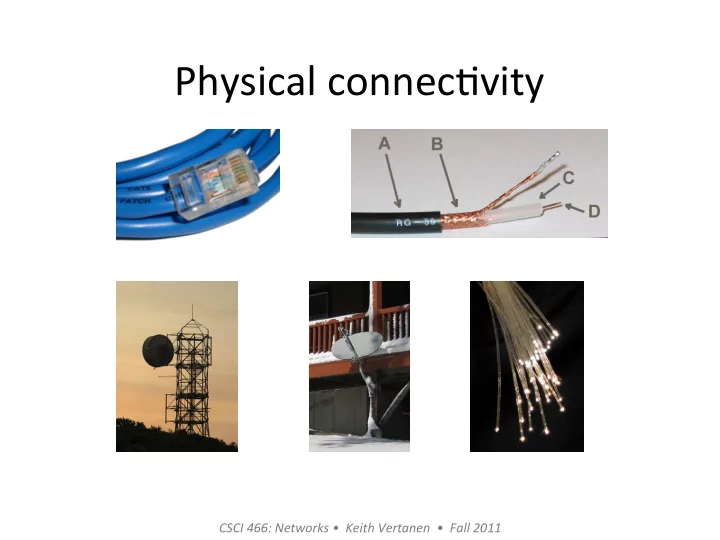
Physical ¡connec-vity ¡

CSCI ¡466: ¡Networks ¡• ¡ ¡Keith ¡Vertanen ¡ ¡• ¡ ¡Fall ¡2011 ¡
slide-2
SLIDE 2

Overview ¡

  • Chapter ¡2: ¡
  • 1. How ¡do ¡we ¡transmit ¡bits ¡from ¡one ¡place ¡to ¡

another? ¡

  • 2. How ¡do ¡we ¡aggregate ¡bits ¡into ¡frames? ¡
  • 3. How ¡do ¡we ¡detect ¡errors? ¡
  • 4. How ¡do ¡we ¡make ¡links ¡appear ¡reliable? ¡
  • 5. How ¡do ¡we ¡share ¡links ¡between ¡mul-ple ¡hosts? ¡

2 ¡

slide-3
SLIDE 3

Overview ¡

  • Today: ¡
  • 1. How ¡do ¡we ¡transmit ¡bits ¡from ¡one ¡

place ¡to ¡another? ¡

  • Different ¡transmission ¡medium ¡
  • Limits ¡on ¡transmission ¡speed ¡
  • Encoding ¡bits ¡onto ¡the ¡medium ¡

– Corresponds ¡to ¡OSI ¡physical ¡layer ¡

¡

3 ¡

slide-4
SLIDE 4

A ¡bird’s-­‑eye ¡view ¡

4 ¡

  • All ¡links ¡conceptually ¡the ¡same ¡

– Both ¡to ¡end-­‑user ¡and ¡to ¡routers ¡ – But ¡real ¡details ¡depend ¡on ¡physical ¡link ¡details ¡ ¡

slide-5
SLIDE 5

Transmission ¡medium ¡

  • All ¡links ¡rely ¡on ¡electromagne-c ¡radia-on ¡

propaga-on ¡through ¡a ¡medium ¡

  • Classes ¡of ¡transmission ¡medium: ¡

– Guided ¡media ¡ ¡

  • Magne-c ¡media ¡
  • Cables ¡

– Unguided ¡media ¡

  • Wireless ¡
  • Satellite ¡

5 ¡

slide-6
SLIDE 6

Magne-c ¡media ¡

  • Magne-c ¡tape, ¡removable ¡media ¡(DVD) ¡

– “sneakernet” ¡

  • Very ¡high ¡bandwidth ¡for ¡very ¡low ¡cost ¡

– 60 ¡x ¡60 ¡x ¡60 ¡cm ¡box ¡holds ¡1000 ¡800GB ¡tapes ¡ – FedEx ¡overnight, ¡bandwidth: ¡70 ¡Gbps ¡ – Cost: ¡about ¡0.5 ¡cents ¡/ ¡GB ¡ “Never ¡underes-mate ¡the ¡bandwidth ¡of ¡a ¡sta-on ¡ wagon ¡full ¡of ¡tapes ¡hurtling ¡down ¡the ¡highway” ¡

  • ­‑Andrew ¡Tanenbaum, ¡Computer ¡Networks ¡5th ¡edi-on

¡

6 ¡

slide-7
SLIDE 7

Twisted ¡pairs ¡

  • Pairs ¡of ¡wires ¡twisted ¡together ¡

– Normally ¡unshielded, ¡just ¡wires ¡and ¡insula-on ¡ – Twists ¡avoid ¡wires ¡becoming ¡an ¡antenna ¡ – Signal ¡carried ¡as ¡difference ¡in ¡voltage ¡between ¡wires ¡

  • Noise ¡affects ¡both ¡wires ¡similarly ¡

– Category ¡5 ¡“cat ¡5” uses ¡four ¡pairs ¡

  • 100 ¡Mbps ¡Ethernet ¡uses ¡two, ¡one ¡for ¡reach ¡direc-on ¡
  • 1 ¡Gbps ¡Ethernet, ¡all ¡four ¡in ¡both ¡direc-ons ¡simultaneously ¡(cat ¡5e) ¡
  • Bandwidth ¡of ¡350 ¡Mhz ¡for ¡cat ¡5e ¡

7 ¡

slide-8
SLIDE 8

Coaxial ¡cable ¡

  • Coaxial ¡cable ¡“coax” ¡

– Beber ¡shielding ¡than ¡unshielded ¡twisted ¡pair ¡ (UTP) ¡ – Longer ¡distances ¡ – Greater ¡bandwidth, ¡up ¡to ¡a ¡few ¡GHz ¡ – Today, ¡primarily ¡last-­‑mile ¡

  • Yesterday: ¡long-­‑distance ¡telephone ¡trunks ¡

8 ¡

slide-9
SLIDE 9

Power ¡lines ¡

  • Use ¡exis-ng ¡power ¡lines ¡for ¡networking ¡

– Advantages: ¡no ¡extra ¡plug ¡or ¡radio ¡ – Disadvantages: ¡wires ¡vary ¡in ¡houses, ¡vary ¡with ¡ appliances, ¡no ¡twis-ng ¡to ¡cancel ¡noise ¡

9 ¡

slide-10
SLIDE 10

Computer ¡industry ¡improvements ¡

  • Processing ¡power ¡

– 1981 ¡IBM ¡PC, ¡4.77 ¡Mhz ¡ – Today, ¡4-­‑core ¡CPU, ¡3 ¡Ghz ¡ – Factor ¡of ¡2500 ¡increase ¡

  • Networking ¡power ¡

– 1981, ¡T3 ¡telephone ¡line, ¡45 ¡Mbps ¡ – Today, ¡modern ¡long ¡distance ¡line, ¡100 ¡Gbps ¡ – Factor ¡of ¡2000 ¡increase ¡ ¡ ¡

10 ¡

slide-11
SLIDE 11

Fiber ¡op-cs ¡

11 ¡

  • Communica-on ¡via ¡light ¡

– Op-cal ¡fibers ¡conduct ¡light ¡

  • Via ¡total ¡internal ¡reflec-on ¡

– Parts: ¡

  • Light ¡source ¡(LED ¡or ¡semiconductor ¡laser) ¡
  • Transmission ¡media ¡(the ¡glass ¡fiber) ¡
  • Detector ¡(photodiode) ¡

– Very ¡long ¡distances ¡(100km) ¡without ¡amplifica-on ¡ – No ¡interference ¡from ¡other ¡cables ¡ – Difficult ¡to ¡tap ¡ ¡

slide-12
SLIDE 12

Fiber ¡versus ¡copper ¡

  • Fiber ¡advantages ¡

– Higher ¡bandwidth ¡than ¡copper ¡ – Lower ¡abenua-on, ¡requires ¡fewer ¡repeaters ¡ – Not ¡affected ¡by ¡electromagne-c ¡interference ¡ – Thinner ¡and ¡lighter ¡ – Difficult ¡to ¡tap ¡

  • Fiber ¡disadvantages ¡

– Less ¡familiar ¡technology ¡ – Damaged ¡if ¡bent ¡too ¡much ¡ – Fiber ¡interfaces ¡more ¡expensive ¡than ¡electrical ¡

12 ¡

slide-13
SLIDE 13

Electromagne-c ¡spectrum ¡

13 ¡

slide-14
SLIDE 14

Radio ¡transmission ¡

  • Advantages: ¡

– Easy ¡to ¡generate ¡ – Penetrates ¡buildings ¡ – Omnidirec-onal, ¡no ¡alignment ¡of ¡transmiber ¡and ¡receiver ¡ – Travels ¡long ¡distances ¡

  • Signal ¡drops ¡same ¡frac-on ¡as ¡distance ¡doubles ¡
  • VLF, ¡LF, ¡MF ¡bands ¡follow ¡curvature ¡of ¡earth ¡
  • HF ¡band ¡bound ¡off ¡ionosphere ¡
  • Disadvantages: ¡

– Interference ¡with ¡other ¡users ¡ – Strictly ¡controlled ¡by ¡governments ¡ – Low ¡bandwidth ¡

14 ¡

slide-15
SLIDE 15

Microwave ¡

  • Microwave ¡transmission ¡

– Above ¡100 ¡Mhz ¡waves ¡go ¡in ¡straight ¡line ¡ – Focus ¡into ¡a ¡beam ¡with ¡parabolic ¡antenna ¡ – Use ¡to ¡be ¡heart ¡of ¡long-­‑distance ¡telephone ¡system ¡

  • MCI ¡= ¡Microwave ¡Communica-ons, ¡Inc. ¡

– Advantages: ¡

  • No ¡right ¡of ¡way ¡needed ¡to ¡lay ¡cable ¡
  • Rela-vely ¡inexpensive ¡compared ¡to ¡laying ¡cable ¡

– Disadvantages: ¡

  • Earth ¡gets ¡in ¡the ¡way, ¡100 ¡m ¡tower ¡→ ¡needs ¡towers ¡every ¡80 ¡km ¡
  • Refrac-on ¡off ¡low-­‑lying ¡atmosphere, ¡mul-path ¡fading ¡
  • Above ¡4 ¡Ghz, ¡absorbed ¡by ¡water ¡

¡

15 ¡

slide-16
SLIDE 16

Satellite ¡

  • Communica-on ¡satellites ¡

– Big ¡microwave ¡repeater ¡in ¡the ¡sky ¡ – Transponders ¡listen ¡to ¡por-on ¡of ¡spectrum ¡ – Beams ¡signal ¡back ¡to ¡earth ¡on ¡different ¡frequency ¡

  • Wide ¡beam, ¡cover ¡large ¡por-on ¡of ¡Earth ¡
  • Spot ¡beams, ¡area ¡a ¡few ¡hundred ¡km ¡in ¡diameter ¡

16 ¡

slide-17
SLIDE 17

Satellite ¡placement ¡

17 ¡

  • Geosta-onary ¡satellites ¡(GEO) ¡
  • Medium-­‑Earth ¡orbit ¡(MEO) ¡
  • Low-­‑Earth ¡orbit ¡(LEO) ¡
slide-18
SLIDE 18

Geosta-onary ¡orbit ¡

18 ¡

  • Geosta-onary ¡satellites ¡

– At ¡al-tude ¡of ¡35,800km, ¡satellite ¡appears ¡to ¡remain ¡ mo-onless ¡ – Examples: ¡DirecTV, ¡Dish ¡Network, ¡HughesNet, ¡WildBlue ¡ – Advantages: ¡

  • No ¡need ¡to ¡track, ¡always ¡in ¡view ¡
  • Inherently ¡broadcast ¡media ¡

– Disadvantage: ¡ ¡

  • Long ¡latency ¡due ¡to ¡great ¡distance ¡
  • Only ¡180 ¡or ¡so ¡in ¡sky ¡at ¡once ¡
  • Inherently ¡broadcast ¡media ¡
slide-19
SLIDE 19

Medium-­‑Earth ¡orbit ¡

  • Medium-­‑Earth ¡orbit ¡satellites ¡

– Around ¡6 ¡hours ¡to ¡circle ¡Earth ¡ – Must ¡be ¡tracked ¡as ¡they ¡move ¡through ¡sky ¡ – Lower ¡so ¡less ¡powerful ¡transmiber ¡needed ¡ – Examples: ¡GPS ¡global ¡posi-oning ¡system ¡(USA), ¡Galileo ¡ (EU), ¡GLONASS ¡(Russia) ¡

19 ¡

slide-20
SLIDE 20

Low-­‑Earth ¡orbit ¡

  • Low-­‑Earth ¡orbit ¡satellites ¡

– Rapid ¡mo-on ¡across ¡sky ¡ – Large ¡number ¡needed ¡for ¡complete ¡system ¡ – Close ¡to ¡ground, ¡low ¡latency ¡and ¡low ¡power ¡ – Cheaper ¡launch ¡cost ¡ – Examples: ¡Globalstar, ¡Iridium, ¡weather ¡satellites ¡

20 ¡

slide-21
SLIDE 21

Satellite ¡versus ¡fiber ¡

  • Satellite ¡advantages ¡

– Rapid ¡deployment ¡

  • Disaster ¡response

¡ ¡

  • Military ¡communica-on ¡ ¡

– When ¡terrestrial ¡infrastructure ¡poorly ¡developed ¡ ¡ – Broadcas-ng ¡is ¡essen-al ¡

  • TV ¡or ¡radio ¡broadcast ¡

21 ¡

slide-22
SLIDE 22

Using ¡the ¡link ¡

  • Transmission ¡speed ¡is ¡limited! ¡

– Shannon-­‑Hartley ¡Theorem ¡

  • Upper ¡bound ¡to ¡the ¡capacity ¡of ¡a ¡link ¡as ¡a ¡func-on ¡of ¡

the ¡channel ¡bandwidth ¡and ¡the ¡signal-­‑to-­‑noise ¡

¡

C ¡= ¡B ¡log2(1 ¡+ ¡S/N) ¡

¡

¡where ¡C ¡is ¡achievable ¡capacity ¡in ¡bits-­‑per-­‑second ¡(bps) ¡

¡B ¡is ¡bandwidth ¡of ¡channel ¡(Hz) ¡ ¡S ¡is ¡the ¡average ¡signal ¡power ¡ ¡N ¡is ¡the ¡average ¡noise ¡power ¡

22 ¡

slide-23
SLIDE 23

Link ¡capacity ¡

– Signal-­‑to-­‑noise ¡ra-o ¡(SNR), ¡expressed ¡in ¡decibels ¡ ¡ ¡ ¡ ¡SNR ¡= ¡10 ¡log10(S/N) ¡ – Example: ¡

  • Channel ¡capacity ¡of ¡a ¡voice-­‑grade ¡phone ¡line ¡
  • Frequencies ¡of ¡300 ¡Hz ¡to ¡3300 ¡Hz ¡ ¡
  • SNR ¡of ¡30 ¡dB, ¡30 ¡= ¡10 ¡log10(S/N) ¡

¡

C ¡= ¡B ¡log2(1 ¡+ ¡S/N) ¡ B ¡= ¡3000 ¡Hz ¡ S/N ¡= ¡1000 ¡ C ¡= ¡3000 ¡log2(1001) ¡= ¡30 ¡kbps ¡

¡

¡

23 ¡

slide-24
SLIDE 24

Encoding ¡bits ¡

24 ¡

  • Physical ¡links ¡allow ¡us ¡to ¡propagate ¡signals ¡
  • Modulate ¡signal ¡on ¡link ¡

¡

  • We’ll ¡ignore ¡the ¡modula-on ¡details ¡

– Assume ¡two ¡discrete ¡signals: ¡high ¡and ¡low ¡

Amplitude ¡shin ¡keying ¡(ASK) ¡ Frequency ¡shin ¡keying ¡(FSK) ¡ Phase ¡shin ¡keying ¡(PSK) ¡

slide-25
SLIDE 25

Encoding ¡bits ¡

25 ¡

  • Network ¡adapter ¡

– Hardware ¡the ¡connects ¡node ¡to ¡link ¡ – Send: ¡encodes ¡bits ¡into ¡signal ¡ ¡ – Receive: ¡decodes ¡signal ¡into ¡bits ¡

slide-26
SLIDE 26

Non-­‑return ¡to ¡zero ¡

  • Non-­‑return ¡to ¡zero ¡(NRZ) ¡

– Use ¡the ¡obvious ¡mapping: ¡

  • Data ¡value ¡1 ¡high ¡signal ¡
  • Data ¡value ¡0 ¡low ¡signal ¡

26 ¡

slide-27
SLIDE 27

Problems ¡with ¡NRZ ¡

  • Non-­‑return ¡to ¡zero ¡(NRZ) ¡

– Problem ¡1: ¡baseline ¡wander ¡

  • Receiver ¡keeps ¡average ¡of ¡signal ¡seen ¡thus ¡far ¡
  • Uses ¡average ¡to ¡determine ¡high ¡versus ¡low ¡
  • Too ¡many ¡consecu-ve ¡0s ¡or ¡1s, ¡biases ¡average ¡

– Problem ¡2: ¡clock ¡recovery ¡

  • Encoding ¡and ¡decoding ¡driven ¡by ¡clock ¡
  • Synchroniza-on ¡required ¡between ¡sender ¡and ¡receiver ¡

– Adjust ¡clock ¡on ¡transi-on ¡from ¡high-­‑to-­‑low ¡or ¡low-­‑to-­‑high ¡ ¡

  • Too ¡many ¡consecu-ve ¡0s ¡or ¡1s, ¡clocks ¡diverge ¡

27 ¡

slide-28
SLIDE 28

Manchester ¡encoding ¡

  • Manchester ¡encoding ¡

– XOR ¡bits ¡with ¡clock ¡signal ¡ – 0 ¡bit ¡is ¡low-­‑to-­‑high ¡transi-on ¡ – 1 ¡bit ¡is ¡high-­‑to-­‑low ¡transi-on ¡ – Disadvantage: ¡requires ¡twice ¡the ¡bit ¡rate ¡ – Used ¡in ¡10 ¡Mbps ¡Ethernet ¡

28 ¡

slide-29
SLIDE 29

Non-­‑return ¡to ¡zero ¡inverted ¡

  • Non-­‑return ¡to ¡zero ¡inverted ¡(NRZI) ¡

– To ¡send ¡a ¡1: ¡transi-on ¡from ¡current ¡level ¡ – To ¡sent ¡a ¡0: ¡stay ¡at ¡current ¡level ¡ ¡ – Solves ¡consecu-ve ¡1s ¡problem ¡ – S-ll ¡have ¡problem ¡for ¡consecu-ve ¡0s ¡ ¡

29 ¡

slide-30
SLIDE 30

4B/5B ¡encoding ¡

  • 4B/5B ¡encoding ¡

– Every ¡4 ¡bits ¡encoded ¡as ¡5 ¡bits ¡ – Avoid ¡runs ¡of ¡0s, ¡choose ¡code ¡words ¡smartly: ¡

  • No ¡more ¡than ¡one ¡leading ¡0 ¡
  • No ¡more ¡than ¡two ¡trailing ¡0s ¡
  • Thus ¡no ¡pair ¡of ¡code ¡words ¡has ¡> ¡three ¡consecu-ve ¡0s ¡

– Transmit ¡using ¡NRZI ¡(avoids ¡runs ¡of ¡1s) ¡ ¡ ¡ – 80% ¡efficiency ¡ – Used ¡in ¡100 ¡Mbps ¡Ethernet ¡

30 ¡

slide-31
SLIDE 31

4B/5B ¡encoding ¡

  • 4-­‑bit ¡signal ¡= ¡16 ¡possibili-es ¡
  • 5-­‑bit ¡code ¡word ¡= ¡32 ¡possibili-es ¡

– 11111 ¡idle ¡link ¡ – 00000 ¡dead ¡link ¡ – 00100 ¡halt ¡ – 6 ¡valid ¡remaining: ¡

  • Control ¡symbols ¡

31 ¡

slide-32
SLIDE 32

Other ¡encoding ¡

  • 8B/10B ¡encoding ¡

– Similar ¡idea ¡as ¡4B/5B ¡ – Encode ¡8 ¡bits ¡using ¡10 ¡bits ¡ – At ¡most ¡5 ¡consecu-ve ¡0s ¡or ¡1s ¡ – 80% ¡efficiency ¡ – Used ¡in ¡Gigabit ¡Ethernet, ¡SATA, ¡USB ¡3.0, ¡etc. ¡

  • 64B/66B ¡encoding ¡

– More ¡efficient ¡that ¡4B/5B, ¡8B/10B ¡ – Used ¡in ¡10 ¡Gigabit ¡Ethernet ¡

32 ¡

slide-33
SLIDE 33

Summary ¡

33 ¡

  • Physical ¡connec-vity ¡

– Twisted ¡pair, ¡coax, ¡fiber ¡ – Terrestrial ¡radio, ¡microwave ¡ – Satellite ¡

  • Encoding ¡bits ¡

– Must ¡be ¡clever ¡to ¡avoid ¡problems ¡ – NRZI ¡plus ¡code: ¡4B/5B, ¡8B/10B, ¡etc. ¡ ¡