NLI Update 2012 Elhanan Adler, Marina Goldsmith NLIs Mission and - - PowerPoint PPT Presentation

nli update 2012
SMART_READER_LITE
LIVE PREVIEW

NLI Update 2012 Elhanan Adler, Marina Goldsmith NLIs Mission and - - PowerPoint PPT Presentation

NLI Update 2012 Elhanan Adler, Marina Goldsmith NLIs Mission and Goals NLIs Mission and Goals Collect and preserve expressions of Israeli and Jewish culture throughout the generations Provide the finest, up-to-date services to


slide-1
SLIDE 1

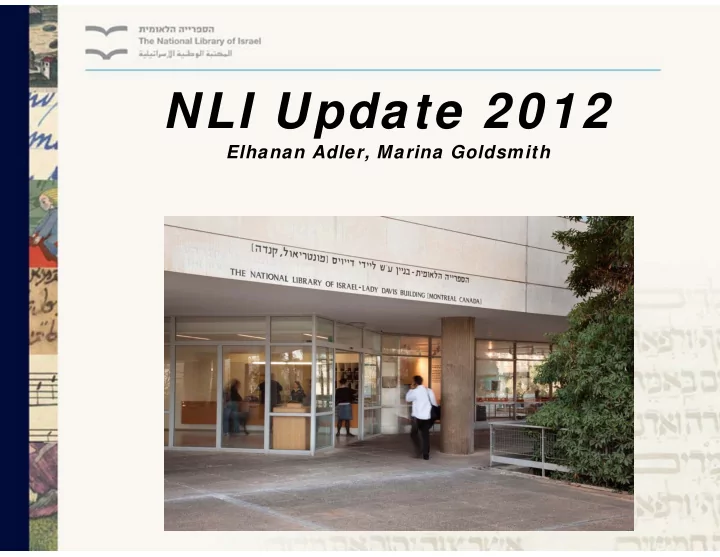
NLI Update 2012

Elhanan Adler, Marina Goldsmith
slide-2
SLIDE 2

NLI’s Mission and Goals NLI’s Mission and Goals

  • Collect and preserve expressions of Israeli and

Jewish culture throughout the generations

  • Provide the finest, up-to-date services to the wider

public and to researchers

  • Provide open access to its treasures, and to impart

them by means of educational and cultural activities in both physical and virtual space

slide-3
SLIDE 3

Topics

  • Part I: Metadata Update [or Technical Services Update]
  • Multilingual authorities: names and subjects
  • Rambi update
  • Conversion of local subjects to LSCH
  • Integration of the Bibliography of the Hebrew Book into the NLI catalog
  • Retroconversion of card catalog: status report
  • Item level records for periodicals, manuscripts and microfilmed manuscripts
  • Part II: Digitization, Readers Services, New Building Plans
  • Digitization Center: from boutique to mass production
  • Music Center: progress report
  • Primo: Comprehensive Discovery and Delivery Solution
  • Readers’ Services
  • New home for NLI: 2016
slide-4
SLIDE 4

Retroconversion of Card Catalog 2010-2011: Status Report

  • Cyrillic character cards converted in-house: 19,000
  • Records received from Backstage Library Works
  • Latin character cards: 350,000
  • U.N. publication cards: 3,800
  • Music publication cards: 41,000
  • The records in each delivery were analyzed, local fields added, other

fields dropped or tweaked before upload. The records were then refined by library staff according to notes added by BSLW and based

  • n tests developed in the library. Holdings were added globally and/or

manually.

slide-5
SLIDE 5

Retroconversion of Card Catalog 2010-2011: Status Report

  • Work plan for 2012-2013
  • Manual addition of holdings and items to ca. 1300 records
  • De-dup bibliographic records
  • De-dup authority headings

Before After

slide-6
SLIDE 6

Item level records Item level records for periodicals, for periodicals, manuscripts and microfilmed manuscripts and microfilmed manuscripts manuscripts

  • Purpose: enable accurate inventory of holdings and

computerized requests

  • Periodicals
  • Item information: arrival date of issues, number of copies, sent to bindery data
  • Large index cards: from establishment of the Library through 1991
  • Recorded in Aleph 300: 1991-2010. Copied into Aleph 500 in April 2011
  • Recorded in Aleph 500: 2010-present
  • Conversion of data on cards to Aleph 500: 2012-2013
  • Manuscripts and Microfilmed Manuscripts
  • Global creation of holdings records and items: 2012
slide-7
SLIDE 7

Examples of periodical holdings cards

slide-8
SLIDE 8

Digital Content: Strategy

Digital Content

Promote accessibility, expansion of services Preservation Serve the National Heritage Projects Collection development

slide-9
SLIDE 9

Users and content

  • General Public

Classic Israeli and Judaic Publication Database of newspapers and children’s periodicals Music Public events – lifeline of Israel Life cycle and the Jewish calendar

  • Scholarly Community

History of Israel, from the beginning of Zionism and the first wave of immigration Jewish Studies Islamic Studies Land of Israel Studies Hebrew Literature Hebrew and Jewish Music

  • Cultural and Educational

History Civics Geography Judaism Literature

slide-10
SLIDE 10

Digitization Center: from boutique to mass production

slide-11
SLIDE 11

Main Goal:

“Move the NLI from boutique digitization to massive scale production of digital collections based on its (and its partners’) physical collections” NLI-DC has entered a pilot phase during 2012.

slide-12
SLIDE 12

Collections

Archives

Photographs Personal Archives Ephemer a

Manu- scripts

Microfilmed & Digitized manuscripts Manuscript s

Books

Ordinary Books Rare Books

Periodi- cals

News- papers Journals

Sound

Sound Archives Personal Archives

  • f

Musician s

Maps

Books Maps

slide-13
SLIDE 13

Pilot Details

  • 9-10 months, followed by an evaluation phase
  • Limited throughput – 50% or less than production
  • 1 shift only
  • About 10-11 Full time employees
  • Remote QA (by a vendor) – an option to consider
  • Cross organization integration process – from

physical storage to digital repository

slide-14
SLIDE 14

5 Basic Workflow s

  • Books
  • Manuscripts
  • Archives / Archival Materials (&ephemera)
  • Newspapers
  • Maps
  • photographs

Out of scope – audiovisual (outsourced)

slide-15
SLIDE 15

In-House Digitization

Books Manuscripts Archives Maps Capability of digitizing 100 books/day = 5 million pages/yr. Digitizing 1000 mss/yr. + All Hebrew Manuscripts in IHMM Digitize 100,000+ documents/yr. from NL collections Convert the whole NL map collection to digital form

slide-16
SLIDE 16

Outsourced

Newspapers Ephemera Archives (IAN) 200,000 newspaper pages/yr. 50,000 items/yr. Digitize 250,000+ documents/yr. from Israeli Archives

slide-17
SLIDE 17

Standards

  • LoC FADGI [=Federal Agencies Digitization

Guidelines Initiative] (more-or-less)

  • Scan once assumption (in most cases)
slide-18
SLIDE 18

Scanning Equipment - Treventus Scanner

slide-19
SLIDE 19

Scanning Equipment - pilot

  • Hassleblad H4D

Digital Back

slide-20
SLIDE 20

Scanning Equipment - Microfilm Reel Scanner (TBS)

slide-21
SLIDE 21

Books Workflow Example

Selection De- Duplication? Conveying

Delivery

Physical Check Scanning QA (I) P t deskew) Post Production (Crop, deskew) QA (II) OCR, Struct. Metadata QA (III) “Packaging” (PDF, METS)

Still Not implemented

slide-22
SLIDE 22

NLI Music Center

http://web.nli.org.il/sites/NLI/English/music/Pages/default.aspx

slide-23
SLIDE 23

Evolution of a melody

ינב בכשרצויה דיב רמוחכ הנה יכ

slide-24
SLIDE 24

% catalog % digit hours Items

Collections

100** 90 2,000 7,600

K

Kol Israel Records (78rpm records) 1.1

80 100 (20*) 2,400 2,400

CD

Studio and Field Recordings BORN DIGITAL (CDs & sound files) 1.2

100** 89 (4*) 5,000 6,700

YC, Y

Field recording on tapes (RR tapes) 1.3

100** 100 (7*) 3,000 2,500

Y

Field recordings on Compact Cassette and DAT (Digital Audio Tape) 1.4

100 100 300 6,800

MCD

Kol Israel Tape Collection (audio CDs) 1.5

40 75 2,600 4,000

JMR, TAK

Rare records ‐ Jacob Michael and NSA collection (78 rpm records) 1.6

10 1,500 2,000

JR

Early records of the NSA collection (LP records) 1.7

100** 50 (2*) 5,400 5,400

CD

Modern collection of Jewish music (commercial CDs) 1.8

100** 240 274

Y

Non‐commercial and Field Recordings on Video 1.9

100** 100 167

Y

Rushes and Masters of video and productions 1.10

87** 79.8 (77) 22,540 37,841 Total

* % of exceptions/damaged ** inventory only / analytic needed / improvement & enrichment needed

Legacy Heritage Project – Digitization of NLI Sound Archive

slide-25
SLIDE 25

Primo: Comprehensive Discovery and Delivery Solution

Provides users with one stop solution for the discovery and delivery of print and digital information - regardless of format and location. Discovery Primo offers advanced, high quality search results based on existing metadata Delivery After discovery, Primo can provide immediate access to digital or electronic content or facilitate the delivery of the physical item.

slide-26
SLIDE 26

What’s going into Primo

  • NLI’s entire catalogue, including books, periodicals, archival

material, music, manuscripts, etc.

  • Primo Central: databases, Rambi, e-resources, IHP
  • Digitool: digital repository
  • SFX: link resolver
slide-27
SLIDE 27

Stages and schedules

  • Define what is searchable and how will it be

displayed

  • Analyze and map the metadata (to be completed by end
  • f June)
  • Testing the first version by the working group

(mid-June and onwards)

  • Improved version: QA and testing by

expanded group

  • Go live! (September 16, 2012)
slide-28
SLIDE 28

Readers Services

  • Computerized ordering from stacks
  • Increase in number of reference librarians
  • Facebook
  • Document delivery services
slide-29
SLIDE 29

Computerized ordering from stacks

Conclusions

  • Improved service for

readers

  • Improved control for

librarians

  • 40% decrease in

unfulfilled requests

  • 10,000 new registered

patrons within the first year

  • 550 orders per day
slide-30
SLIDE 30

How can w e help you?

  • Facebook chat
  • Email
  • Fax
  • Phone call
slide-31
SLIDE 31

Document Delivery Services

NLI soon to join WorldCat Resource Sharing

  • Simplify the international loan

process

  • Make articles from our

collections more accessible

slide-32
SLIDE 32

New Home for NLI

slide-33
SLIDE 33

Location

slide-34
SLIDE 34

Timeline for the New Building

1996-1998 Intl Visiting Committee 2016 Building Completed 2011 NLI Granted Independent Legal Status 2007 National Library Law Passed by Knesset 2002-2004 Committee for Changing Status of National Library 2008-2010 Master Plan for Renewal 2010-11 Design Brief 2012 Architectural Competition 2014-16 Construction

slide-35
SLIDE 35

New Library Building A new home, coupled with open, online access to many of its holdings, will enable the National Library to fulfill its

  • bjectives and role in the 21st century, making its treasures available to the scholarly community and to people of every

nation and religion. The building, which is intended to house the Library and its functions for generations to come, will host two primary populations: 'users' will take advantage of the Library's extensive collections, digital access, and research facilities; 'visitors' will tour the building, attend exhibitions, or participate in lively educational and cultural activities, inspired by the Library's treasures. The building and its surroundings will provide a vibrant, stimulating physical setting – an ideal study environment, a meeting place for scholars, intellectuals, artists and all seekers of knowledge, and a dynamic venue fostering interaction and cooperation among the diverse communities it serves. The design of the building will:

  • Establish a consummate whole that reflects the Library's vision of openness and accessibility; its core disciplines: Judaism,

Israel, Islam and the Middle East, and the Humanities; and the wealth of cultural treasures it holds;

  • Create a pleasant, user-friendly space that is easy to navigate, comfortable and convenient for everyone in it, encouraging

extended stays and frequent visits while providing added value to the Library's resources and services and encouraging participation in the activities that will take place there;

  • Fulfill the diverse needs of large communities of users and staff while allowing efficient operation of the Library's work

procedures as well as storage of its holdings in strictly controlled climatic and security conditions;

  • Maximize the potential of the site while integrating it, with sensitivity, into the landscape and a built environment,

characterized by the presence of major national and cultural institutions;

  • Creatively combine the Library's museum component, its works of art, and its technology in its architectural conception;
  • Manifest long-term sustainability and green design with an emphasis on easy, efficient maintenance and the flexibility to

permit future changes.

slide-36
SLIDE 36

Space requirements

slide-37
SLIDE 37

Where are w e now ?

  • First stage of architectural competition open to local

architects complete 81 proposals submitted. 4 Israeli architects chosen to continue to round 2

  • Second stage to be completed by October 2012

Participants: 4 finalists from the first stage plus 4 Israeli and 4 international architects who were directly invited to participate

http://nli-competition.org.il/en

slide-38
SLIDE 38

Thank You for your Attention Questions?