Phylogenetic differentiation of silkworm ( Bombyx mori L.) strains - - PowerPoint PPT Presentation

phylogenetic differentiation of silkworm bombyx mori l
SMART_READER_LITE
LIVE PREVIEW

Phylogenetic differentiation of silkworm ( Bombyx mori L.) strains - - PowerPoint PPT Presentation

Phylogenetic differentiation of silkworm ( Bombyx mori L.) strains with different origin raised in Bulgaria * Teodora Staykova 1 , Panomir Tzenov 2 , Yolanda Vasileva 2 , Diana Arkova-Pantaleeva 2 , Dimitar Grekov 3 , Krasimira Avramova 3 1 Plovdiv


slide-1
SLIDE 1

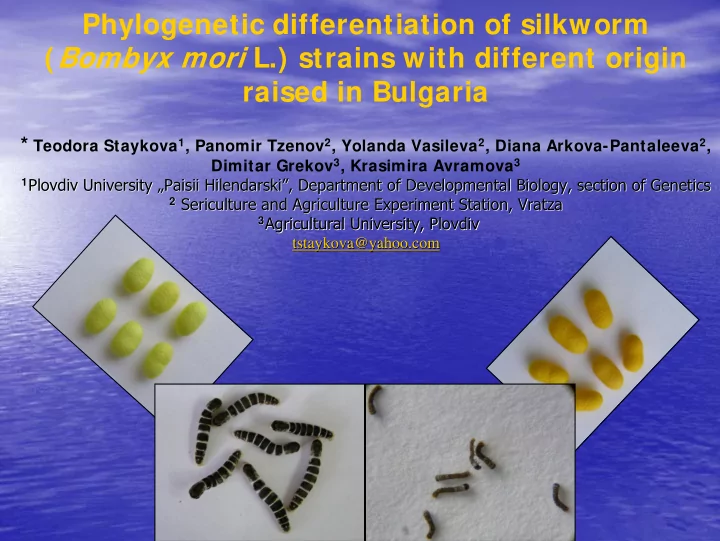
Phylogenetic differentiation of silkworm (Bombyx mori L.) strains with different origin raised in Bulgaria

* Teodora Staykova1, Panomir Tzenov2, Yolanda Vasileva2, Diana Arkova-Pantaleeva2,

Dimitar Grekov3, Krasimira Avramova3

1 1Plovdiv University

Plovdiv University „ „Paisii Paisii Hilendarski Hilendarski” ”, , Department of Developmental Biology, section of Genetics Department of Developmental Biology, section of Genetics

2 2 Sericulture

Sericulture and Agriculture and Agriculture Experiment Station, Vratza Experiment Station, Vratza

3 3Agricultural University, Plovdiv

Agricultural University, Plovdiv tstaykova tstaykova@ @yahoo yahoo. .com com

slide-2
SLIDE 2

I ntroduction I ntroduction

The mulberry silkworm, Bombyx mori L., has long been used as a model system for basic studies. The economic and scientific significance of silkworm have made this species the subject of intensive genetic studies since the beginning of the last century, and thus, the most important insect genetic model after Drosophila melanogaster. The mulberry silkworm has a large number of geographical strains and inbred lines which show substantial variation for a large number of quantitative

  • traits. The traditional breeding activities, involving hybridization between

members of elite groups, are adding new breeds every year. At present, in the silkworm, traits such as cocoon shape, cocoon colour, silk fibre length, larval duration, together with many other ethological traits, are used to differentiate varieties. The selection of parental strains for a breeding programme is based on these characteristics. But the silkworm varieties, particularly those which have been bred from crosses involving many varieties, cannot be distinguished by the use

  • f

conventional

  • characteristics. The use of molecular markers could provide a solution to

the problem, by providing specific DNA and isozyme profiles (Reddy et al., 1999). The isozyme profiles of the strains would be useful in producing reliable estimates of genetic diversity, for the selection of parents for the development of elite hybrids.
slide-3
SLIDE 3

The aim The aim

  • to determine the

to determine the degree of diversity degree of diversity and the existing relationships and the existing relationships between between ten silkworm strains with ten silkworm strains with different origin different origin belonging to the belonging to the silkworm silkworm germplasm germplasm bank of bank of Bulgaria Bulgaria, , using using isoenzyme isoenzyme markers markers. .

slide-4
SLIDE 4

Material and Methods

Strains Origin Vratza 1 BULGARIA Belopol 1/18 BULGARIA Belopol 2/21 BULGARIA Gergana 1 BULGARIA Gergana 2 BULGARIA Ogosta 1 BULGARIA Alb Cislau 29 ROMANIA E 29 EGYPT Ukrainian 20 UKRAINЕ Syria 1 Syria

slide-5
SLIDE 5
  • From 30 to 40 larvae were selected randomly from

each strain on the fifth day of the fifth instar and were used in the study. The larval haemolymph was taken with a transactional cut through one of the prolegs. The spectrum of nonspecific esterases (EST) (ЕС 3.1.1) from hemolymph was studied by means of 7.5% PAGE (Stoykova et al., 2003). 10μl of each sample was applied into the gel. Method of Shaw and Prasad (1970) was used to visualize the nonspecific esterases.

  • Allele and genotype frequencies, observed (Ho) and

expected (He) heterozygosity, deviation from the Hardy-Weinberg equilibrium, Nei’s genetic distance (D), and Wright's fixation index (FST) were calculated using BIOSYS-1.

  • The UPGMA dendrogram was constructed using the

PHYLIP software package.

slide-6
SLIDE 6

Results and Discussion

  • The nonspecific esterases from the B. mori

haemolymph were under polygene control and for four of the esterase genes (Bes A, Bes B, Bes D and Bes Е) was described polymorphism (Egorova et al., 1985; He, 1995; Stoykova et.al., 2003; Staykova, 2008), which was also confirmed in this

  • study. Genepool of the studied ten races

regarding their allele composition and the frequencies of different alleles was analyzed

  • n the basis of this polymorphism. Race

specificity was ascertained (Table 1).

slide-7
SLIDE 7

Table 1. Allele frequencies in strains tested

  • In this study we found polymorphism on the Bes A locus in the races Alb Cislau 29 and E 29. This locus was

monomorphic in all other tested strains and presented with Bes A1 allele.

  • The Bes B1 frequency was highest for the Gergana 1 strain, the Bes B2 allele – for Ogosta 1, and Bes B3 – for

Syria 1.

  • We established the highest frequency of the Bes D1 allele for the strain of Gergana 2, of Bes D2 – for Belopol

2/21, and of Bes D3 – for Syria 1. The Bes D0 allele was presented in the genepool of the strain E 29, only.

  • The Bes Е locus was polymorphic and presented by three alleles. For Ukrainian 20, there was fixed the Bes Е0

allele, while for Ogosta 1 – the Bes Е1 allele. Among all strains where we found polymorphism by locus Bes Е the highest frequency was demonstrated by the Bes Е0 allele.

slide-8
SLIDE 8

The average number of alleles per locus calculated with BIOSYS-1 varied from 1.3 (for Ukrainian 20) to 2.5 (for Belopol 1/18 and Belopol 2/21). The degree of polymorphism was highest for strains Alb Cislau 29 and E 29 (100%), and lowest – for Ukrainian 20 (25%). The observed heterozygosity (Ho) calculated with BIOSYS-1varied from 0.392 (for Alb Cislau 29) to 0.083 (for Ukrainian 20). The expected heterozygosity (He) was higher than the observed one in all tested strains.

slide-9
SLIDE 9

Results and Discussion

  • The test for conformance to Hardy-Weinberg

equilibrium manifested significant differences between the obtained and expected genotype frequencies for the most of the strains (except Alb Cislau 29) resulting from the selection.

  • The mean value of FST (0.3116) calculated
  • n the base of the established polymorphism,

showed that 31.16% of the genetic variability was observed between the different strains, which corresponds to the level of the inter- strain genetic differentiation.

slide-10
SLIDE 10

Table 3. Nei’s (1972) genetic distance (above diagonal) based

  • n isoenzymes
  • On the grounds of the allele frequencies was also calculated a genetic

distance by Nei, which varied from 0.050 (between the strains Belopol1/18 and Belopol 2/21) to 0.768 (between strains Ogosta 1 and Ukrainian 20).

slide-11
SLIDE 11

The phylogenetic tree constructed by the UPGMA method consisted of two major subgroups from E 29 strain. The first one contained strains Syria 1, Alb Cislau 29, Gergana 1 and Gergana 2, and the second one included Ukrainian 20, Belopol 1/18, Belopol2/21 and Vratza 1.

slide-12
SLIDE 12

The data obtained in this study for The data obtained in this study for the inter the inter-

  • and intra

and intra-

  • strain diversity

strain diversity and strain differentiation, could be and strain differentiation, could be used used for breeding purposes for breeding purposes of the

  • f the

mulberry silkworm mulberry silkworm Bombyx Bombyx mori mori L L. . and and marker marker-

  • assisted selection

assisted selection. .

slide-13
SLIDE 13

Acknowledgments Acknowledgments This work has been financed by This work has been financed by “ “Fund for Scientific Researches Fund for Scientific Researches” ” at at Ministry of Education and Science Ministry of Education and Science – – contract contract DO 02 DO 02– –63/11.12.2008 63/11.12.2008. .

Thank you Thank you ! !