Celebrate! 2015 International Y ear of S oils December 5, World S - - PowerPoint PPT Presentation

celebrate
SMART_READER_LITE
LIVE PREVIEW

Celebrate! 2015 International Y ear of S oils December 5, World S - - PowerPoint PPT Presentation

Celebrate! 2015 International Y ear of S oils December 5, World S oil Day Food and Agriculture Organization of the United Nations www.fao.org/ soils-2015/ en/ S ee also www.S S S A.org/ IYS Start w ith the Soil: The Groundw ork for


slide-1
SLIDE 1

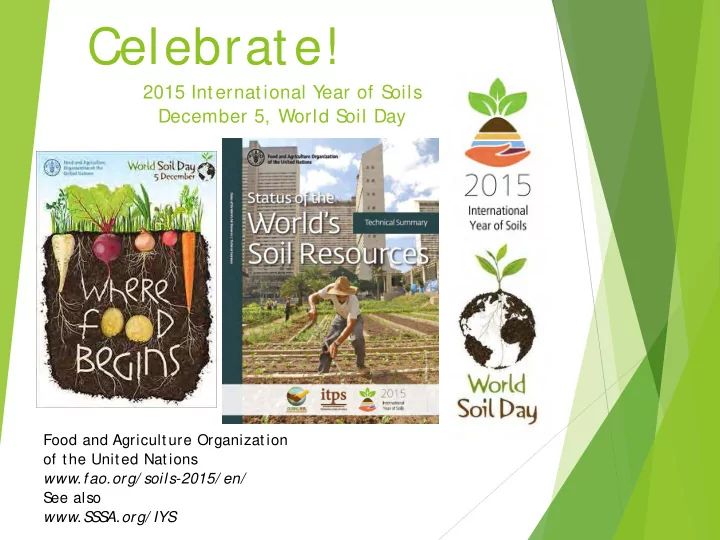
Celebrate!

Food and Agriculture Organization

  • f the United Nations

www.fao.org/ soils-2015/ en/ S ee also www.S S S A.org/ IYS

2015 International Y ear of S

  • ils

December 5, World S

  • il Day
slide-2
SLIDE 2

Start w ith the Soil: The Groundw ork for Healthy Plants

Stephanie Murphy, Ph.D.

Rutgers Soil Testing Laboratory

slide-3
SLIDE 3

What is Soil?

Factors of Soil Formation

“Soils are developed; they are not merely an accumulation of debris resulting from decay of rock and organic materials… In other words, a soil is an entity – an

  • bject of nature which has characteristics that

distinguish it from all other objects in nature.”

Millar & Turk, 1943

  • Parent Material
  • Biological activity
  • Climate processes
  • Topography
  • Time
slide-4
SLIDE 4

What is Soil?

“…soil is the link between the rock core of the Earth and the living things

  • n its surface…”

Simonson, 1957

Most definitions refer to soil as a media for plant growth

The unconsolidated mineral or

  • rganic material on the immediate

surface of the Earth that serves as a natural medium for the growth of land plants.

Soil Science Society of America

slide-5
SLIDE 5

Soil: plant growth medium

Soil provides:

  • Storage of water
  • Bank of nutrients
  • Physical support, anchoring roots
  • Diffusion if gases (O2, CO2, etc.)
slide-6
SLIDE 6

Soil: Habitat for Organisms

  • Soil is an ecosystem; soil is “alive”...

USDA-NRCS

slide-7
SLIDE 7

Soil: Regulator of water

The Hydrologic Cycle Soil-Plant-Atmosphere water cycle

usgs.gov Brady & Weil, 1999

slide-8
SLIDE 8

Soil: Recycler of raw materials Organic Inorganic

synthesis in plant decomposition in soil

H2O, Ammonium, Carbon dioxide Mineral nutrients

Fungi c/ o chestofbooks.com Bacteria c/ o etc.usf.edu Feldspar sci-culture.com 2: 1 clays wsu.edu

slide-9
SLIDE 9

Soil: Engineering medium

  • foundation of roadbeds, buildings,

and other infrastructure

  • Berms, bioretention basins, and
  • ther constructed “root zones” are

engineered plant media

www.watershedmanagement.vt.gov gvt.net

www.watershedmanagement.vt.gov

slide-10
SLIDE 10

Components of soil

– mineral particles

(inorganic)

– organic matter

(derived from organisms)

– water

(H2O and dissolved salts)

– air

(N2, O2, CO2, H2O vapor, etc.)

What is Soil?

Brady & Weil, 1999

slide-11
SLIDE 11

Soils change across the landscape soil profile - a vertical cross-section of soil exhibiting its horizontal layering soil horizon - layer approximately parallel to the soil surface Horizons result from soil-forming processes, including: additions, losses, transformations, translocation

Soil is 3-D!

slide-12
SLIDE 12
  • Measuring various properties of soils to understand processes and

effects of management

  • Features of horizons in a soil profile allows classification & mapping
  • Soil properties are measured as indicators of soil quality

Characterizing soils

slide-13
SLIDE 13

Soil Texture

Particle-size distribution

Sand = 0.05 to 2 mm Silt = 0.002 to 0.05 mm Clay < 0.002 mm

Larger than 2mm: not-soil; gravel, cobbles, stones, etc.

slide-14
SLIDE 14

Soil Texture influences…

  • pore space, soil density • soil structure
  • water retention, available water • aeration
  • water infiltration • runoff, erosion
  • cohesion, plasticity • temperature
  • shrink-swell character • pH (acidity)
  • microbial activity • o.m. content
  • fertility, productivity • management
slide-15
SLIDE 15

Between particles: Pores

Two main classes of pore size Macroporosity -

  • responsible for transmission
  • f water & air (aeration)

Microporosity -

  • responsible for retention of

water against the force of gravity

http: / / edafologia.ugr.es/ iluv/ media/ hor4.gif

Thin section of soil

Pores - containing water and/or air

slide-16
SLIDE 16

Soil structure

  • the arrangement of soil particles into aggregates

Soil aggregates are held together by humus, microbial gums, clays.

Brady & Weil, 1999

slide-17
SLIDE 17

Types of Soil Structure

Granular Prismatic Blocky Platy Structure alters pore size distribution of a soil. Good soil structure promotes water and air movement into and through soil, and allows unobstructed root growth.

slide-18
SLIDE 18

Soil organic matter

  • Organically-derived component of soil
  • “Active” organic matter – relatively fresh
  • “Humus” – highly decomposed fraction
  • Strongly influences many soil properties
  • In “upland” soils, amount and distribution

– Compare to organic soils

USDA-NRCS http: / / nesoil.com/ images

slide-19
SLIDE 19

Brady & Weil, 1999

Plant Residue to Soil Humus

So il Org a nic Ma tte r e le me nta l a na lysis: C 50-60% N 5% P 0.6-1.2% S 0.5% C:N ra tio =10:1

www.soils.wisc.edu/virtual_museum/som/index.html

slide-20
SLIDE 20

Soil Organic Matter Effects

Characteristic Effect in soil Adsorption of humus to soil particles Aggregation of particles (soil structure development, tilth, porosity, drainage) High water-holding capacity More plant-available water Contains Nitrogen, Phosphorus, Sulfur, etc. Source of plant nutrients, short- and long-term Ion exchange capacity: Cations & Anions Nutrient retention, buffering capacity Contains carbon Energy source for microbes, storage of C Chelation of metals Increase bioavailability of certain mineral nutrients Adsorption of organic molecules Reduced effectiveness of certain pesticides Black color Heat absorption

slide-21
SLIDE 21

Benefits of Soil Carbon

Water & Nutrient Holding

Time Soil Quality

Aggregation & Infiltration Productivity Air & Water Quality; Wildlife Habitat Soil Carbon

USDA-NRCS

slide-22
SLIDE 22

Nutrient Supply

  • “Essential nutrients” –

necessary for the growth and reproduction

  • f plants
  • From air or water:

– C, H, O

  • From soil:

– Macronutrients

N, P, K, Ca, Mg, S

– Micronutrients

Cu, Mn, Zn, B, Fe, Mo

Bennett, 1993

Plant content

N 2-5% P 0.2-0.5% K 1-5% Ca 0.1-1% Mg 0.1-0.4% S 0.1-0.3% Fe 50-250 ppm Zn 20-100 ppm Mn 20-300 ppm Cu 5-20 ppm B 10-100 ppm Mo 0.1-0.5 ppm

slide-23
SLIDE 23

Concept of the limiting factor

Plant production is constrained by the most-limiting growth factor Potential limiting factors essential elements pH light water temperature

  • xygen

CO2 etc. Increasing the level of a non-limiting factor will not improve production

Brady & Weil, 1999

slide-24
SLIDE 24

Degree of Acidity [H+]

  • r Alkalinity

an important plant- growth factor that can be managed Optimum for most plants: pH 6.5 to 6.8 Acid-loving plants: adapted to pH 4.5 to 5.5

Soil pH

Alkaline Neutral pH 7 [ H+ ] = 10-7 Acidic

Brady & Weil, 1999

slide-25
SLIDE 25

Brady & Weil, 1999

  • Soil pH affects

nutrient availability

(solubility)

  • Aluminum toxicity

damages roots at low pH

  • Direct damage also

possible at high pH

Effects of Soil pH

slide-26
SLIDE 26

Soil Ecology and Plant Nutrition

  • Plants are the dominant

primary producers in soil.

  • Nutrient cycling and

sustainable systems depend on soil organisms.

  • Plant residues etc. broken

down to release (recycle) nutrients.

  • Symbiotic relationships

contribute to plant nutrition.

– Mycorrhizae – Rhizobia/Legume –

  • ther
  • Diversity helps maintain

balanced populations.

www.ecoplexity.org

slide-27
SLIDE 27

“Topsoil”

  • The “top” of an undisturbed or cultivated “native” soil?

– Depth ranges widely – Characteristics of native soils vary according to: parent material, climate, topography, vegetation and other organisms, and time (degree of aging) – Soil texture, organic matter content, pH, nutrients, structure (aggregation)

slide-28
SLIDE 28

Where does the “topsoil” come from?

  • No legal definition:

how do you know what you’re getting?

  • Much of the “topsoil” commercially available

today for landscaping use is “manufactured”.

slide-29
SLIDE 29

Rutgers Resources for Soil Evaluation

Rutgers Soil Testing Laboratory

http: / / njaes.rutgers.edu/ soiltestinglab

  • Basic fertility test
  • Topsoil evaluation

NJAES Publications:

http: / / njaes.rutgers.edu/ pubs Fact Sheet 901

Recom m ended Topsoil Properties for Landscaping Use pH: most : acid-loving 6.0 to 6.8 5.0 to 5.5 Organic content 1.5% to 10% Sand 40% to 65% Fines 5% to 20% clay

slide-30
SLIDE 30

Soil problems in sub/ urban areas

  • Removal/ disturbance/ mixing of soil horizons

– Amount of topsoil returned – Quality and Quantity matter! – Structural deterioration

  • Fertility
  • Water-holding capacity
  • Compaction
  • Erosion
  • De-icing salt contamination

(in cold climates)

  • Underlying hydrology

www.extension.umn.edu/ garden/ landscaping/ implement/ soil_berms.html

120 cubic feet 500 cubic feet 1000 cubic feet caseytrees.org

slide-31
SLIDE 31

Compaction

  • A change in soil structure

due to pressure - resulting in decrease of total soil porespace volume

  • Changes pore size distribution
  • Degree of damage depends on

load pressure, soil water content, soil texture

Bulk Porosity Infil- Density Total Macro- tration g/cm3 % % in/h None 1.09 58.9 33.1 3.0 Moderate 1.47 44.6 19.2 1.13 Heavy 1.80 27.9 3.0 0.28

Foot traffic under grass

USDA-NRCS

slide-32
SLIDE 32

Consequences of compaction

  • Reduced movement of air and water
  • Greater retention of water
  • Build-up of toxic gases
  • Root growth may be limited,

function & viability compromised

  • Alters microbial population/activity
slide-33
SLIDE 33

What’s underneath matters!

  • Be concerned about what the topsoil is going over –

Compacted subsoil? Discontinuity of texture? Inhibiting water movement and root penetration

  • Water-storage ability and drainage,

groundwater recharge

slide-34
SLIDE 34

Developed vs. Natural Landscape

Compare:

  • Topsoil
  • Subsoil density
  • Permeability

Diagrams: USDA-NRCS Urban Soil Primer

  • Biological activity
  • Water storage
  • Suitability for roots
slide-35
SLIDE 35

Sustainable

  • using a resource in such a way that it

is not depleted or permanently damaged

  • Horticultural best management practices (BMPs)

are operations which establish, maintain, or improve conditions for healthy vegetative growth and environmental quality

  • Minimal input – at least in long term

green-gardener.org ecocomplex.rutgers.edu

slide-36
SLIDE 36

Maintain Good Soil Structure

  • Prevent compaction

– limit traffic and other loads, especially when soil is wet – Promote infiltration

  • Prevent erosion to conserve soil

and protect natural water bodies and stormwater management infrastructure

  • Limited tillage

– Coring to alleviate compaction, improve aeration & infiltration, and incorporate amendments – Deep ripping when necessary

  • Promote biological activity
  • Addition of organic matter
slide-37
SLIDE 37

Enhance soil organic matter and soil life

  • Add organic amendments when starting low
  • With adequate initial levels of OM,

healthy vegetation will help maintain OM and sustain soil life

  • Mulch clippings back into lawn
  • A practice and a goal: “maintaining healthy crop”

– plants initiate the soil food web

www.northernplains.org

www.lawnsmith.co.uk

slide-38
SLIDE 38

Maintain a healthy “crop”

  • Maintain dense cover to protect soil surface
  • Irrigate during establishment or drought
  • Re-establish vegetation when necessary
  • Deal with pest outbreaks when necessary
  • Off-season care

– avoid damage from snowplows, de-icing salts

slide-39
SLIDE 39

Soil Test! To manage soil pH and nutrient levels

slide-40
SLIDE 40

Conclusions

  • Stewardship of soils in sub/ urban landscapes will avoid

many problems and minimize costs in the long run

  • Monitoring and measured management of soils will

help develop and sustain successful landscapes

  • BMPs often involve prevention of soil degradation:

compaction, smearing, bare soil, crusting/ sealing, fertility depletion, acidification, erosion – to minimize pollution risks of waterways and help maintain healthy landscapes!

Rutgers Soil Testing Laboratory

soiltest@aesop.Rutgers.edu www.facebook.com/ RutgersSoilTestingLab