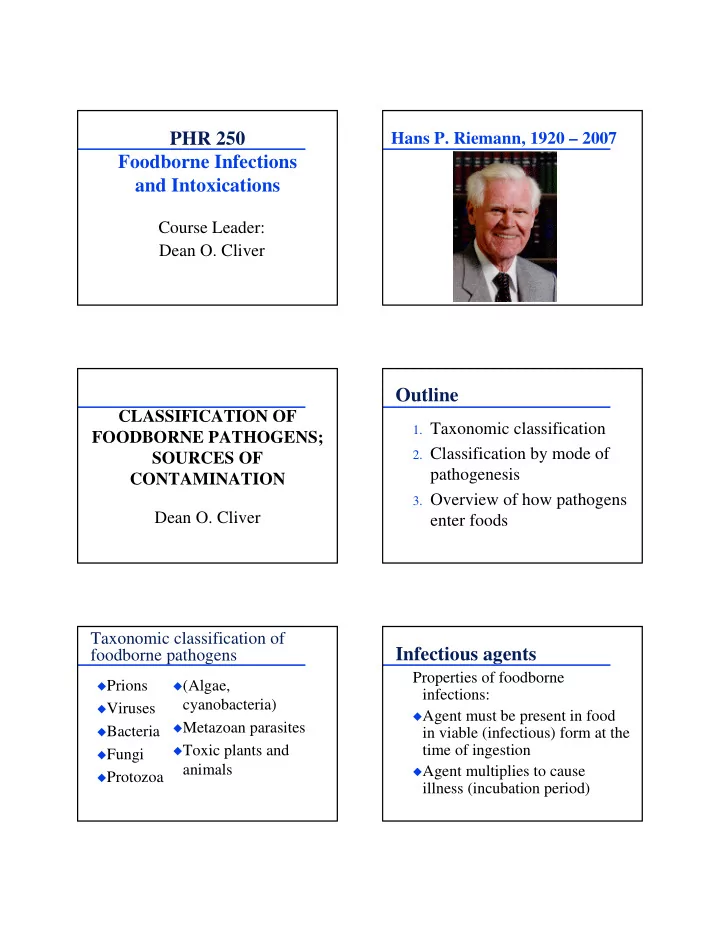
SLIDE 1 PHR 250 Foodborne Infections and Intoxications
Course Leader: Dean O. Cliver Hans P. Riemann, 1920 – 2007 CLASSIFICATION OF FOODBORNE PATHOGENS; SOURCES OF CONTAMINATION Dean O. Cliver
Outline
- 1. Taxonomic classification
- 2. Classification by mode of
pathogenesis
- 3. Overview of how pathogens
enter foods Taxonomic classification of foodborne pathogens
Prions Viruses Bacteria Fungi Protozoa (Algae,
cyanobacteria)
Metazoan parasites Toxic plants and
animals
Infectious agents
Properties of foodborne infections:
Agent must be present in food
in viable (infectious) form at the time of ingestion
Agent multiplies to cause
illness (incubation period)
SLIDE 2
Infectious agents
Prions—new variant CJD Viruses—hepatitis A,
noroviruses, etc.
Bacteria—Campylobacter,
Clostridium perfringens, Escherichia coli, Listeria, Salmonella, Shigella, Vibrio, etc.
Infectious agents
Protozoa—Cryptosporidium
parvum, Entamoeba histolytica, Giardia lamblia, Toxoplasma gondii, etc.
Metazoan parasites—
roundworms, tapeworms, flukes
Intoxicating agents
Properties of foodborne intoxications:
Toxic substance is present in
food at the time of ingestion
Onset of illness is often more
rapid
Intoxicating agents
Bacteria—Bacillus cereus,
Clostridium botulinum, Staphylococcus aureus
(Algae, cyanobacteria)
Intoxicating agents
Fungi—Aspergillus, Fusarium,
Penicillium, etc.
Toxic plants and animals—
mushrooms, cassava, fugu, etc.
Chemicals
Other classes of foodborne disease "Exceptional" foodborne diseases:
Allergy—serologic reaction Intolerance—enzyme
deficiency (abnormal people?)
SLIDE 3 Other classes of foodborne disease Idiopathic illnesses:
Acute—"Chinese
restaurant syndrome”
Chronic—cancer,
heart disease
Grower (Inputs) Retailer Distributor Consumer Processor Food Service
"Food Chain"
Sources of foodborne pathogens Preharvest:
Inherent toxicants—acorns,
cassava, olives, etc. Sources of foodborne pathogens Preharvest:
Zoonoses—
enterohemorrhagic E. coli, Trichinella spiralis, (Brucella, Coxiella burnetii, Mycobacterium bovis, prions
Sources of foodborne pathogens Preharvest:
Field contaminants—
Cryptosporidium parvum, enterohemorrhagic E. coli, Vibrio parahaemolyticus, etc. Sources of foodborne pathogens Harvest or slaughter:
Cross-contamination—
Listeria, Salmonella
Water—enterohemorrhagic E.
coli, hepatitis A virus, etc.
Humans—hepatitis A virus,
Salmonella, etc.?
SLIDE 4 Grower (Inputs) Retailer Distributor Consumer Processor Food Service
"Food Chain"
Sources of foodborne pathogens Processing:
Problems rare in U.S. at
present
Colonization of facilities by
Listeria, Salmonella
If bakeries are included,
viruses
Grower (Inputs) Retailer Distributor Consumer Processor Food Service
"Food Chain"
Sources of foodborne pathogens
Storage and distribution—
most problems with temperature control, rather than contamination
Grower (Inputs) Retailer Distributor Consumer Processor Food Service
"Food Chain"
Sources of foodborne pathogens Retailing and food service;
Opportunities for human-source
contamination: hepatitis A virus, Shigella, pathogenic E. coli (other than EHEC)
Cross-contamination with EHEC,
Listeria, Salmonella, etc.
SLIDE 5 Grower (Inputs) Retailer Distributor Consumer Processor Food Service
"Food Chain"
Sources of foodborne pathogens Final preparation and serving
Opportunities for human-
source contamination: –bacteria & viruses –Giardia lamblia –Taenia solium –etc.
Summary
Foodborne pathogens can be
classified –taxonomically or –by mode of pathogenesis
Pathogens may enter food at
any stage; some risks are more easily remedied than others