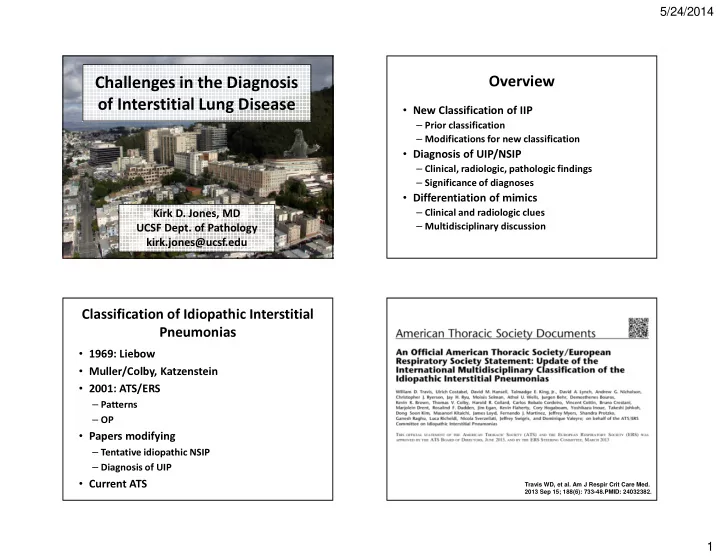
Challenges in the Diagnosis of Interstitial Lung Disease New - - PowerPoint PPT Presentation

challenges in the diagnosis of interstitial lung disease
SMART_READER_LITE
LIVE PREVIEW

Challenges in the Diagnosis of Interstitial Lung Disease New - - PowerPoint PPT Presentation

5/24/2014 Overview Challenges in the Diagnosis of Interstitial Lung Disease New Classification of IIP Prior classification Modifications for new classification Diagnosis of UIP/NSIP Clinical, radiologic, pathologic findings


slide-1
SLIDE 1

5/24/2014 1

Challenges in the Diagnosis

  • f Interstitial Lung Disease

Kirk D. Jones, MD UCSF Dept. of Pathology kirk.jones@ucsf.edu

Overview

  • New Classification of IIP

– Prior classification – Modifications for new classification

  • Diagnosis of UIP/NSIP

– Clinical, radiologic, pathologic findings – Significance of diagnoses

  • Differentiation of mimics

– Clinical and radiologic clues – Multidisciplinary discussion

Classification of Idiopathic Interstitial Pneumonias

  • 1969: Liebow
  • Muller/Colby, Katzenstein
  • 2001: ATS/ERS

– Patterns – OP

  • Papers modifying

– Tentative idiopathic NSIP – Diagnosis of UIP

  • Current ATS

Travis WD, et al. Am J Respir Crit Care Med. 2013 Sep 15; 188(6): 733-48.PMID: 24032382.

slide-2
SLIDE 2

5/24/2014 2

Current Classification

  • Some diseases demoted

– LIP

  • Introduction of “rare” categories

– Rare IIP’s: LIP, PPFE – Rare patterns: AFOP, bronchiolocentric

  • NSIP officially an IIP

– Previously given temporary status

  • Categorize some entities

– Idiopathic, mmm not so much

Pattern that has been demoted

  • Lymphoid interstitial pneumonia

– Histology shows broad expansion of the interstitium by chronic inflammation – Often a lymphoma – When not a lymphoma – CTD vs CVID – Now a “rare IIP”

LIP in CVID LIP in CVID

slide-3
SLIDE 3

5/24/2014 3

Septal extension Pleura Mass

Lymphoma

Added Entities

  • Rare IIP

– Idiopathic pleuroparenchymal fibroelastosis – LIP (as mentioned in demoted)

  • Rare patterns

– Acute fibrinous organizing pneumonia – Bronchiolocentric interstitial fibrosis

Pleuroparenchymal Fibroelastosis

  • Pleural and subpleural fibrosis
  • Upper lobes show consolidation with traction

bronchiectasis

  • Described in Japan by Amitani
  • Progression in majority, death in 40%
  • Unknown cause
  • Don’t mistake an apical fibrous cap for PPFE!
slide-4
SLIDE 4

5/24/2014 4

Acute Fibrinous Organizing Pneumonia

  • Pattern of acute lung injury
  • Likely lies along spectrum from DAD to OP
  • Polypoid plugs of fibrin with early
  • rganization
  • Poor prognosis in original series

– Most referred to AFIP – referral bias

Bronchiolocentric Fibrosis

  • Histologic changes with fibrosis centered on

small airways

  • “Bronchiolization” of alveolar ducts
  • Many cases may have either HP or CTD
slide-5
SLIDE 5

5/24/2014 5

New Categorization

  • Chronic fibrosing

– Usual interstitial pneumonia – Non-specific interstitial pneumonia

  • Smoking-related

– Desquamative interstitial pneumonia – Respiratory bronchiolitis

  • Acute/Subacute

– Diffuse alveolar damage – Organizing pneumonia

Interstitial fibrosis, difficult to classify

UIP NSIP DIP OP DAD LIP Elastotic fibrosis RB Travis WD, et al. Am J Respir Crit Care Med. 2013 Sep 15; 188(6): 733-48. PMID: 24032382.

Diagnosis of Usual Interstitial Pneumonia

  • Hey, let’s be like radiologists!

Raghu G, et al. Am J Respir Crit Care Med. 2011 Mar 15; 183(6): 788-824. PMID: 21471066. Spatial heterogeneity Temporal heterogeneity

Fibrosis - with “temporal heterogeneity”

  • neycomb fibrosis

ld collagenous fibrosis

  • Pathologic Findings - Temporal Heterogeneity

– H – O – R – N ecent (fibroblastic) fibrosis

  • rmal lung
slide-6
SLIDE 6

5/24/2014 6

Words to the clinician

  • I don’t make a diagnosis of:

– Definite, Probable, Possible, Not…UIP

  • I do put it in the comment:

– Reasons for – describing histology – Reasons against – describing the features against

Significance of a UIP Diagnosis

  • Don’t treat with the usual agents!

– Prednisone and azathioprine shown to be bad – PANTHER study

  • Increased deaths (8 vs. 1)
  • Increased hospitalization (23 vs. 7)

– NAC vs placebo no difference

  • Novel antifibrotics and TKI’s

– ASCEND trial – INPULSIS trial

King TE Jr et al. N Engl J Med 2014.

ASCEND Trial (Pirfenidone)

slide-7
SLIDE 7

5/24/2014 7

Richeldi L et al. N Engl J Med 2014.

INPULSIS 1 and 2 Diagnosis of UIP

  • Be aware of clinical and radiologic findings

– Idiopathic pulmonary fibrosis usually age 50+

  • Some exceptions
  • If younger, consider UIP pattern in CTD, HP, familial

fibrosis, drug reaction

– UIP shows basilar and subpleural distribution

  • If prominent upper lobe disease, consider PPFE, HP
  • Look for classical histologic findings with

spectrum from scarred to normal (HORN) Diagnosis of Nonspecific Interstitial Pneumonia

  • Clinical findings may be as nonspecific as its

name:

– Dyspnea, cough

  • May have some findings to suggest etiology

– Exposures, drugs, serologic studies, systemic symptoms

  • Some radiologic clues

– Subpleural sparing – Traction bronchiectasis without honeycombing

Diagnosis of NSIP

  • Pathologic findings are:

– Diffuse alveolar septal thickening by inflammation and/or fibrosis – “Variable but diffuse”

  • Similar fibrosis in different zones of the pulmonary

lobule

slide-8
SLIDE 8

5/24/2014 8

Differential Diagnosis

  • Usual interstitial pneumonia pattern

– Idiopathic pulmonary fibrosis – Chronic hypersensitivity pneumonia, connective tissue disease, other rarities (asbestosis, drug reaction, PPFE)

  • Nonspecific interstitial pneumonia

– “Other” far exceeds “idiopathic” – CTD, HP, drug most common – Rarely see other mimics of NSIP – amyloid, PVOD If my pathologist tells me the biopsy shows NSIP, then my job has only just begun.

Talmadge E. King, Jr, MD

Case 1

  • 50-year-old male with chief complaint of

worsening shortness of breath over 1-2 years

  • Travels extensively with entertainment

commitments

slide-9
SLIDE 9

5/24/2014 9

slide-10
SLIDE 10

5/24/2014 10

Case 1 - Diagnosis

  • Cellular interstitial pneumonia with foreign-

body giant cell reaction

– Aspiration – Drug injection – Toxic inhalation

  • Occupational hazard of rock and roll?

Case 1 - Diagnosis

  • Hypersensitivity pneumonia

Hypersensitivity Pneumonia

  • Reaction of the lung to inhaled antigen
  • See characteristic CT findings

– Centrilobular ground glass nodules – The “head cheese” sign

  • GGO, normal, air-trapping = triple density

Courtesy of Rick Webb, MD

slide-11
SLIDE 11

5/24/2014 11

HP - Histology The Four-Part Triad

  • Diffuse lymphoplasmacytic interstitial

infiltrate

– With bronchiolocentric accentuation

  • Poorly-formed granulomas
  • Foci of organizing pneumonia

Case 1 - Diagnosis

  • Traveled with same pillow for 15 years

– Down pillow – Typical exposure

  • Other cases we have observed:

– Feathers: Pets, Farm animal, Duvet, Pillow, Jacket. – Molds: Work freezer, Man-Cave, Sleep number mattress – Mycobacteria: Indoor spa, shower – ? Central valley: Almond dust?

Case 2

  • 24-year-old woman with interstitial lung

disease.

  • Dry cough, Raynaud’s phenomenon, possible

feather exposure, arthralgias.

  • CT shows patchy ground glass opacities with

a peripheral predominance.

slide-12
SLIDE 12

5/24/2014 12

Case 2 - Diagnosis

  • Cellular and fibrosing interstitial pneumonia

(non-specific interstitial pneumonia pattern).

  • Found to have a CK of 1108 (nl = 39-189)
  • Autoimmune myositis
  • Improved with mycophenolate
  • In our practice, patients with clinical

symptoms get a large panel of serologic studies and likely won’t be biopsied.

Clues for CTD

  • Connective tissue diseases, due to their

immune activation, often affect several compartments of the lung (i.e. alveolar septa, small airways, vessels, pleura).

  • Prominent lymphoid aggregates
  • Pleuritis
  • UIP pattern with lack of central normal lung

– UIP/NSIP overlap

Case 3

  • 73-year-old woman with a six month history
  • f shortness of breath.
slide-13
SLIDE 13

5/24/2014 13

Case 3 - Diagnosis

  • Cellular nonspecific interstitial pneumonia

with prominent lymphoid aggregates and

  • rganizing pneumonia

– I would probably be thinking connective tissue disease, but it looked like a prior case of a man with BPH.

Case 3 - Continued

  • Missing drug history.

– Medicine note: no drugs of concern. – Surgeon’s pre-op note: Nitrofurantoin.

  • “It wasn’t me.”
  • On nitrofurantoin for 1-1/2 years.

– Stealth drug (post-coital UTI’s)

  • www.pneumotox.com
slide-14
SLIDE 14

5/24/2014 14

Case 4 – MDD Illustrated

  • 62-year-old man with severe pulmonary

fibrosis

  • Prior biopsy with UIP pattern
  • Now undergoing bilateral lung transplant

Subpleural honeycombing Fibroblast foci Normal-appearing lung Fibroblast foci

slide-15
SLIDE 15

5/24/2014 15

Pathologic Pattern

  • Usual interstitial fibrosis

– Marked fibrosis with honeycombing – Patchy involvement of lung – Fibroblast foci present – ?Features suggesting alternate diagnosis?

Bronchiolocentric Fibrosis Poorly-formed granuloma

Pathologic Diagnosis

  • Interstitial fibrosis, UIP pattern, with

bronchiolocentric fibrosis and chronic inflammation, and poorly-formed granulomas.

  • Most consistent with chronic hypersensitivity

pneumonia.

slide-16
SLIDE 16

5/24/2014 16

Final Diagnosis

  • Familial Interstitial Fibrosis

– Telomerase mutation (TERT gene)

  • With superimposed hypersensitivity

pneumonia

Conclusions

  • There is a new classification of IIP’s

– Not much has changed – an “update” – Recognition that not all are idiopathic – Stressing importance of multidisciplinary discussion

References

  • Raghu G, et al. An official ATS/ERS/JRS/ALAT statement: idiopathic pulmonary fibrosis: evidence-based guidelines for

diagnosis and management. Am J Respir Crit Care Med. 2011 Mar 15; 183(6): 788-824. PMID: 21471066.

  • Travis WD, et al. An official American Thoracic Society/European Respiratory Society statement: Update of the

international multidisciplinary classification of the idiopathic interstitial pneumonias. Am J Respir Crit Care Med. 2013 Sep 15; 188(6): 733-48.PMID: 24032382.

  • Jones KD, Urisman A. Histopathologic approach to the surgical lung biopsy in interstitial lung disease. Clin Chest Med.

2012 Mar; 33(1): 27-40.PMID: 22365243.

  • Urisman A, Jones KD. Pulmonary pathology in connective tissue disease. Semin Respir Crit Care Med. 2014 Apr; 35(2):

201-12. PMID: 24668535.

  • Takemura T, et al. Pathological differentiation of chronic hypersensitivity pneumonitis from idiopathic pulmonary

fibrosis/usual interstitial pneumonia. Histopathology. 2012 Dec; 61(6): 1026-35. PMID: 22882269.

  • Katzenstein AL, Mukhopadhyay S, Myers JL. Diagnosis of usual interstitial pneumonia and distinction from other fibrosing

interstitial lung diseases. Hum Pathol. 2008 Sep; 39(9): 1275-94. PMID: 18706349.