Phosphorus Compliance Plan By: Tim Nennig (Village of Grafton), Jon - - PowerPoint PPT Presentation

phosphorus compliance plan
SMART_READER_LITE
LIVE PREVIEW

Phosphorus Compliance Plan By: Tim Nennig (Village of Grafton), Jon - - PowerPoint PPT Presentation

The Route to Developing a Phosphorus Compliance Plan By: Tim Nennig (Village of Grafton), Jon Butt (Symbiont) Agenda 1. Background 2. WPDES Permit Requirements 3. Preliminary Alternatives 4. The final plan 5. Next steps Background


slide-1
SLIDE 1

The Route to Developing a Phosphorus Compliance Plan

By: Tim Nennig (Village of Grafton), Jon Butt (Symbiont)

slide-2
SLIDE 2

Agenda

  • 1. Background
  • 2. WPDES Permit Requirements
  • 3. Preliminary Alternatives
  • 4. The final plan
  • 5. Next steps
slide-3
SLIDE 3

Background – Village of Grafton

  • Established: 1896
  • Location: Ozaukee County,

20 miles north of Milwaukee

  • Population: 11,459 (2010)
  • Early Industries:
  • Furniture
  • Brewery
  • Cheese
  • Lumber
  • Geography:
  • Milwaukee River
slide-4
SLIDE 4

Background – Grafton WWTP

  • Built: 1958
  • Last Upgrade: 2005
  • Average Flow: 1.50 gpd
  • Design Flow: 2.50 gpd
  • Type: Activated Sludge
  • Twelve (12) sewage lift

stations

  • 54 miles sanitary

sewers

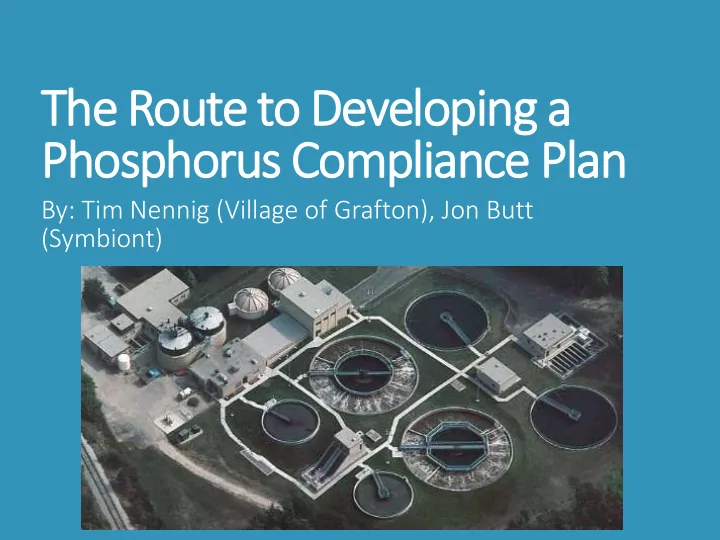
Gr Grafton WWTP

slide-5
SLIDE 5

Background – Grafton WWTP

slide-6
SLIDE 6

WPDES Permit Requirements

  • Permit issued: Newly issued September 2019
  • Milwaukee River TMDL TP Allocations:

Total Phosphorus Month Monthly Mass (lb) Days per Month Daily Average (lb/day) January 91.29 31 2.94 February 95.53 28 3.41 March 87.07 31 2.81 April 88.55 30 2.95 May 96.38 31 3.11 June 96.49 30 3.22 July 86.83 31 2.80 August 84.04 31 2.71 September 86.50 30 2.88 October 72.21 31 2.33 November 88.49 30 2.95 December 82.55 31 2.66 Annual Limit 1,055.94

slide-7
SLIDE 7

Existing Conditions

slide-8
SLIDE 8

Background – Wastewater Effluent

TMDL Compliance

slide-9
SLIDE 9

Preliminary Alternatives

1.

  • 1. Treatment Plan

lant Im Improvements 2.

  • 2. Nutr

trie ient Tradin ing 3.

  • 3. Adaptiv

ive management 4.

  • 4. Multi

lti-Dis ischarger r Varia iance (MDV)

slide-10
SLIDE 10

Let’s start with - MDV

  • Is the Village Eligible?
  • The Village has an existing treatment plant
  • The Village must upgrade with tertiary filtration of the

equivalent to meet the WQBEL

  • The Village is facing significant Capital improvements

associated with a 35-year-old treatment plant but future sewer rate increases can not be included in the financial analysis – sewer rates with improvements for TP WQBEL compliance < 1% of the MHI

  • No – The Village is not eligible
slide-11
SLIDE 11

How about Nutrient Trading?

  • The Village needs 1,532 lb/yr without any changes

to the WWTP

  • Or, the Village could reduce the need to 268 lb/yr if

a small WWTP project were completed

  • Where to supply the need?
slide-12
SLIDE 12

Up Up-river Agricultural Sources

Type of Ag Operation % of Land Acres of Ag type Baseline P (acres) (lb/yr) Cash Grain 40% 10,000 70,066.6 Dairy 40% 10,000 30,672.9 CAFO 20% 5,000 20,325.0 Total 25,000 121,064.5

slide-13
SLIDE 13

Looks promising except Ag non-point sources need to achieve 85% to 90% reductions

to meet TMDL obligations Long term trades possible on the remaining 10 to 15%. 100% Phosphorus reductions only possible if land is removed from production (Baker Cheese trade) Trading does not appear viable until more clarification is provided on trading within TMDL areas.

slide-14
SLIDE 14
  • Treatment Plant improvements or Adaptive Management?

What’s left?

  • Treatment Plant

improvements

  • Capital $3.8 M
  • O&M $270K/yr
  • PV > $7M
  • No turning back
  • Does not address MS4
  • Easy to do
  • Adaptive

Management

  • Annual spend $200K to

$400K – depending on the year

  • There is annual O&M -

$30K/yr

  • Best case PV > $3.35M
  • MS4 can be included
  • Lots of Unknown
  • Many options – you

can change your mind!

slide-15
SLIDE 15
  • In the end, the Village felt:
  • 1. The in-river TP concentration is 0.01 mg/L over the

criteria – it is worth it a try to see if it can be lowered

  • 2. The Village can always switch to treatment plant

upgrades or trading

  • 3. There is an active Watershed group that can help the

Village

  • 4. The Village plans to use an administrator to implement

the plan

  • 5. The Village can apply for funding to help reduce the

cost to the Village

Winner is – Adaptive Management

slide-16
SLIDE 16
  • Ass

ssis ist the County with ith im improvements to Mole le Creek

  • Install BMP’s along the Milwaukee River within action

area

  • Install ag BMP’s up-riv

iver r from the actio ion area

  • In

Invest in in sm small ll im improvement to th the WWTP TP

So what’s the plan?

slide-17
SLIDE 17

Action Area & Monitoring Plan

slide-18
SLIDE 18

Reduction Targets

Location Reduction Target Lb/yr Mole Creek & Milwaukee River within the action area 1,000 Milwaukee River upstream from action area 5,160 Treatment Plant 1,280 Total 7,440

slide-19
SLIDE 19

The Village has already started

The Village has committed up to $5,000 per farm up to 4 farms to: Plant cover crops in the fall of 2019 To practice no till The Village has pledged this support for 2019-2020 and 2020- 2021. This work is being done in conjunction with Ozaukee County and the Milwaukee River Watershed Clean Farm Families.

slide-20
SLIDE 20

The plan will be iterative …

Make an improvement Collect Data Analyze the data

slide-21
SLIDE 21

The goal

  • Return the River TP

concentration to WQ criteria at as low a cost to the Village rate payers as possible

slide-22
SLIDE 22

What’s next?

  • The Village will submit the AM plan with the permit renewal

application

  • The Village will begin water monitoring program in May

2020

  • The Village will complete the first year of funding ag

partners Spring 2020

  • The Village expects to advance some small projects within

the action area throughout 2020