
Speech recognition (briefly)
Chapter 15, Section 6
Chapter 15, Section 6 1Outline
♦ Speech as probabilistic inference ♦ Speech sounds ♦ Word pronunciation ♦ Word sequences
Chapter 15, Section 6 2Speech as probabilistic inference
It’s not easy to wreck a nice beach Speech signals are noisy, variable, ambiguous What is the most likely word sequence, given the speech signal? I.e., choose Words to maximize P(Words|signal) Use Bayes’ rule: P(Words|signal) = αP(signal|Words)P(Words) I.e., decomposes into acoustic model + language model Words are the hidden state sequence, signal is the observation sequence
Chapter 15, Section 6 3Phones
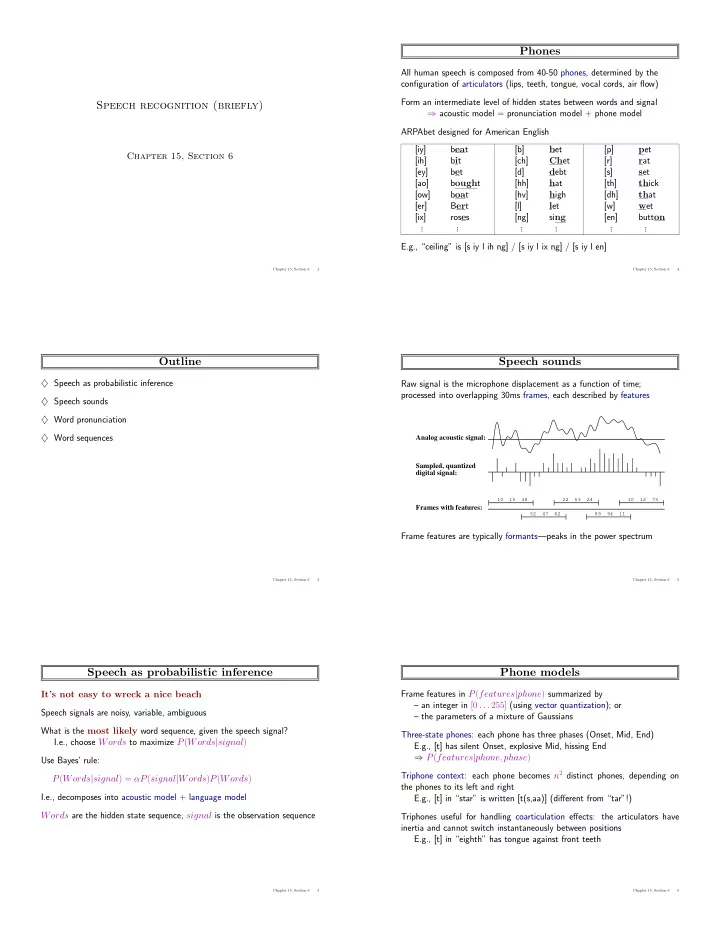
All human speech is composed from 40-50 phones, determined by the configuration of articulators (lips, teeth, tongue, vocal cords, air flow) Form an intermediate level of hidden states between words and signal ⇒ acoustic model = pronunciation model + phone model ARPAbet designed for American English [iy] beat [b] bet [p] pet [ih] bit [ch] Chet [r] rat [ey] bet [d] debt [s] set [ao] bought [hh] hat [th] thick [ow] boat [hv] high [dh] that [er] Bert [l] let [w] wet [ix] roses [ng] sing [en] button . . . . . . . . . . . . . . . . . . E.g., “ceiling” is [s iy l ih ng] / [s iy l ix ng] / [s iy l en]
Chapter 15, Section 6 4Speech sounds
Raw signal is the microphone displacement as a function of time; processed into overlapping 30ms frames, each described by features
Analog acoustic signal: Sampled, quantized digital signal: Frames with features:
10 15 38 52 47 82 22 63 24 89 94 11 10 12 73
Frame features are typically formants—peaks in the power spectrum
Chapter 15, Section 6 5Phone models
Frame features in P(features|phone) summarized by – an integer in [0 . . . 255] (using vector quantization); or – the parameters of a mixture of Gaussians Three-state phones: each phone has three phases (Onset, Mid, End) E.g., [t] has silent Onset, explosive Mid, hissing End ⇒ P(features|phone, phase) Triphone context: each phone becomes n2 distinct phones, depending on the phones to its left and right E.g., [t] in “star” is written [t(s,aa)] (different from “tar”!) Triphones useful for handling coarticulation effects: the articulators have inertia and cannot switch instantaneously between positions E.g., [t] in “eighth” has tongue against front teeth
Chapter 15, Section 6 6