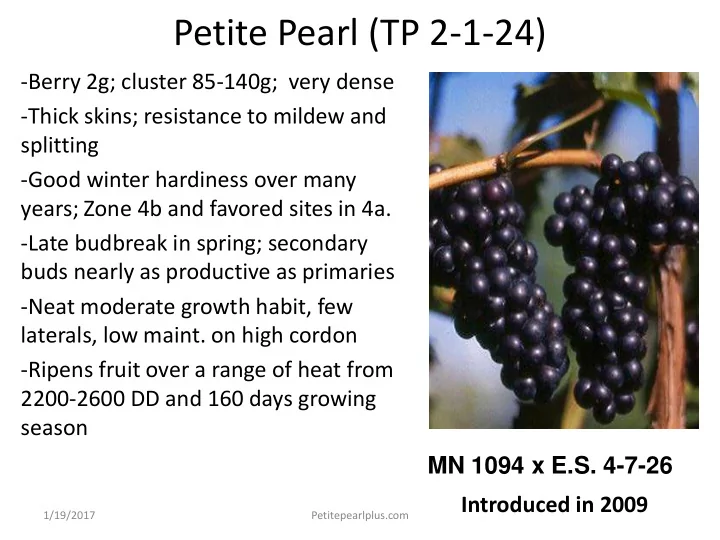
Petite Pearl (TP 2-1-24) -Berry 2g; cluster 85-140g; very dense - - PowerPoint PPT Presentation

petite pearl tp 2 1 24
SMART_READER_LITE
LIVE PREVIEW

Petite Pearl (TP 2-1-24) -Berry 2g; cluster 85-140g; very dense - - PowerPoint PPT Presentation

Petite Pearl (TP 2-1-24) -Berry 2g; cluster 85-140g; very dense -Thick skins; resistance to mildew and splitting -Good winter hardiness over many years; Zone 4b and favored sites in 4a. -Late budbreak in spring; secondary buds nearly as


slide-1
SLIDE 1

Petite Pearl (TP 2-1-24)

  • Berry 2g; cluster 85-140g; very dense
  • Thick skins; resistance to mildew and

splitting

  • Good winter hardiness over many

years; Zone 4b and favored sites in 4a.

  • Late budbreak in spring; secondary

buds nearly as productive as primaries

  • Neat moderate growth habit, few

laterals, low maint. on high cordon

  • Ripens fruit over a range of heat from

2200-2600 DD and 160 days growing season MN 1094 x E.S. 4-7-26

1/19/2017 Petitepearlplus.com

Introduced in 2009

slide-2
SLIDE 2

Petite Pearl (TP 2-1-24)

Typical harvest parameters in Twin Cities area: 24 Brix, pH = 3.45, TA = 0.7-0.8 Target pH for harvest is 3.45

Abundant soft tannins The best wines have been produced using 48 hour cold soak.

Wine:

Deep garnet red, Complex, Good tannin structure Excellent balance of acid, tannin and alcohol.

Fruit harvested earlier than full maturity have produced some

  • utstanding rose wines (2016 Lincoln Peak Winery Petite Pearl Rose)

1/19/2017 Petitepearlplus.com 2

slide-3
SLIDE 3

Petite Pearl Crimson Pearl

MN 1019 Manitoba Riparia 64 Landot 244 MN1094 MN 1016 E.S. 4-7- 26 Carmine Seyve-Villard 12-375 Mandan Wilder Landot 4511

  • N. Dakota

riparia E.S. 283 MN 78 Swenson Red E.S. 2- 12-27 E.S. 193 E.S. 5-14 St. Croix Seyve-Villard 12-375 E.S.80 Seibel1000 MN 78 E.S. 593 Open MN 78 Seneca Beta Kendaia Witt riparia Concord Seibel11800 MN 78 vinifera labrusca labrusca vinifera lLignan blanc Ontario

Olmo, UC-Davis, 1946 Hansen, SDSU, 1935 French Hybridizers, 1875-1935 Vitis species Elmer Swenson, 1950-2004 Old American hybrids, 1800’s Hemstad, UM Rogers, 1858 NYSES, Geneva, 1906-39

Cabernet Sauvignon x Carignan Grenache

Louis Suelter, MN, 1880

Geneology of Petite Pearl and Crimson Pearl Tom Plocher, 2013

1/19/2017

slide-4
SLIDE 4

Verona (T.P. 1-1-34)USPP

Berry 2g, black; Cluster 120-200 g Some injury in the worst winters at Hugo, MN; best in U.S. Hardiness Zone 4b or 5 Excellent resistance to mildews and splitting Late budbreak in spring. Ripens rather late in the Twin Cities, slightly after Frontenac, 10 days after Petite Pearl, in early October. Needs 2600 Degree Days F and 170 days growing season.

Troubador x E.S. 5-4-16

1/19/2017 Petitepearlplus.com 4

Introduced in 2015

slide-5
SLIDE 5

Verona (T.P. 1-1-34)USPP

Typical harvest numbers in Twin Cities area: 22-24 brix; pH = 3.35-3.38; TA < 1% Lots of polyphenols in skins; good portion of them as tannin As a red wine

Deeply colored; abundant soft tannins; Good balance between acid, tannin, and alcohol. Aroma is complex As a rose Garnet color, cherry aroma and lots of body; lush vinifera-like fruit, good balance and finish.

Wine quality often rated above Petite Pearl in blind tastings. U.S. Patent Pending

1/19/2017 Petitepearlplus.com 5

slide-6
SLIDE 6

Crimson Pearl (T.P. 2-1-17)USPP

  • Berry 2.5 g; cluster 100-250 gm
  • Very early wood ripening and good

winter hardiness; the most rugged vine from my work

  • Late bud break in spring; holds its

dormancy very well

  • Neat growth habit, moderate vigor
  • n top wire cordon
  • Good disease resistance and little

rot or splitting

  • Ripens 5-7days earlier than Petite

Pearl in 2500 degree Days F and

155 days growing season MN 1094 x E.S. 4-7-26

1/19/2017 Petitepearlplus.com 6

Introduced in 2015

slide-7
SLIDE 7

Crimson Pearl (T.P. 2-1-17)USPP

Typical harvest in Twin Cities: 22-23 brix, pH = 3.4-3.8, TA < 0.8% As a dry red: Fits well in a fruity dry red style with soft tannins and deep crimson color. As a Rose:

  • 24 hour cold soak and pressing followed by cool fermentation produces a

very fruity rose with raspberry flavor.

  • Saignee method has produced rose wines with tropical fruit aromas.

All styles have good balance between acid, tannin, and alcohol

U.S. Patent Pending

1/19/2017 Petitepearlplus.com 7

slide-8
SLIDE 8

Tom Plocher contact:

  • tplocher@outlook.com
  • Petitepearlplus.com