SLIDE 1 CS-5630 / CS-6630 Visualization Fitering & Aggregation
Alexander Lex alex@sci.utah.edu
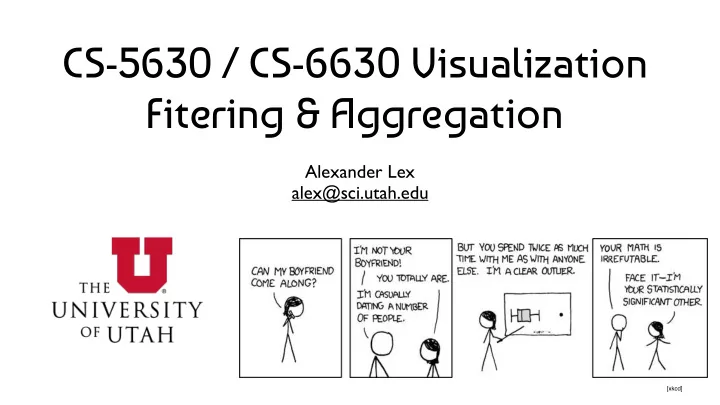
[xkcd]
SLIDE 2
Administrativa
SLIDE 3
Project
Assigned a primary and a consulting TA All project feedback coordinated between them Primary is your point of contact, keep consulting in the loop You can set up meetings Homework 5 feedback by Friday Nov 16-Nov 20 — Mandatory meeting with TA
SLIDE 4
Filter & Aggregate
SLIDE 5
SLIDE 6 Filter
elements are eliminated What drives filters? Any possible function that partitions a dataset into two sets
Bigger/smaller than x Fold-change Noisy/insignificant
SLIDE 7
Dynamic Queries / Filters
coupling between encoding and interaction so that user can immediately see the results of an action Queries: start with 0, add in elements Filters: start with all, remove elements Approach depends on dataset size
SLIDE 9 Ahlberg 1994
ITEM FILTERING
SLIDE 10
NONSPATIAL FILTERING
SLIDE 11 Scented Widgets
information scent: user’s (imperfect) perception of data GOAL: lower the cost of information foraging
through better cues
Willett 2007
SLIDE 12 Interactive Legends
Controls combining the visual representation of static legends with interaction mechanisms of widgets Define and control visual display together
Riche 2010
SLIDE 13
Aggregation
SLIDE 14
Aggregate
a group of elements is represented by a (typically smaller) number of derived elements
SLIDE 15 Item Aggregation
Histogram
score number of students
SLIDE 16 Histogram
Good #bins hard to predict make interactive! rule of thumb: #bins = sqrt(n)
10 Bins 20 Bins age age # passengers # passengers
SLIDE 17 Density Plots
http://web.stanford.edu/~mwaskom/software/seaborn/tutorial/plotting_distributions.html
SLIDE 18 Box Plots
aka Box-and-Whisker Plot Show outliers as points! Not so great for non-normal distributed data Especially bad for bi- or multi- modal distributions
Wikipedia
SLIDE 19 One Boxplot, Four Distributions
http://stat.mq.edu.au/wp-content/uploads/2014/05/Can_the_Box_Plot_be_Improved.pdf
SLIDE 20 Notched Box Plots
Notch shows
m +/- 1.5i x IQR/sqrt(n) A guide to statistical significance.
Kryzwinski & Altman, PoS, Nature Methods, 2014
SLIDE 21 Box(and Whisker) Plots
http://xkcd.com/539/
SLIDE 22 Comparison
Streit & Gehlenborg, PoV, Nature Methods, 2014
SLIDE 23 Violin Plot
= Box Plot + Probability Density Function
http://web.stanford.edu/~mwaskom/software/seaborn/tutorial/plotting_distributions.html
SLIDE 24 Showing Expected Values & Uncertainty
NOT a distribution!
Error Bars Considered Harmful: Exploring Alternate Encodings for Mean and Error Michael Correll, and Michael Gleicher
SLIDE 25 Heat Maps
binning of scatterplots instead of drawing every point, calculate grid and intensities
2D Density Plots
SLIDE 26
SLIDE 27 Continuous Scatterplot
Bachthaler 2008
SLIDE 28 Hierarchical Parallel Coordinates
Fua 1999
SLIDE 29 Spatial Aggregation
modifiable areal unit problem
in cartography, changing the boundaries of the regions used to analyze data
can yield dramatically different results
SLIDE 30 A real district in Pennsylvania Democrats won 51% of the vote
but only 5 out of 18 house seats
SLIDE 31 31
http://www.sltrib.com/opinion/ 1794525-155/lake-salt-republican- county-http-utah Valid till 2002
SLIDE 32 Voronoi Diagrams
Given a set of locations, for which area is a location n closest? D3 Voronoi Layout:
https://github.com/mbostock/d3/wiki/ Voronoi-Geom
SLIDE 33 Constructing a Voronoi Diagram
Calculate a Delauney triangulation Voronoi edges are perpendicular to triangle edges.
http://paulbourke.net/papers/triangulate/
SLIDE 34 Delauney Triangulation
Start with all-encompassing fake triangle For existing triangles: check if circumcircle contains new point Outer edges of triangles form polygon, delete all inner edges Create triangle connecting all
SLIDE 35 Voronoi Examples
Sidenote: Voronoi for Interaction
SLIDE 36
Attribute aggregation
1) group attributes and compute
a similarity score across the set 2) dimensionality reduction,
to preserve meaningful structure
SLIDE 37
Attribute aggregation
1) group attributes and compute
a similarity score across the set 2) dimensionality reduction,
to preserve meaningful structure
SLIDE 38
Attribute aggregation
1) group attributes and compute
a similarity score across the set 2) dimensionality reduction,
to preserve meaningful structure
SLIDE 39 Clustering
Classification of items into “similar” bins Based on similarity measures
Euclidean distance, Pearson correlation, ...
Partitional Algorithms
divide data into set of bins # bins either manually set (e.g., k- means) or automatically determined (e.g., affinity propagation)
Hierarchical Algorithms Produce “similarity tree” – dendrogram Bi-Clustering Clusters dimensions & records Fuzzy clustering allows occurrence of elements in multiples clusters
SLIDE 40 Clustering Applications
Clusters can be used to
- rder (pixel based techniques)
brush (geometric techniques) aggregate
Aggregation
cluster more homogeneous than whole dataset statistical measures, distributions, etc. more meaningful
SLIDE 41
Clustered Heat Map
SLIDE 42 F+C Approach, with Dendrograms
[Lex, PacificVis 2010]
SLIDE 43
Cluster Comparison
SLIDE 44
Aggregation
SLIDE 45
Example: K-Means
Pick K starting points as centroids Calculate distance of every point to centroid, assign to coaster with lowest value Update centroid to the mean of cluster Repeat
SLIDE 46 K-Means Properties
Have to pick K Assumptions about data: roughly “circular” clusters of equal size
http://stats.stackexchange.com/questions/133656/how-to-understand-the-drawbacks-of-k-means
SLIDE 47 K-Means Unequal Cluster Size
http://stats.stackexchange.com/questions/133656/how-to-understand-the-drawbacks-of-k-means
SLIDE 48
Attribute aggregation
1) group attributes and compute
a similarity score across the set 2) dimensionality reduction,
to preserve meaningful structure
SLIDE 49 Dimensionality Reduction
Reduce high dimensional to lower dimensional space Preserve as much of variation as possible Plot lower dimensional space Principal Component Analysis (PCA)
linear mapping, by order of variance
SLIDE 50
PCA
SLIDE 51 PCA Example – CS 171 Project 2013
[Mercer & Pandian] http://mu-8.com/
SLIDE 52 Multidimensional Scaling
Nonlinear, better suited for some DS Multiple approaches Works based on projecting a similarity matrix
How do you compute similarity? How do you project the points?
Popular for text analysis
[Doerk 2011]
SLIDE 53 Can we Trust Dimensionality Reduction?
http://www-nlp.stanford.edu/projects/dissertations/browser.html
Topical distances between departments in a 2D projection Topical distances between the selected Petroleum Engineering and the others.
[Chuang et al., 2012]
SLIDE 54 Probing Projections
http://julianstahnke.com/probing-projections/
SLIDE 55 MDS for Temporal Data: TimeCurves
http://aviz.fr/~bbach/timecurves/