CS-5630 / CS-6630 Visualization for Data Science Filtering & - - PowerPoint PPT Presentation

cs 5630 cs 6630 visualization for data science filtering
SMART_READER_LITE
LIVE PREVIEW

CS-5630 / CS-6630 Visualization for Data Science Filtering & - - PowerPoint PPT Presentation

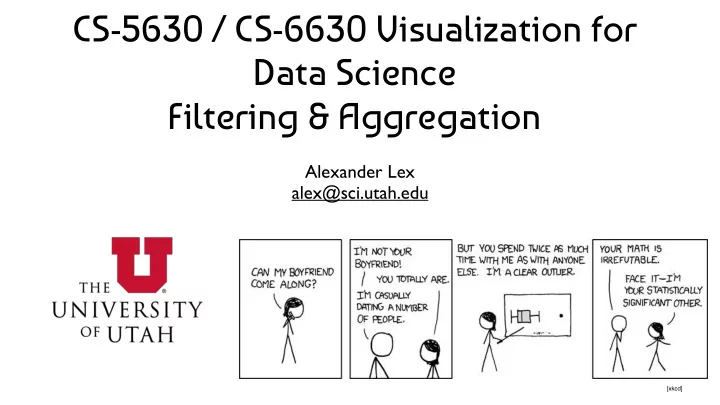
CS-5630 / CS-6630 Visualization for Data Science Filtering & Aggregation Alexander Lex alex@sci.utah.edu [xkcd] Filter elements are eliminated What drives filters? Any possible function that partitions a dataset into two sets

slide-1
SLIDE 1

CS-5630 / CS-6630 Visualization for Data Science Filtering & Aggregation

Alexander Lex alex@sci.utah.edu

[xkcd]

slide-2
SLIDE 2
slide-3
SLIDE 3

Filter

elements are eliminated What drives filters? Any possible function that partitions a dataset into two sets

Bigger/smaller than x Fold-change Noisy/insignificant

slide-4
SLIDE 4

Dynamic Queries / Filters

coupling between encoding and interaction so that user can immediately see the results of an action Queries: start with 0, add in elements Filters: start with all, remove elements Approach depends on dataset size

slide-5
SLIDE 5

Sketch-based Queries

Idea: we have a mental model of a pattern. Let user sketch it!

http://detexify.kirelabs.org/classify.html

slide-6
SLIDE 6

Sketch-based Queries

Time Series

https://www.youtube.com/watch?v=4YQTuUuIFbI

[Mannino, Abouzied, 2018]

slide-7
SLIDE 7

Ahlberg 1994

ITEM FILTERING

slide-8
SLIDE 8

Scented Widgets

information scent: user’s (imperfect) perception of data GOAL: lower the cost of information foraging 
 through better cues

Willett 2007

slide-9
SLIDE 9

Item Filtering with Scented Widgets

https://keshif.me/gallery/olympics

slide-10
SLIDE 10

Interactive Legends

Controls combining the visual representation of static legends with interaction mechanisms of widgets Define and control visual display together

Riche 2010

slide-11
SLIDE 11

Aggregation

slide-12
SLIDE 12

Aggregate

a group of elements is represented by a (typically smaller) number of derived elements

slide-13
SLIDE 13

Why Aggregate?

slide-14
SLIDE 14

What’s a histogram?

slide-15
SLIDE 15

Histograms Explained

http://tinlizzie.org/histograms/

slide-16
SLIDE 16

Histogram

Good #bins hard to predict make interactive! rules of thumb:

#bins = sqrt(n) #bins = log2(n) + 1

10 Bins 20 Bins age age # passengers # passengers

slide-17
SLIDE 17

Unequal Bin Width

https://www.nytimes.com/interactive/2015/02/17/upshot/what-do-people-actually-order-at-chipotle.html?_r=1

Can be useful if data is much sparser in some areas than others Show density as area, not hight.

slide-18
SLIDE 18

Density Plots (Kernel Density Estimation)

http://web.stanford.edu/~mwaskom/software/seaborn/tutorial/plotting_distributions.html

slide-19
SLIDE 19

One of these things is not like the

  • ther…

19 charts are random samples from a gaussian. 1 chart has 20% of samples with identical value

[Corell et al, InfoVis 2019]

slide-20
SLIDE 20

Detecting Data Flaws

Tricky with aggregate visualization Bin size / kernel type / bandwidth / visualization choice all affect different situations

slide-21
SLIDE 21

Box Plots

aka Box-and-Whisker Plot Show outliers as points! Bad for non-normal distributed data Especially bad for bi- or multi- modal distributions

Wikipedia

slide-22
SLIDE 22

One Boxplot, Four Distributions

http://stat.mq.edu.au/wp-content/uploads/2014/05/Can_the_Box_Plot_be_Improved.pdf

slide-23
SLIDE 23

Notched Box Plots

Notch shows 
 m +/- 1.5i x IQR/sqrt(n)

  • > 95% Confidence Intervall

A guide to statistical significance.

Kryzwinski & Altman, PoS, Nature Methods, 2014

slide-24
SLIDE 24

Box(and Whisker) Plots

http://xkcd.com/539/

slide-25
SLIDE 25

Comparison

Streit & Gehlenborg, PoV, Nature Methods, 2014

slide-26
SLIDE 26

Bar Charts vs Dot Plots

https://twitter.com/robustgar/status/859318971920769024 Data Source https://bmcneurosci.biomedcentral.com/articles/10.1186/1471-2202-10-67

slide-27
SLIDE 27

Violin Plot

= Box Plot + Probability Density Function

http://web.stanford.edu/~mwaskom/software/seaborn/tutorial/plotting_distributions.html

slide-28
SLIDE 28

Showing Expected Values & Uncertainty

NOT a distribution!

Error Bars Considered Harmful: Exploring Alternate Encodings for Mean and Error Michael Correll, and Michael Gleicher

slide-29
SLIDE 29

Heat Maps

binning of scatterplots instead of drawing every point, calculate grid and intensities

2D Density Plots

slide-30
SLIDE 30
slide-31
SLIDE 31

Continuous Scatterplot

Bachthaler 2008

slide-32
SLIDE 32

Spatial Aggregation

slide-33
SLIDE 33

Spatial Aggregation

modifiable areal unit problem

in cartography, changing the boundaries of the regions used to analyze data 
 can yield dramatically different results

slide-34
SLIDE 34

A real district in Pennsylvania Democrats won 51% of the vote
 but only 5 out of 18 house seats

slide-35
SLIDE 35

Updated Map after Court Decision

https://www.nytimes.com/interactive/2018/11/29/us/politics/north-carolina-gerrymandering.html?action=click&module=Top%20Stories&pgtype=Homepage

slide-36
SLIDE 36

36

http://www.sltrib.com/opinion/ 1794525-155/lake-salt-republican- county-http-utah Valid till 2002

slide-37
SLIDE 37

2016 Congressional Elections

https://www.dailykos.com/stories/2016/12/29/1611906/-Here-s-what-Utah-might-have-looked-like-in-2016-without-congressional-gerrymandering

slide-38
SLIDE 38

Voronoi Diagrams

Given a set of locations, for which area is a location n closest? D3 Voronoi Layout:

https://github.com/d3/d3-voronoi

slide-39
SLIDE 39

Voronoi Examples

slide-40
SLIDE 40

Voronoi for 
 Interaction

Useful for interaction: 
 Increase size of target area to click/hover Instead of clicking on point, hover in its region

https://github.com/d3/d3-voronoi/

slide-41
SLIDE 41

Constructing a Voronoi Diagram

Calculate a Delauney triangulation

Triangulation where no vertices are in a circle described by the vertices

  • f a triangle

Voronoi edges are perpendicular to triangle edges.

http://paulbourke.net/papers/triangulate/

https://en.wikipedia.org/wiki/Delaunay_triangulation

slide-42
SLIDE 42

Design Critique

slide-43
SLIDE 43

http://mariandoerk.de/edgemaps/demo/ https://goo.gl/IDRXDl

slide-44
SLIDE 44

Clustering

slide-45
SLIDE 45

Clustering

Classification of items into “similar” bins Based on similarity measures

Euclidean distance, Pearson correlation, ...

Partitional Algorithms

divide data into set of bins # bins either manually set (e.g., k- means) or automatically determined (e.g., affinity propagation)

Hierarchical Algorithms Produce “similarity tree” – dendrogram Bi-Clustering Clusters dimensions & records Fuzzy clustering allows occurrence of elements in multiples clusters

slide-46
SLIDE 46

Clustering Applications

Clusters can be used to

  • rder (pixel based techniques)

brush (geometric techniques) aggregate

Aggregation

cluster more homogeneous than whole dataset statistical measures, distributions, etc. more meaningful

slide-47
SLIDE 47

Clustered Heat Map

slide-48
SLIDE 48

Cluster Comparison

slide-49
SLIDE 49

Aggregation

TYLER JONES TYLER JONES

slide-50
SLIDE 50

Example: K-Means

Goal: Minimize aggregate intra-custer distance (inertia)

total squared distance from point to center of its cluster for euclidian distance: this is the variance measure of how internally coherent clusters are

slide-51
SLIDE 51

Lloyd’s Algorithm

Input: set of records x1 … xn, and k (nr clusters) Pick k starting points as centroids c1 … ck While not converged:

  • 1. for each point xi find closest centroid cj
  • for every cj calculate distance D(xi , cj)
  • assign xi to cluster j defined by smallest distance
  • 2. for each cluster j, compute a new centroid cj 


by calculating the average of all xi assigned to cluster j

Repeat until convergence, e.g.,

no point has changed cluster distance between old and new centroid below threshold number of max iterations reached

slide-52
SLIDE 52
  • 1. Initialization
  • 2. Assign Clusters
  • 3. Update Centroids
  • 4. Assign Clusters

And repeat until converges

slide-53
SLIDE 53

Illustrated

https://www.naftaliharris.com/blog/visualizing-k-means-clustering/

slide-54
SLIDE 54

Choosing K

slide-55
SLIDE 55

Properties

Lloyds algorithm doesn’t find a global optimum Instead it finds a local optimum It is very fast:

common to run multiple times and pick the solution with the minimum inertia

slide-56
SLIDE 56

K-Means Properties

Assumptions about data: roughly “circular” clusters of equal size

http://stats.stackexchange.com/questions/133656/how-to-understand-the-drawbacks-of-k-means

slide-57
SLIDE 57

K-Means Unequal Cluster Size

http://stats.stackexchange.com/questions/133656/how-to-understand-the-drawbacks-of-k-means

slide-58
SLIDE 58

DBScan

Density-based spatial clustering of applications with noise Idea: Clusters are dense groups if point belongs to a cluster, it should be near to lots of other points in that cluster. Parameters:

Epsilon: if new point distance to closest point in cluster is < epsilon, add to cluster Min points: what’s the smallest cluster (outliers)

https://www.naftaliharris.com/blog/visualizing-dbscan-clustering/

slide-59
SLIDE 59

Hierarchical Clustering

Two types:

agglomerative clustering start with each node as a cluster and merge divisive clustering start with one cluster, and split

slide-60
SLIDE 60

Agglomerative Clustering Idea

A B C D E F A B C D E F

https://youtu.be/XJ3194AmH40?t=4m29s

slide-61
SLIDE 61

Linkage Criteria

How do you define similarity between two clusters to be merged (A and B)?

  • maximum linkage distance: two elements that are apart the

furthest

  • use minimum linkage distance: the two closest elements
  • use average linkage distance
  • use centroid distance
slide-62
SLIDE 62

F+C Approach, with Dendrograms

[Lex, PacificVis 2010]

slide-63
SLIDE 63

Hierarchical Parallel Coordinates

Fua 1999

slide-64
SLIDE 64

Dimensionality Reduction

slide-65
SLIDE 65

Dimensionality Reduction

Reduce high dimensional to lower dimensional space Preserve as much of variation as possible Plot lower dimensional space Principal Component Analysis (PCA)

linear mapping, by order of variance

slide-66
SLIDE 66

PCA

slide-67
SLIDE 67

Multidimensional Scaling

Multiple approaches Works based on projecting a similarity matrix

How do you compute similarity? How do you project the points?

Popular for text analysis

[Doerk 2011]

slide-68
SLIDE 68

Can we Trust Dimensionality Reduction?

http://www-nlp.stanford.edu/projects/dissertations/browser.html

Topical distances between departments in a 2D projection Topical distances between the selected Petroleum Engineering and the others.

[Chuang et al., 2012]

slide-69
SLIDE 69

Probing Projections

http://julianstahnke.com/probing-projections/

slide-70
SLIDE 70

t-SNE

t-distributed stochastic neighbor embedding non-linear algorithm: different transformations for different regions

Visualizing data using t-SNE, Maaten and Hinton, 2008

slide-71
SLIDE 71
slide-72
SLIDE 72

MDS for Temporal Data: TimeCurves

http://aviz.fr/~bbach/timecurves/