patterns in human subthalamic nucleus Kim Scott Mentor: Henry - - PowerPoint PPT Presentation
Effects of nicotine on neuronal firing patterns in human subthalamic nucleus Kim Scott Mentor: Henry Lester SURF seminar, January 15, 2009 Smoking tobacco protects against Parkinsons Disease (PD). Identical twins: 10 pack- years
Smoking tobacco protects against Parkinson’s Disease (PD).
- Identical twins: 10 pack-years’ difference!
(Tanner et al. 2002)
- Risk increases with years since quitting
(Ritz et al. 2007)
- Nicotine has a protective effect in culture and
animal models (Quik et al 2007) Conclusion: Chronic nicotine prevents the degeneration of dopaminergic neurons in the substantia nigra.
2
Deep brain stimulation in PD
3
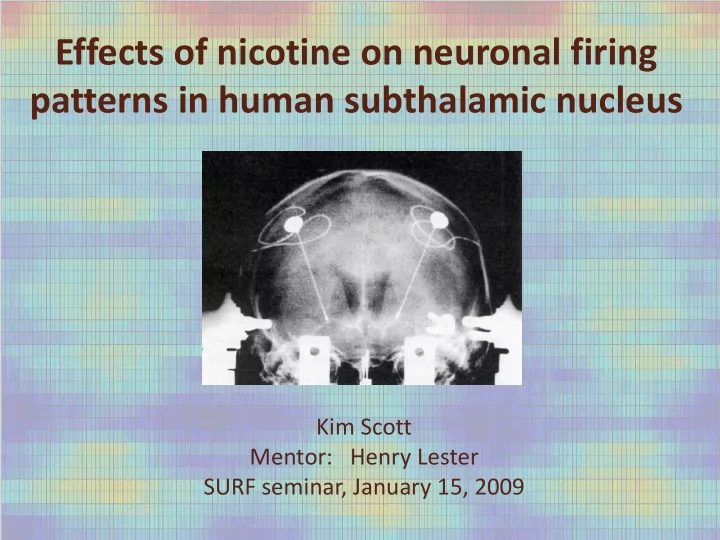
Electrical stimulation of the subthalamic nucleus (STN) at 120-180 Hz immediately relieves motor symptoms of PD.
Deep brain stimulation in PD
Why is this important to us?
- It’s an ethical reason to put electrodes in human
brains
- Suggests a focus on subthalamic nucleus (STN)
4 Bevan et al. 2002 Garcia et al. 2005
How does nicotine affect firing patterns in STN: “What changes?”
- Experimental protocol
- Spike detection and sorting
- 1-2 Hz oscillation
- Hope for the future
5
Recording procedure
Currently available STN recordings:
- 8 patients (2 smokers)
- Placebo recordings in all but first two patients.
Active placebo in newest patient!
- Variable lengths of recording, ~5 minutes total.
6
Baseline Nasal saline solution (placebo) Nasal nicotine solution
1.2 mm 1.2 mm
Protocol · Spike detection · Oscillation · Hope and plans
Spike detection isn’t automatic
7
2 0 4 0 2 0 4 020 ms 20 μV
Protocol · Spike detection · Oscillation · Hope and plans
Osort: spike detection and sorting
8 Rutishauser et al. 2006
filtered trace power signal
M S
detected spikes
Protocol · Spike detection · Oscillation · Hope and plans
Sample sorted cluster: LUD ch. 2
9
Interspike interval histogram count
Protocol · Spike detection · Oscillation · Hope and plans
Nothing obvious changes.
- Peak amplitude, variation therein, variation in
shape of waveform
- Firing rate, coefficient of variation
- Burst propensity
- Connections among these factors
10 Protocol · Spike detection · Oscillation · Hope and plans
1-2 Hz bursting oscillation is real.
11
10 μV 25 s 5 s 1 s
Protocol · Spike detection · Oscillation · Hope and plans
Firing of an STN neuron isn’t a renewal process.
12 Protocol · Spike detection · Oscillation · Hope and plans
The autocorrelation function
13
Patient LUD, channel 1 Lags (s)
Protocol · Spike detection · Oscillation · Hope and plans
Properties of 1-2 Hz oscillation
- Statistically significant oscillation detected in 30
- f 47 clusters
- Tightly clustered frequencies across channels in
the same patient: average variance 0.0022 Hz
- Consistent changes across channels with
placebo and nicotine
- Units tend to synchronize in or out of phase
14
- Almost unique to our group
Protocol · Spike detection · Oscillation · Hope and plans
Brief contralateral stimulation abolishes 1-2 Hz oscillation
15
Side I Side II Percent of units
- scillating at
0-2 Hz
(Data from Chibirova et al., 2005)
Protocol · Spike detection · Oscillation · Hope and plans
Possible sources of oscillation
16
Plenz & Kital 1999:
- STN oscillates in culture!
- STN-GPe cut: abolishes
synchronization and
- scillation
- STN-cortex cut: centers
frequency at 0.8 Hz
Magill et al. 2001:
- ~ 1 Hz oscillation in STN
phase-locked to slow- wave activity in cortex
- Bursting is more
intense in dopamine depletion
Protocol · Spike detection · Oscillation · Hope and plans
Nothing obvious changes.
- Peak amplitude, variation therein, variation in shape of
waveform
- Firing rate, coefficient of variation
- Burst propensity
- Strength of oscillation (several measures)
- Variation in oscillation timing
- Frequency of oscillation
- Phase variance, strength, or frequency of
synchronization
- Connections among these
17 Protocol · Spike detection · Oscillation · Hope and plans
Future recordings
18
ECG control Blood samples Drug comparison
Next steps in analysis
- Measures of synchrony across all clusters
- Higher-order features: clustering of bursts
- Connections between low-frequency
components of raw trace and burst timing
Protocol · Spike detection · Oscillation · Hope and plans
Acknowledgments
- Henry Lester
- Johannes Schwarz (Universität Leipzig)
- Shawna Frazier
- Ueli Rutishauser
- Pam Fong
- Lester lab
- the Caltech SURF program and Richter
Memorial Fund
19
References
Benarroch, E.E. Subthalamic nucleus and its connections: anatomic substrate for the network effects of deep brain stimulation. Neurology 70, 1991-1995 (2008). Bevan, M.D., Magill, P.J., Terman, D., Bolam, J.B. & Wilson, C.J. Move to the rhythm: oscillations in the subthalamic nucleus-external globus pallidus network. TRENDS in Neurosciences 25, 525-531 (2002). Chibirova O.K., Aksenova T.I., Benabid A., Chabardes S., Larouche S., Rouat J., & Villa A.E.P. Unsupervised spike sorting of extracellular electrophysiological recording in subthalamic nucleus of Parkinsonian patients. BioSystems 79, 159-171 (2005). Garcia, L., D'Alessandro, G., Bioulac, B. & Hammond, C. High-frequency stimulation in Parkinson's disease: more or less? TRENDS in Neurosciences 28, 209-216 (2005). Hahnloser, R.H.R. Cross-intensity functions and the estimate of spike-time jitter. Biol Cybern 96, 497-506 (2007). Levy, R., Hutchison, W.D., Lozano, A.M. & Dostrovsky, J.O. High-frequency synchronization of neuronal activity in the subthalamic nucleus of Parkinsonian patients with limb tremor. J Neurosci 20, 7766-7775 (2000). Magill, P.J., Bolam, J.P. & Bevan, M.D. Dopamine regulates the impact of the cerebral cortex on the subthalamic nucleus-globus pallidus
- network. Neuroscience 106, 313-330 (2001).
Plentz, D. & Kital, S.T. A basal ganglia pacemaker formed by the subthalamic nucleus and external globus pallidus. Nature 400, 677-682 (1999). Quik, M., Bordia, T. & O'Leary, K. Nicotinic receptors as CNS targets for Parkinson's disease. Biochem Pharmacol 74, 1224-1234 (2007). Ritz, B., Ascherio, A., Checkoway, H., Marder, K.S., Nelson, L.M., Rocca, W.A., Ross, G.W., Strickland, D., Van Den Eeden, S.K., & Gorell, J. Pooled analysis of tobacco use and risk of Parkinson disease. Arch Neurol 64(7): 990-997 (2007). Rutishauser, U., Schuman, E.M. & Mamelak, A.N. Online detection and sorting of extracellularly recorded action potentials in human medial temporal lobe recordings, in vivo. J Neurosci Methods 154, 204-224 (2006). Tanner, C.M., Goldman, S.M./, Aston, D.A., Ottman, R., Ellenberg, J., Mayeux, R., Langston, J.W. Smoking and Parkinson’s disease in
- twins. Neurology 58:581-588 (2002).
20
- 100
- 50
21
Challenge: artifact ID & correction
160075 160070 160065 Time (ms) Signal 00 (µV)- 1000
- 800
- 600
- 400
- 200
- 400
- 200
WEN VOG HAE
Protocol · Spike detection · Oscillation · What changes? · Progress and plans
Gain changes during recording
22
… are removable!
23
Power thresholding
24
We’re not limited to studying pairs of clusters
- The cross-correlation is only defined for
two signals, but:
25 Protocol · Spike detection · Oscillation · What changes? · Progress and plans
1
- Compute pairwise autocorrelations
2
- Optimally align spike trains
3
- Pool aligned spike trains
4
- Compute the autocorrelation
5
- Compare to control
26
- Direct pathway: striatum inhibits Gpi/SNr
inhibits thalamus
- Indirect pathway: striatum inhibits Gpe
inhibits STN excites Gpi/SNr inhibits thalamus.
- STN is part of the indirect pathway
- Disfunction leads to impulsivity
- B.G. possibly participate in action selection.
27