SLIDE 1
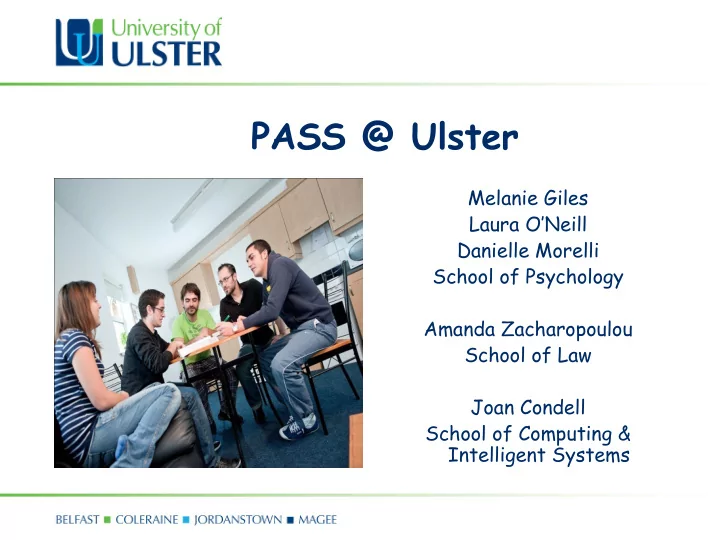
PASS @ Ulster
Melanie Giles Laura O’Neill Danielle Morelli School of Psychology Amanda Zacharopoulou School of Law Joan Condell School of Computing & Intelligent Systems
SLIDE 2
Why Do Students Attend Peer Assisted Study Programs? An Application of the Theory of Planned Behaviour
SLIDE 3
Background
This year, the Schools of Psychology, Law and Computing and Intelligent Systems have piloted the PASS initiative within the University of Ulster. Early indications suggest that the scheme is already having a positive effect on performance. For example, mean module marks have increased significantly.
SLIDE 4
Background
Qualitative comments also suggest that PASS is aiding the transition process by allowing students to build supportive networks. As a consequence, the scheme has already been extended to Economics and there are plans for the School of Nursing to join the group in September 2011.
SLIDE 5
Background
However, it is acknowledged that for students to reap the benefits they need to expend a certain quality of effort and non-attendance amongst some students is still an issue of concern.
SLIDE 6
Background
Whilst attendance may be viewed as a relatively crude measure of engagement in that it can only ever be indicative of participation and does not necessarily consider the quality of involvement, it has been found to be an important variable in determining student success (Douglas, 2008).
SLIDE 7
Background
It therefore seems feasible to suggest that those who aren’t attending aren’t engaging and as a consequence are likely to do less well. As such, there is a need to explore attendance at PASS sessions so that we might find better ways to engage students in the learning process.
SLIDE 8
Background
Whilst there is no conclusive evidence to suggest that characteristics that students bring with them such as gender, ethnicity or ability levels will influence the extent to which they engage as students (see Trowler and Trowler, 2010), there is some evidence to suggest that other factors might contribute to their interest and level of engagement in learning. For example, economic and social pressures (Longhurst, 1999), dissatisfaction with courses and teachers and peer influences (Brewster & Fager, 2000) may all play a role.
SLIDE 9 Background
Clearly, these influences will be more important for some students than for others and an understanding
- f the most salient issues for a particular student
population will be fundamental in shaping the design and delivery of a programme. However, perhaps surprisingly, despite the rhetoric on the value of student engagement, there is little evidence to suggest that students are engaged in issues beyond their own learning. Consequently, there is a need to involve them more directly in shaping the design and delivery of the curriculum.
SLIDE 10
Aim
With this in mind, this study employed the Theory of Planned Behaviour (TPB), a socio-psychological framework to predict and explain attendance at peer assisted study sessions. More specifically, the aim was to identify the factors influencing students’ attitudes and motivations to engage with the process, to assess their relative importance and to inform its future delivery.
SLIDE 11
The Theory of Planned Behaviour
The TPB has been found to be a very useful model for predicting and explaining behaviour and more recently, for designing behavioural change interventions. It works on the premise that the best way to explore behaviour is to measure behavioural intention, which in turn is seen to be a function of four independent variables notably, attitudes, subjective norm (influence of significant others), perceived control and self-efficacy.
SLIDE 12
SLIDE 13
The Theory of Planned Behaviour
Each of these variables are based on a set of underlying beliefs. By measuring these beliefs we can explore why people hold certain attitudes, for example, why students choose to engage in peer assisted study, which in turn can provide valuable information for informing the future delivery of the programme.
SLIDE 14 The Theory of Planned Behaviour
Using the theory to change behaviour:
- Conduct an elicitation study to identify modal salient
beliefs and use these to construct a TPB type questionnaire.
- Administer questionnaire to a sample of people drawn
from the target population to identify the determinants of the target behaviour.
- Develop an intervention based on the questionnaire
components most strongly associate with the target behaviour.
- Evaluate the intervention pre and post test using the
questionnaire.
SLIDE 15 Method
- Elicitation Study: Beliefs were elicited by conducting
- ne to one interviews with 12 first year students and
evaluated in conjunction with the results obtained from a series of focus groups conducted with students in 3 separate disciplines.
- Questionnaire Survey: The information elicited from
the elicitation study was used to construct an Ajzen and Fishbein questionnaire. The questionnaire was designed to assess key TPB constructs including both direct and belief-based measures.
SLIDE 16 Elicitation Study
Questions were of the form:
- What do you consider are the advantages and/or
disadvantages of attending PASS sessions?
- Are there any groups or people who would approve
and/or disapprove of you attending PASS sessions?
- What factors might encourage and/or prevent you
from attending PASS sessions?
SLIDE 17 Results of Elicitation Study
Advantages/disadvantages of attending PASS sessions: ‘Going to PASS means we get a chance to look over our notes and gain a better understanding of what has been taught in lectures. Hopefully that will pay off when we get our results’ ‘I wouldn’t have made some of my friends if it wasn’t for PASS’. Its good because you have time when you can talk
- penly to each other about the course and our work
because we wouldn’t do it any other time’
SLIDE 18
Results of Elicitation Study
Advantages/disadvantages of attending PASS sessions: ‘’It’s hard to go to PASS when we have so much work to do at times, we definitely don’t need any extra” “I guess it would be better if more students went but I know some people are really worried about all the work they have to do and going to additional things just stresses them out”
SLIDE 19 Results of Elicitation Study
Groups or people who would approve/disapprove of you attending PASS sessions: “ Our PASS leaders are really nice and easy to talk to. If we don’t want to ask a lecturer something in front
- f everyone in class we can just ask them at PASS”
“ My Dad would expect me to take every opportunity I had to try my best to get a good grade in my degree, so I guess that would include going to PASS”
SLIDE 20 Results of Elicitation Study
Factors that might encourage/prevent you from attending PASS sessions: “I wish there was more structure to the classes, that would definitely make me go more. Sometimes they (PASS leaders) don’t know what to do with us” “I think it works well if it is done well if you know what I
- mean. If the leaders are doing what they are meant to
be doing it works, but when they are just having a chat
- r messing around there isn’t much point on you going,
you could do better on your own”
SLIDE 21 Results of Elicitation Study
Attitudinal Beliefs:
- Gain a better understanding of course material
- Make friends
- Prevent me from getting on with other things
Normative Beliefs:
- My friends
- My PASS leaders
Control Beliefs:
- An organised structure to PASS
- Previous experience of PASS
- Feeling embarrassed or uncomfortable
SLIDE 22 The Questionnaire
Intentions:
- Intention is a measure of the extent to which an
individual is motivated to attend PASS.
- The mean of three items (‘I intend/will try/have
decided to attend PASS’); Cronbach’s alpha = 0.89.
SLIDE 23 The Questionnaire
Attitudes:
- Attitudes represent a person’s feelings and beliefs about
attending PASS.
- The direct measure: the mean of four items (e.g.
Enjoyable/unenjoyable; valuable/worthless); Cronbach’s alpha = 0.94.
- The belief-based measure: the product of 11 outcome
evaluations (e.g. gaining a better understanding of course material, making friends, becoming more familiar with the department) and the corresponding behavioural beliefs.
SLIDE 24 The Questionnaire
Subjective norm:
- A measure of the extent to which an individual
perceives significant people in their life to endorse attendance at PASS
- The direct measure: three items (‘people who are
important to me think I should/would approve/want me to attend PASS. . .’); Cronbach’s alpha = 0.76.
- The belief-based measure: the product of 4 normative
beliefs (i.e. partner, family, others in PASS group, PASS leaders) and the corresponding motivations to comply.
SLIDE 25 The Questionnaire
Self-efficacy:
- A measure of the extent to which an individual
believes he/she has the confidence/ability to attend PASS
- The mean of three items (‘I believe I have the
ability/am capable/am confident that I will attend PASS’); Cronbach’s alpha = 0.88.
SLIDE 26 The Questionnaire
Perceived Control:
- A measure of the respondent’s judgement about the
extent to which his/her decision to attend PASS is influenced by factors outside his/her control.
- The direct measure: mean of three items (e.g. ‘whether
- r not I attend PASS is entirely up to me’); Cronbach’s
alpha = 0.54.
- The belief-based measure: product of 15 belief strength
items (e.g. previous experience of PASS, an organised structure to PASS, feeling embarrassed or uncomfortable) and the corresponding power statement.
SLIDE 27 Results
Some general findings:
- 76% of students reported to have previously
attended more than 4 PASS sessions; 57.4% had attended all of them and only 11% had attended only
- ne.
- 76% of students declared an intention to continue
attending PASS regularly; 63% said it was ‘extremely likely’ that they would try.
SLIDE 28
SLIDE 29 Results (continued)
Predicting intentions:
- Together the independent variables produced a
multiple correlation of .831, accounting for 69% of the variance in intention [F(4,68) = 37.98, p<0.01].
- The standardised regression coefficients showed that
attitude, subjective norm and self-efficacy were all significant predictors of intention.
SLIDE 30 Results (continued)
Understanding intentions: Further correlation analyses suggested the following factors were instrumental in the decision to attend PASS:
- Attitudes: being able to ask more questions / better
understanding of course material / achieving better results / learning from other students / making friends
SLIDE 31 Results (continued)
Significant others:
Family / PASS leaders
SLIDE 32 Results (continued)
Control:
PASS / Effective PASS leaders / a more organised structure / lack of motivation
SLIDE 33
SLIDE 34
SLIDE 35 Summary of Findings
Findings suggest that PASS is serving to:
- Enhance academic performance by providing
- pportunities for students to clarify their learning
- Aid the transition process by allowing students to
build supportive networks Moreover, attendance seems to be influenced by:
- The belief that it will facilitate learning
- Effective PASS leaders and a coherent structure to
sessions
- The influence of one’s significant others
SLIDE 36 Summary of Findings
The main implications:
- Highlight academic and social benefits in promotional
materials
- Acknowledge the role of one’s significant others when
promoting PASS
- Careful recruitment, training and on-going support for
PASS leaders
- Increased emphasis on planning to ensure a coherent
structure to PASS sessions
SLIDE 37 Future Directions
The next stage will be to:
- Implement the recommendations that have emerged
from this study and conduct a more detailed evaluation, perhaps using the TPB to guide the process.
- Explore the development of employability skills for
PASS leaders.
SLIDE 38 For further information on PASS @ Ulster, please contact one of
- ur Staff Coordinators:
- Dr Melanie Giles (School of Psychology)
E: ml.giles@ulster.ac.uk
- Mrs Amanda Zacharapoulou (School of Law)
E: a.zacharapoulou@lster.ac.uk
- Dr Joan Condell (School of Computing and Intelligent Systems)
E: j.condell@ulster.ac.uk