Pasifika Cultural Responsiveness 2017 CPPA Principal and Leadership - - PowerPoint PPT Presentation

pasifika cultural responsiveness 2017
SMART_READER_LITE
LIVE PREVIEW

Pasifika Cultural Responsiveness 2017 CPPA Principal and Leadership - - PowerPoint PPT Presentation

Pasifika Cultural Responsiveness 2017 CPPA Principal and Leadership Workshop June 2017 A key goal for Government is to create the conditions for strong, vibrant and successful Pasifika communities communities that can help build a more


slide-1
SLIDE 1

Pasifika Cultural Responsiveness 2017

CPPA Principal and Leadership Workshop June 2017

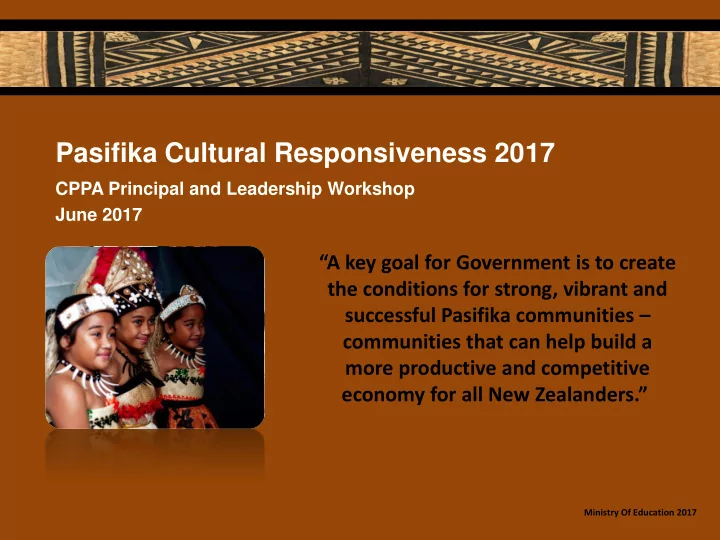
“A key goal for Government is to create the conditions for strong, vibrant and successful Pasifika communities – communities that can help build a more productive and competitive economy for all New Zealanders.”

Ministry Of Education 2017

slide-2
SLIDE 2
  • Develop knowledge and understanding around

Pasifika Success – Pasifika Education Plan

  • Strengthen cultural responsiveness
  • Develop strategies to support schools working with

diverse learners

slide-3
SLIDE 3

Put some

in our

slide-4
SLIDE 4

PEP EP Vision "Five out of five Pasifika learners participating, engaging, and achieving in education, secure in their identities, languages, and cultures and contributing fully to Aotearoa New Zealand’s social, cultural, and economic well being.“

Pasifika Education Plan, Ministry of Education 2013-2017

slide-5
SLIDE 5

WHAT IS THE PASIFIKA EDUCATION PLAN?

The PEP is an education strategy aimed at raising the participation, engagement, and achievement of Pasifika learners. It is based around the notion that strengthening school learners will help to strengthen communities.

slide-6
SLIDE 6

5th PEP

  • 2001 - 2005
  • 2006 – 2010
  • 2008 – 2012
  • 2009 – 2012
  • 2013 – 2017

5 KEY FOCUS AREAs

  • Parents, Families, &

Communities (PFC)

  • Early Learning
  • Schooling
  • Tertiary
  • Education Sector-wide

Ministry Of Education 2017

slide-7
SLIDE 7

Literacy and Numeracy Transitions Quality and Effective Teaching Governance and Leadership Accountability and Performance Pasifika Competencies High Expectations for Success Evidence and Data Pasifika Connectedness Location Intergenerational Identities, Languages and Cultures Multiple World Views Talanoa Ako

Reciprocal Relationships Respect Spirituality Service Belonging Leadership Love Family Inclusion Pasifika Learners, Parents, Families and Communities PASIFIKA ENGAGEMENT Personalising learning and creating successful pathways for learners across their education journeys

PASIFIKA IDENTITY LEVERS FOR CHANGE

P a s i f i k a E d u c a t i o n P l a n 2 0 1 3 – 2 0 1 7

Ministry Of Education 2017
slide-8
SLIDE 8

Ministry Of Education 2017

The PEP

  • puts Pasifika learners, their parents,

families, and communities at the centre of education decisions

  • requires all educational providers to

respond to the identities, languages, and cultures of each Pasifika group

  • acknowledges the necessity of

involving the wider community in raising achievement

slide-9
SLIDE 9

Ministry Of Education 2017

The PEP

  • will use student achievement data and

information to increase the knowledge and voice of Pasifika learners, parents, families, and communities

  • aims to achieve optimum learning by

promoting closer alignment and compatibility between the learner’s educational environment, and their home and/or cultural environment

slide-10
SLIDE 10

REGION TOTAL

POPULATION

TOTAL PASIFIKA TOTAL PASIFIKA % TOTAL

STUDENT

TOTAL PASIFIKA

STUDENTS

YEAR 0-6 PASIFIKA STUDENTS

CHRISTCHURCH

436,056

10,881

2.6% 57,800

2836 1666

ASHBURTON

31,041

1,055

3.4% 5200

326 235

TIMARU

43,929

483

1.1% 7700

148 90

slide-11
SLIDE 11
slide-12
SLIDE 12

Pacific Island/Nation Cook Islands Fiji Kiribati Niue Papua New Guinea Samoa Solomon Islands Tokelau Tonga Tuvalu Greeting Kia Orana Bula vinaka Mauri Fakaalofa lahi atu Gude (goo-DAY) Tālofa lava Halo oloketa Talofa ni Mālō e lēlei Fakatalofa atu Thank you Meitaki maata Vinaka vaka levu Ko rab’a Fakaaue lahi Tenkyu Fa’afetai lava Tank iu Fakafetai lahi lele Mālō ‘aupito Fakafetai lasi

slide-13
SLIDE 13
slide-14
SLIDE 14
slide-15
SLIDE 15

Culture is...

...the way of life of a discrete group, which includes a language, a body of accumulated knowledge, skills, beliefs and values...central to the understanding of human relationships and...that members of different cultural groups have unique systems of perceiving and organising the world around them...the ways in which we have been socialised largely influence our behaviour and way of thinking as our world view.

[Helu-Thaman, 1998]

slide-16
SLIDE 16

Cultural Definitions

Cultural awareness is about being aware that there are different cultures whose ways of interacting with others may differ from our

  • wn ways

Cultural responsiveness is placing the needs of the child/family we are working with at the centre of decision making – identifying and working with the child/family’s strengths to promote positive

  • utcomes

Cultural safety is about the child/family who is receiving services and/or support feeling valued, listened to and respected by those working with them

slide-17
SLIDE 17

Cultural Awareness Continuum Parochial stage: My way is the only way Ethnocentric stage: I know their way, but my way is better Synergistic stage: My way and their way Participatory Third Culture stage: Our way

Adapted from Stephanie Quappe & Giovanna Cantatore

slide-18
SLIDE 18
slide-19
SLIDE 19
slide-20
SLIDE 20

In order to teach you, I must know you

Each person brings their own culturally generated tradition in interactions with others and for many this function occurs unconsciously. In our NZ setting the dominant cultural discourse is a Eurocentric world view.

[Allen, Taleni, Robertson, 2008]

slide-21
SLIDE 21

What is important is the relationship educators have with the child, parents and families; how they relate to and interact with them has an impact on engagement and increases the likelihood of an intervention being successful.

[Bishop et al., 2002]

slide-22
SLIDE 22

Is our Pasifika community engaged? What is our Pasifika student data telling us? How do we ensure key messages about learning and achievement is understood by our Pasifika learner, parents, and community? How do we build/strengthen relationships with Pasifika NGO agencies to support our work? How does our school l poli lices, system ems and processes support diverse rse lear arne ners rs?

slide-23
SLIDE 23

Pasifika Power Up Plus programme NZEI Teacher Workshops – Carrying the Tapa & Koko Time School based Pasifika Talanoa / Fono NZQA’s NCEA ma le Pasifika Workshops Samoan Language Resource Teacher ESOL Bilingual Assessment Tool & TA PLD course

slide-24
SLIDE 24

https://www.educationcounts.govt.nz/publications/pa sifika http://www.tka.nz/teketearonui/Event_catalogu e/Carrying_the_Tapa.aspx http://www.ptap.ac.nz/ https://www.educationcounts.govt.nz/topics/bes/develo ping-mathematical-inquiry/14-culturally-responsive- pedagogy Health Service Providers in Canterbury Etu Pasifika – 173 Montreal St, 365 1002 Vaka Tautua – 105 Bamford St, 376 4677 http://www.vakatautua.co.nz/

slide-25
SLIDE 25

“The culture of the child can not enter the classroom until it has first entered the consciousness of the teacher.” Basil Bernstein

slide-26
SLIDE 26