Partners With Business Partners With Business Overview PWB - - PDF document

partners with business
SMART_READER_LITE
LIVE PREVIEW

Partners With Business Partners With Business Overview PWB - - PDF document

12/17/15 Collaborating to Enhance Employment Outcomes for Transition Age Youth: Partners With Business Partners With Business Overview PWB maximizes integration and minimizes cost by capitalizing on strong natural supports available to


slide-1
SLIDE 1

12/17/15 1

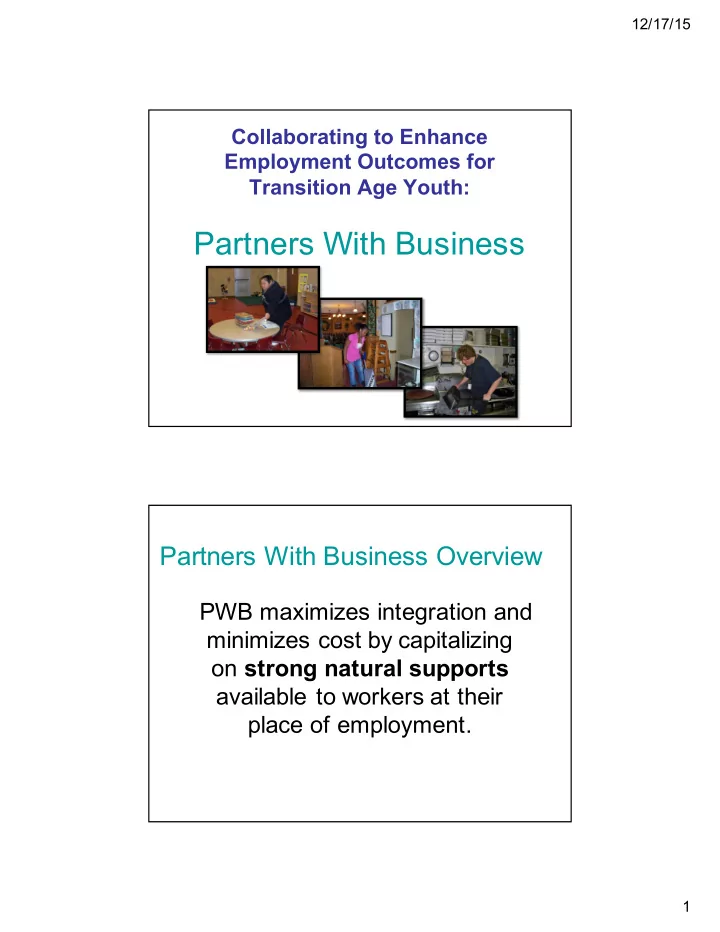
Collaborating to Enhance Employment Outcomes for Transition Age Youth:

Partners With Business

Partners With Business Overview

PWB maximizes integration and minimizes cost by capitalizing

  • n strong natural supports

available to workers at their place of employment.

slide-2
SLIDE 2

12/17/15 2

Who were the partners in the development of this model:

  • Dane County High Schools
  • Dane County Dept. of Human Services
  • Division of Voc. Rehabilitation (DVR)
  • Local Businesses
slide-3
SLIDE 3

12/17/15 3

Identifying our Common Values

What is our goal for individuals with disabilities and work?

  • Highest level of independence possible.
  • Highest level of community integration possible.
  • Least dependence upon ‘unnatural supports’ possible.

Two benefits of PWB:

  • Responsive to businesses’ needs
  • Highly cost effective

Pick a student to think about throughout this training.

slide-4
SLIDE 4

12/17/15 4

Natural Supports Path

The employer provides all natural supports to the employee while accessing a Partners with Business vocational provider for back-up as needed.

Natural Supports Plus Path

The employer will be paid (reimbursement for time) to provide the needed supplemental assistance traditionally provided by the vocational provider. This path includes a higher level of responsibility and accountability for the employer. A vocational provider will be recommended to provide regular back up assistance as needed by the employer.

slide-5
SLIDE 5

12/17/15 5

So PWB is only for ‘really capable’ individuals, right?

  • Wrong! Individuals of all ability levels can be

good candidates for PWB.

  • Side-by-side work routines can allow for more

prompting/cueing for individuals who need it.

  • Adaptive tools such as visual checklists can

hugely increase an individual's independence.

Real life PWB examples, anyone?

slide-6
SLIDE 6

12/17/15 6

Partners with Business: Step 1

Thorough Knowledge of Student and Business Environment

Student/Business Environment Criteria:

  • Can there be regular, consistent communication between

employee, employer and the follow along vocational support provider?

  • Are team members on board to help with logistical support of

employee such as transportation, attendance, work clothing and hygiene, etc.?

  • Is the employer willing to hire employee on a long term

basis, paying competitive wage?

  • Can the employee readily access identified staff to get

support or is there a support plan in place for employee to access?

slide-7
SLIDE 7

12/17/15 7

Partners with Business: Step 2

Thorough Knowledge of Student and Business Environment Support Analysis and Systematic Instruction

Remember the PWB Goal:

  • Highest level of independence possible.
  • Highest level of community integration possible.
  • Least dependence upon ‘unnatural supports’

possible. And/Or

  • To help our students/clients achieve the highest

level of independence possible in their lives and at their jobs.

  • To teach our students/clients how to

appropriately interact in all social situations, but specifically at their jobs.

slide-8
SLIDE 8

12/17/15 8

Support Analysis and Systematic Instruction

  • - Why do we spend the time?

1. Consistency with your own methods. 2. Job Coaches are given a very specific protocol to follow, keeping enabling behaviors to a minimum & consistency to a maximum. 3. Substitutions and changes in the schedule or personnel don’t affect the employee since their routine/support will not change. 4. Objective measure to base decisions about fading support and to see where you need to address/correct training or protocol.

Why do we spend the time? (continued)

  • 5. Writing the SA forces you to reflect upon

what you are setting up.

  • 6. You can spot patterns & barriers.
  • 7. You can target and chart specific

skills/behaviors.

  • 8. Upon exit into the adult support system or

PWB natural supports, documentation (of support needs) & protocols will exist to help ensure the employee’s continued success.

slide-9
SLIDE 9

12/17/15 9

The Simplest Rating Scale

  • Scale: I = Indirect Prompt

D – Direct Prompt

  • Once initial job training is done (first couple
  • f weeks) the direct prompts should

decrease dramatically and the indirect ones should be prevalent.

  • Indirect Prompt – “What do you do next?”
  • Direct Prompt – “Now you wipe the edges.”

Why Indirect rather than direct?

Indirect Prompts

  • Help prompt recall
  • Help create

memory paths in the brain

  • Are easier to fade
  • Are less enabling
  • Promotes

pride/competency Direct Prompts

  • Gives the answer
  • Enables passive

behaviors

  • Harder to fade
  • Employee keeps

looking to you rather than to self for direction.

slide-10
SLIDE 10

12/17/15 10

Staff: Anna Halverson

Date: 9/7 Date: 11/12 Date: 12/16

Task I D M I D M I D M Comments Retrieve cleaning materials I 4 I 3 I 3

12/16- still needs a prompt to get started

Walk to break room I I

  • I
  • 9/7- sometimes gets distracted by the
  • ther rooms on the way to the break

room

Look at task list I

  • I
  • Wipe table

5 5 6 Look at task list I I

  • I
  • I
  • Wipe down chairs

7 7 10

12/16- took longer because he did a more thorough job cleaning

Look at task list I

  • I
  • Wipe down sink

6 5 7

SA Example

Partners with Business: Step 3

Thorough Knowledge of Student and Business Environment Support Assessment and Systematic Instruction Building Co- Worker/Employer Supports

slide-11
SLIDE 11

12/17/15 11

Building Supports

  • educating coworkers
  • identifying coworkers who naturally support the

employee the most

  • developing a detailed Employee Profile
  • Establishing an Evaluation Process for the

employer/employee

  • Any other supports you have helped implement

at a job site that will remain when school is

  • ver?

Partners with Business Employee Profile

Purpose: To be completed by transition teacher to provide PWB employees and employers with the information necessary to ensure a successful collaboration.

Information: HR Related: Work schedule: Mon Tues Wed Thurs Fri Sat Sun Start time 8:00 8:00 8:00 Break time 10:30 10:30 10:30 Lunch time n/a n/a n/a End time 12:00 12:00 12:00 Total work hours 4 4 4 Emergency Contact: Employee name: ________________________________ Place of employment: _________________________________ Employer address: ______________________________ Employer phone: ______________________________________ Supervisor: ______________________________________ On-site contact: ________________________________________ Start date: _________________ Hourly wage: ____________________ Job title: ___________________________________ Transportation: _____________________________________________________________________________________________ Punch in/Punch out procedure: none- just check in with supervisor at start of shift Frequency of paycheck: 15th and last day of month How employee receives paycheck: direct deposit HR contact information: Rose Williams at (xxx) xxx-xxxx Time-off procedure: submit request a week in advance for anticipated absences, call supervisor when sick or other unanticipated absences Dress code: black pants and any company t-shirt Employee benefits/discounts: one free meal during all 4+ hour shifts First emergency contact: _________________________ Relationship: _________________________ Home/Cell Phone: ______________________________ Work phone: __________________________ First emergency contact: _________________________ Relationship: _________________________ Home/Cell Phone: ______________________________ Work phone: _________________________

slide-12
SLIDE 12

12/17/15 12

Partners with Business Employee Profile Job Supervision and Support Plan Please include 1) job tasks and responsibilities, 2) what tasks require support, 3) who will be providing the support, and 4) when and how the support will be provided: Job responsibilities:

  • Wash dishes
  • Get full bus tubs and brings them to dish area
  • Collect and takes out garbage
  • Put dishes away
  • Keep dish area clean
  • Be on time for work
  • Be a good coworker

Support required:

  • At beginning of each shift, K. needs to be told the expectations of the day (10 minutes,

daily)

  • Gabriela or Joe will check in halfway through each shit to see if K. needs help or has any
  • questions. Will redirect if needed. (10 minutes, daily)
  • Gabriela or Joe will check in at the end of each shift to tell him to finish up soon, clean the

dish area, and take out the garbage. They will help with the dishes if he is behind (organize dishes to be washed/put clean dishes away (10 minutes, daily).

  • Jim, the general manager, checks in to see how K. is doing and if he has any questions or

concerns (15 minutes, weekly).

  • Jim calls K’s guardian, John, once a week to check in with him about any issues he is having

at work, home or with transportation. Knowing that this communication occurs helps K stay out of trouble. He’s extremely vulnerable to peer pressure from gang members and knowing that his time must be accounted for keeps him from making bad decisions. (15 minutes, weekly)

  • Currently, K’s case manager is stopping in once a week for an unseen spot check. He

checks in with Jim and staff about any work issues, and then communicates how K is doing at home. When this is in place, K does very well and is very responsible and independent.

  • Support Plan and Notes

section of Employee Profile- most important part!

  • Will be individualized based
  • n employee
  • Keep language employer

friendly (avoid terms like “Behavior Plan”)

  • Include anything that the

employer needs to know about the employee

Partners with Business Employee Profile Notes Learning style: If K needs to learn a new task, he seems to learn best if he is able to watch someone else complete the task a few times. Sometimes K will say that he knows how to do something even if he doesn’t. It is best to observe K completing a new task a few times before assuming that he is independent. Additional information: School staff have observed that every year around the holiday season, K appears to be slightly depressed. He completes his tasks slower than usual and might need some extra encouragement. He has always snapped out of this on his own, and it probably related to past life events. School staff report that it seems to help if they say hi and check-in with him around this time of the year a little more than usual. They also want to make sure that employers

  • r vocational agencies going forward know that this happens so that they do not worry too much

about it. By January, K is usually back to normal.

Tips for teachers: The notes section of support plan should include anything about the employee that the business should know, including, but not limited to, assistive technology needed, communication style, learning style, visual prompts in place, how to introduce new tasks, how to provide feedback, support strategies, maintenance of any materials (visual prompts, AT, etc.), and protocol for check-ins with vocational agency. The support plan should be individualized based on the employee’s

  • needs. Please attach more pages if necessary.
slide-13
SLIDE 13

12/17/15 13

Partners with Business Evaluation Process

* If the business has another method or form for evaluation, they should feel free to use that. This form should be used as needed.

Purpose: To assess the employee’s progress and needs at work during the final year of school. Directions: Please have the employer, supervisor, or coworker complete the form three times throughout the year if possible—one at the beginning of the year, one in the middle, and one at the end.* Name of employee: _________________________________________ Name and job title of evaluator: _______________________________ Name of business: __________________________________________ Date of evaluation: _________________________________________ 1= Unacceptable, 2 = Poor, 3 = Needs work, 4 = acceptable, 5 = Exemplary Interpersonal Behavior 1 2 3 4 5 Toward Coworkers Toward Management Toward Customers (if applicable) Job Performance 1 2 3 4 5 Speed Accuracy Endurance Work Skills 1 2 3 4 5 Requests time off appropriately Punctuality Attitude Appearance Professionalism Reliability

  • 1. Are there any areas that the employee should work on?

Partners with Business Evaluation Process

* If the business has another method or form for evaluation, they should feel free to use that. This form should be used as needed.

  • 2. Do you think that the employee is able to take on more tasks within their scheduled

hours?

  • 3. Is there a possibility of the employee increasing his/her hours?
  • 4. Are there any other supports, tools, or strategies needed to help the employee be as

independent as possible?

  • 5. Are there any changes to be made by the vocational agency supporting the student that

you would like to see? (i.e., more communication, more/less support for employee, etc.)

slide-14
SLIDE 14

12/17/15 14

Partners with Business Teacher Checklist

Purpose: After identifying as student as a potential Partners with Business candidate, this list can guide transition teachers through the PWB process. The order of items in the checklist will change depending on the situation. For example, a teacher might choose to complete the Support Analysis in order to gauge student independence BEFORE approaching the business about the PWB model.

Teacher Checklist:

  • Talk to student’s team, including the county Transition Coordinator (from FSRC, PCS, UCP,
  • r Dane County), about PWB as a possibility. Invite Anna Halverson if the team needs more

information about PWB. Remember, PWB is not only for the most typically “capable”

  • students. The right job match might mean a student of any ability could participate in PWB.
  • Identify barriers that might prevent the student from being successful within a PWB model of

support.

  • Talk to employer about PWB when the time is right (use PWB Brochure, and feel free to

invite Anna Halverson)

  • Complete the Support Analysis process to determine which tasks require what type of

prompts and how often the prompts occur; most helpful to complete the SA three times on three different dates; can use same form to ensure reliability among school staff

  • Have a supervisor or coworker complete Employee Evaluation OR their own version of an

evaluation or check-in toward the beginning of the student’s employment (while school supports are still in place). This should occur again in the middle and the end of the year.

  • Develop the Employee Profile, which includes the Job Supervision and Support Plan. In the

Support Plan, be sure to include all information that would be helpful for the employer to

  • know. The support plan should be individualized based on the employee’s needs. Avoid

special education jargon or language that might be stigmatizing like “behavioral supports” and “intervention.” Keep the language employer-friendly. The notes section should include (but should not be limited by) the following information, if applicable:

  • Assistive Technology
  • visual prompts necessary
  • communication style
  • learning style
  • best way to introduce new tasks (e.g., give warning the day before,

model, give written directions, etc.)

  • best way to provide feedback
  • support strategies for behaviors that might occur
  • maintenance of any materials (e.g., visual prompts, AT, etc.)
  • protocol for communication with vocational agency
  • Once a vocational agency is in place, gather the PWB Letter to Employers from the county.

Contact Anna Halverson if you do not receive this.

  • Schedule a meeting in the spring with the transition teacher, the student, the student’s parents
  • r guardians, the employer, the vocational agency and the county transition coordinator.

Together, review and edit the Employee Profile.

  • Contact Anna Halverson, PWB consultant for Dane County, if you encounter problems or

have questions about this process: annah@pcsdane.org and (608) 630-9084.

Brief Activity

Think about a student who you think might possibly be a good candidate for PWB, but you’re not sure yet. Write down three challenges that you think might come up as you implement the PWB model of support.

slide-15
SLIDE 15

12/17/15 15

Contact Information:

Anna Halverson Progressive Community Services (608) 630-9084 annah@pcsdane.org Hedy Burke Madison East High School (608) 622-9007 haburke@madison.k12.wi.us Doug Hunt Dane County Department of Human Services (608) 242-6358 Hunt.douglas@co.dane.wi.us