
SLIDE 1
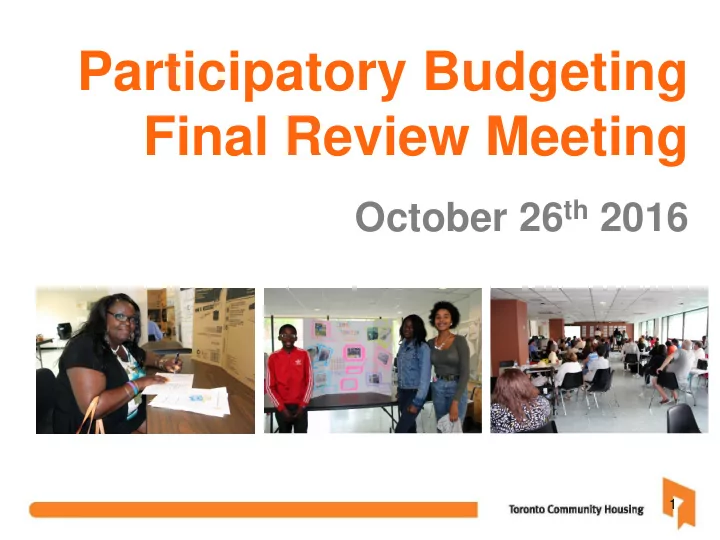
Participatory Budgeting Final Review Meeting
October 26th 2016
Presentation date
1
Participatory Budgeting Final Review Meeting October 26 th 2016 - - PowerPoint PPT Presentation
Participatory Budgeting Final Review Meeting October 26 th 2016 Presentation date 1 Todays Agenda Point Three 1. Welcome 2. Presentation: - Consultation Results - What we heard - What we plan to report to the Board 3. Discussion,
Presentation date
1
2
3
4
5
…For your time
…For your feedback …For working together on solutions
6
Key Themes Consolidated 6 Action Plans & Tenant Proposals Raw Feedback on PB
Solutions What we don’t like What we like
1. Tenant empowerment (involvement and engagement) in decisions from beginning to end 2. TCHC communities get to think and talk about their needs with staff and each-
3. Fairness for tenants through the democratic process (working together to make decisions) 4. Positive interactions with staff who are knowledgeable 1. Better Communications
(drawings, renderings etc.)
the process
process
tenants during construction
communities
available to tenants
scoping info)
funds
1. PB monitoring committees not communicating/meeting their purpose 2. Not enough tenant control at the local level 3. Not enough tenant participation at building-level meetings 4. The process by which tenants choose projects 5. Voting is not fair to tenants 6. Scoping and pricing of projects is often incorrect, and it is inefficient 7. Not enough transparency when communicating project information to tenants
8
3 focus areas for further work
Communications Process Engagement
involvement, the better
throughout the process
around building issues
together
responsibilities (of staff, tenants)
successful
accountability for projects and the work
to learn from: tenant councils, use of space funds etc.
education about PB
participants & new staff
during the entire life of projects
required changes, sign-
processes related to capital projects
9
current process. Staff and tenants will work together to develop new and improved tenant decision-making (‘TDM’) models.
identified as the most important – engagement, process, communications. These are the focus areas for an improved process for tenant decision- making on TCHC budgets.
action plans and proposals for how to design an improved process. These action plans provide staff with an understanding of the types of things tenants want to see in an improved process.
10
pilot a tenant decision-making process specific to the Capital Repair Plan.
Examples of the capital repair plan: Fobs, Lobby upgrades, Repair of damaged interiors, Flooring, Driveway paving, Garbage enclosures , Playgrounds, Steps/sidewalks, Roof replacements, Window Replacement, Boilers etc.
tenant-led decision-making process specific to community-based projects.
This process should be complementary to what is being developed through the tenant engagement system refresh The proposed models and action plans tenants worked on will be analyzed as part
Examples of “community-based projects”: Furniture/Benches, Plants and Gardening, Bike Racks, Library Furniture and Books, Blinds, Fitness Equipment, Recreation Room Furniture etc.
11
12
(tenant decision-making) processes
Please fill out our questionnaire to provide feedback
13
14