Participatory Action Research Dissertation Community College - - PowerPoint PPT Presentation

participatory action research dissertation
SMART_READER_LITE
LIVE PREVIEW

Participatory Action Research Dissertation Community College - - PowerPoint PPT Presentation

Participatory Action Research Dissertation Community College Non-Completion: The Missing Voices of Marginalized Students in Improvement Efforts Massasoit Community College Student Co-researchers: Antazia Dash, Schimid Edmond, Ridge


slide-1
SLIDE 1

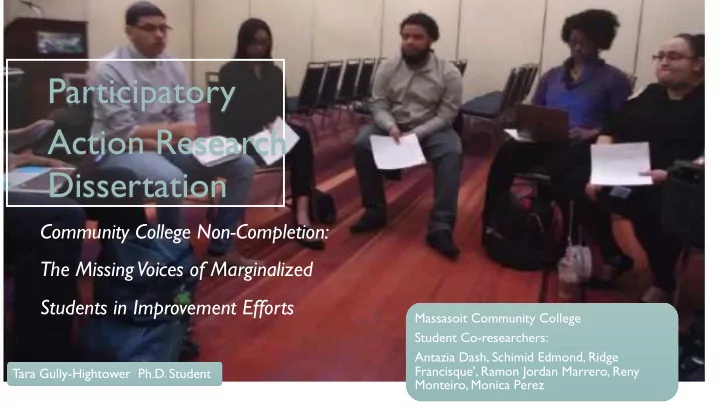
Participatory Action Research Dissertation

Community College Non-Completion: The Missing Voices of Marginalized Students in Improvement Efforts

Massasoit Community College Student Co-researchers: Antazia Dash, Schimid Edmond, Ridge Francisque', Ramon Jordan Marrero, Reny Monteiro, Monica Perez Tara Gully-Hightower Ph.D. Student

slide-2
SLIDE 2

CRITICAL THEORETICAL FRAMEWORKS INFORMING THIS PROJECT

slide-3
SLIDE 3

Cycles of PAR Identify the issues; gather data; analyze data; plan & take action; reflect on action ; repeat the process

slide-4
SLIDE 4

Identify issues – embodiment theory and identification of stress in student’s bodies Research: What causes stress-the relationship between stress and sleep? Collect data on what students do currently to relieve stress & Students’ suggestions for relieving stress Student suggestions for how the institution can help relieve stress on campus Suggestion of mentoring program as a more long-term way for future students to be able to attend college and experience less stress

Share findings Share findings

slide-5
SLIDE 5

Cycle One: Where do you feel your experiences

  • f being on

campus in your body?

slide-6
SLIDE 6

Sharing Embodiment Data with the Community

slide-7
SLIDE 7

STUDENT RESEARCHERS COLLECTED DATA FROM OTHER STUDENTS ON CAMPUS “IDEAS TO HELP STUDENTS STRESS AT MASSASOIT?”

slide-8
SLIDE 8

STUDENT-GENERATED THEMATIC CODES & C ATEGORIES FOR SURVEY RESULTS ON HELPING REDUCE STUDENTS’ STRESS WHILE THEY ARE ON C AMPUS

slide-9
SLIDE 9

1) WHEN DATA IS RE-GROUPED INTO C ATEGORIES RELATED TO EXISTING INSTITUTIONAL STRUCTURE CHANGES & STUDENTS’ DESIRE FOR ADDITION AL SUPPORT ON C AMPUS (NON-AC ADEMIC) 2) “A PLACE FOR….” OR “SPACE FOR” WERE PHRASES REPEATED 43 TIMES IN THE DATA 3) A C ALL FOR “HEALING” AND/OR “SUPPORT” WERE MENTIONED 57 TIMES.

Moments

slide-10
SLIDE 10
  • ‘Puppy room”

A need for play and simple joy of experience” A desire to cuddle small fuzzy animals Participant conveys that they need love and companion ship to reduce stress Not enough nice bonding

  • pportunities on campus.

“Students do not have dorms” Feeling of lacking Understanding that they are different than students at colleges with dorms-but frustration that the schedule and practices at the college are following a structure that does not fit with their circumstances Participant conveys partial recognition that current system around tardiness and the class schedules are based

  • n “norms” that do not fit the

current student body. Structures do not serve the students best “Game room” A place to play does not exist Play and movement are needs that are not currently being met “Gym/pool accessibility” Need for physical movement not met by the college facilities” Physical activity and learning and stress reduction are linked No space/schedule practices that fit…. college not serving everyone’s needs “comfy chairs in classrooms” Physical needs in classrooms not met Physically not comfortable in classes Physical needs not being met “Dance hall in the student center” Participant conveys a desire to dance Movement, play self-expression are lacking Movement, play self-expression are lacking

Significant Statements (Emic) Emerging Themes (Emic/Etic) Critical Theory (Etic) Axial Codes (Etic)

A NEED FOR “A PLACE”

  • r ”SPACE”

Mentioned 42 times in the survey responses
slide-11
SLIDE 11

MOST RECENT ACTION

PAR Student Mentorship Mission

To Improve campus experience for students and Inspire others through Dedicated guidance to Be motivational, Make changes and Interrupt stereo- types Value Statement

Values: Our Behavior: Community Education Youth Help everyone Honesty Openness Genuine Positive Understanding Good listeners

Our Uniqueness:

Engaging with peers Presentations! “student oriented” Reaching the Unreachable

Resources:

Trio

slide-12
SLIDE 12

STUDENTS PRESENT AT AERA 2019

MCCPAR.COM

“We went from listening to authority to becoming the authority”

  • Ridge Francisque'
slide-13
SLIDE 13

REFERENCES

Foucault, M. 1977. Discipline and punish: The birth of the prison. New York: Vintage Freire, P . (1970). Pedagogy of the oppressed (M. Bergman Romas Trans.). New York: Bloomsbury Publishing. Krueger-Henney, P . (2016). What are we listening for? (participatory action) research and embodied social listening to the permanence of anti-black racism in education.The International Journal of Critical Pedagogy, 7(3). Ladson-Billings, G. (1998). Just what is critical race theory and what's it doing in a nice field like education? International Journal of Qualitative Studies in Education, 11(1), 7-24. Patel, L. (2015). Decolonizing educational research: From ownership to answerability. Routledge. Ruglis, J. (2011). Mapping the biopolitics of school dropout and youth resistance. International Journal of Qualitative Studies in Education, 24(5), 627-637. Tuck, E. (2009). Suspending damage: A letter to communities. Harvard Educational Review, 79(3), 409-428.