Parks & Benefits Sustainable Tourism in protected areas of the - - PowerPoint PPT Presentation

parks benefits
SMART_READER_LITE
LIVE PREVIEW

Parks & Benefits Sustainable Tourism in protected areas of the - - PowerPoint PPT Presentation

PARKS & BENEFITS Parks & Benefits Sustainable Tourism in protected areas of the Baltic Sea Region Presentation at Enter Conference, Graz, October 2nd, 2014 by: Martin Kaiser, Mritz National Park authority (DE) Part rt-fi financed ed


slide-1
SLIDE 1

Part rt-fi financed ed by the Europe ropean Union (Euro ropean Regional Deve velopment ent Fund)

PARKS & BENEFITS

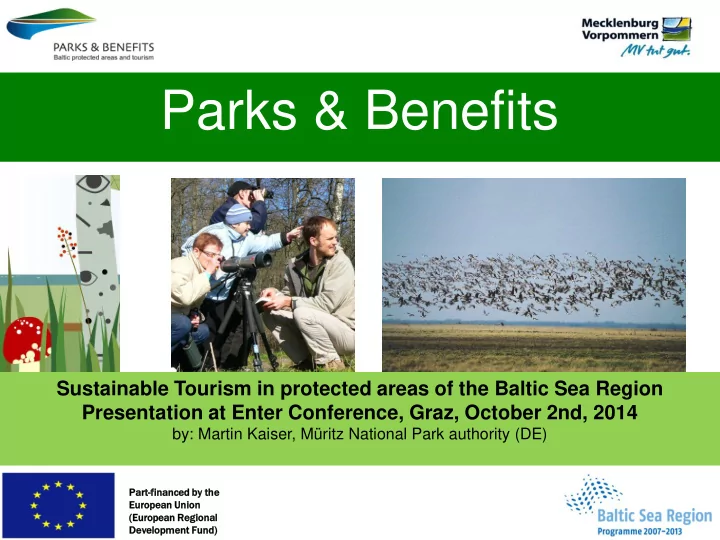
Sustainable Tourism in protected areas of the Baltic Sea Region Presentation at Enter Conference, Graz, October 2nd, 2014

by: Martin Kaiser, Müritz National Park authority (DE)

Parks & Benefits

slide-2
SLIDE 2

Part-fi financ nanced by the European an Union n (Europ

  • pean

an Regional

  • nal

Develop

  • pme

ment nt Fund

Content of the presentation

  • 1. The project in general (structure, objectives, the European Charter)
  • 2. More important project issues & results:
  • Carrying capacity
  • Target groups
  • Marketing nature tourism in the BSR: brands, labels etc.
  • Benefit monitor
  • Investments
  • 3. Summing up
slide-3
SLIDE 3

The project in general: structure

National nal and regional al authori riti ties es Tourism sm associations ations NGOs Univer ersi siti ties es 18 Pa Partner ners fro rom 6 countries es in the Baltic Sea Region n (BSR): : Germany, Denmark, Estonia, Latvia, Lithuania, Norway amongst them: 8 la large pro rotected ed areas

Part-fi financ nanced by the European an Union n (Europ

  • pean

an Regional

  • nal

Develop

  • pme

ment nt Fund

Pro roject ct time: e: Februar uary y 2009 – Januar ary 2012 Budge get: : 2,68 Mio € tot

  • tal (incl. ERDF + No

Norwe wegi gian an Fund) d) 4 wo work rk package kages

slide-4
SLIDE 4

The project in general: objectives

Linking nature conservation with sustainable regional development

Involvement of regional stakehol- ders into protected area‘s regional develepment >> Public-Private- Partnerships

 Implementing the „European

Charter for Sustainable Tourism in Protected Areas“ on Park level

Creating a network of „BSR Charter Parks“

Strengthening awareness & support for Protected Areas

slide-5
SLIDE 5

The European Charter for sustainable tourism in protected areas

+ was established by the Europarc Federation – the European umbrella

  • rganisation for protected areas in 2001

+ is a practical management tool for ensuring that tourism contributes to a balanced economic, social and environmental development of protected areas in Europe. + is a voluntary agreement and aims to encourage good practice by recognising protected areas, which are meeting agreed requirements for the sustainable development and management of tourism + consists of three parts with focus on the protected areas (I), regional tourism busi- nesses (II) and tour operators (III) + is a network of 119 protected areas in 13 countries

slide-6
SLIDE 6

Theme: Carrying capacity

… by a region / protected area without causing damages?

core business of Protected Areas is nature conservation

when working with tourism: keep the balance !

identify existing and potential conflicts

analyse carrying capacity

find consens and take decisions

  • n standars/indicators (zonation,

limitation of visitor numbers, etc.)

l 

put appropriate management in place How many tourists can be carried …

slide-7
SLIDE 7

Theme: Carrying capacity – project results

exchange of experiences how to manage visitors in hot-spots: best-practices

 discussion of indicators 

analysis of the carrying capacity situation in parks

  • f the BSR, focusing on:

l carrying capacity problems l measurement methods l how to use it as management tool 

study „Conditions for the management of carrying capacity in the parks of Parks&Benefits ” (Roskilde University)

slide-8
SLIDE 8

Theme: Target groups analysis for Nature tourism in the Baltic Sea Region

 target groups by

themes

 Birding  Hikers  target groups by

countries of origin:

Germans

 British and Irish  Dutch  target groups by

demographic information

 Generation 50+  Families

…. German hikers spend in average 3 € per Walking km for their hobby: 0,84 € for equipment, shoes and clothing 2,20 € for arrival and departure, meals, lodging and literature = 48 € for a 16km hike …"twitchers“ is a small target group of those, who travel long distances and might send a lot to see a rare bird that would then be "ticked“; Twitching is highly developed in the United Kingdom, the Netherlands, Denmark, Ireland, Finland and Sweden. Target group fact sheets for download
slide-9
SLIDE 9

Theme: Eco labels in the Baltic Sea Region

# eco labels from all project countries were collected, analysed and compared looking at their relevance for Protected areas regions # result: the establishment of a new eco-label for the Baltic Sea Region is neither desirable nor possible # nonetheless: a framework for the Protected Areas in the Baltic Sea Region and for generating a transnational regional identity was needed # a Baltic Sea Region - methodology for the Charter part II (on working with tourism businesses) was developed. # this methodology has been approved by the EUROPARC Federation in September 2011

Part rt-fi financed ed by the Europe ropean Union (Euro ropean Regional Deve velopment ent Fund)

slide-10
SLIDE 10

Theme: Eco labels in the Baltic Sea Region

Results:

Exchange of experiences on eco-labels Definition of minimum criteria, which an eco-label should cover A short guide towards certification and labelling for PA managers A simple user’s guide to ecolabels & certification for tourism businesses

slide-11
SLIDE 11

Theme: Benefit monitor

slide-12
SLIDE 12

 visitor survey: development and application of common

methodology within the Parks of the project

 visitor numbers and spendings as basis to calculate the economic

benefit for the regions

 in the case of Müritz National Park:  2004: 628 job-equivalents (survey Uni Munich)  2010: 651 job-equivalents (survey Uni Greifswald)

Theme: Benefit monitor

Part rt-fi financed ed by the Europe ropean Union (Euro ropean Regional Deve velopment ent Fund)

slide-13
SLIDE 13

Theme: Investments

 Accessibility for all  Visitor monitoring  ICT solutions and GPS systems

>> 3 joint investment plans / overview about different solutions for PAs

slide-14
SLIDE 14

Theme: Investments

Part rt-fi financed ed by the Europe ropean Union (Euro ropean Regional Deve velopment ent Fund)

slide-15
SLIDE 15

Summing up and looking forward

#

Charter is implemented in the BSR # many (more) tourism stake- holders are now involved in the PA‘s work # role of PA‘s is strengthened in their regions and in the BSR # 7 out of 8 participating protected areas awarded the Charter certificate # Follow-up project in BSR in new EU funding period is not likely

>> get your guide to sustainable tourism in PAs

  • incl. all project issues
slide-16
SLIDE 16

Part rt-fi financed ed by the Europe ropean Union (Euro ropean Regional Deve velopment ent Fund)

„PARKS & BENEFITS“:

Here you can find us:

www.parksandbenefits.net

slide-17
SLIDE 17

Finally … Thank you for your attention!