PANEL 4.1: Challenges and opportunities for the promotion of nuclear - - PowerPoint PPT Presentation

panel 4 1 challenges and opportunities for the promotion
SMART_READER_LITE
LIVE PREVIEW

PANEL 4.1: Challenges and opportunities for the promotion of nuclear - - PowerPoint PPT Presentation

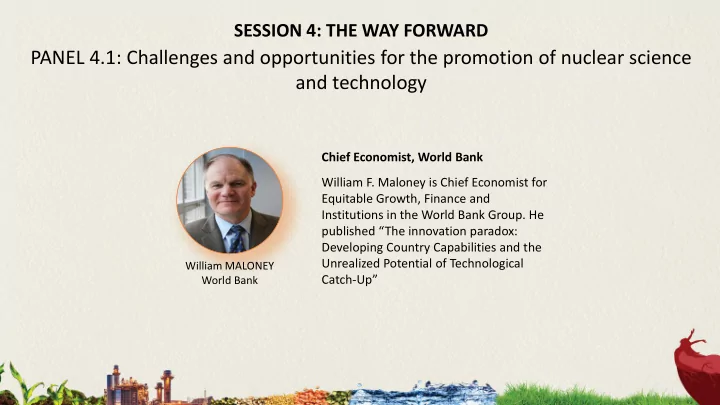
SESSION 4: THE WAY FORWARD PANEL 4.1: Challenges and opportunities for the promotion of nuclear science and technology Chief Economist, World Bank William F. Maloney is Chief Economist for Equitable Growth, Finance and Institutions in the


slide-1
SLIDE 1

PANEL 4.1: Challenges and opportunities for the promotion of nuclear science and technology

SESSION 4: THE WAY FORWARD

William MALONEY World Bank

Chief Economist, World Bank William F. Maloney is Chief Economist for Equitable Growth, Finance and Institutions in the World Bank Group. He published “The innovation paradox: Developing Country Capabilities and the Unrealized Potential of Technological Catch-Up”

slide-2
SLIDE 2

The Innovation Paradox

The Unrealized Promise of Technological Catch-Up

Xavier Cirera William F. Maloney World Bank Vienna, November 2018

The Productivity Project: www.worldbank.org/productivity

slide-3
SLIDE 3

Returns to innovation and adoption rise steeply with distance from the technological frontier

  • Dist. to Frontier Rate of Return to R&D

 USA

  • .18

57%  UK

  • .53

77%  Italy

  • .73

88% Korea

  • 1.33

? Malaysia

  • 2.28

? 200-300? Indonesia

  • 3.74

? Africa ~-5.0 ???

Griffith, Redding, Van Reenen (2004)

Joseph Schumpeter, 1883-1950

slide-4
SLIDE 4

But developing countries do little licensing of foreign technologies…

slide-5
SLIDE 5

And do little of the necessary accompanying R&D

slide-6
SLIDE 6

Maybe they don’t expect high rates of return

Returns to R&D vs. Distance to Frontier

slide-7
SLIDE 7

Technological Capabilities are Critical for Adoption of New Technologies

slide-8
SLIDE 8

Management capabilities: Firms don’t know what they don’t know…..

8

slide-9
SLIDE 9

Pasteur: “Fortune favors the prepared mind” (and prepared countries))

The Productivity Project: www.worldbank.org/productivity