Pandoras Box Problem Introduced by Weitzman (1979), models the cost - - PowerPoint PPT Presentation

pandora s box problem
SMART_READER_LITE
LIVE PREVIEW

Pandoras Box Problem Introduced by Weitzman (1979), models the cost - - PowerPoint PPT Presentation

Pandoras Box Problem Introduced by Weitzman (1979), models the cost of information C c 1 C c 2 n boxes, b 1 , b 2 , . . . , b n , labeled with costs c i and A A X 2 independent reward distributions D i . b 1 b 2 D 1 Pay c i to


slide-1
SLIDE 1

Pandora’s Box Problem

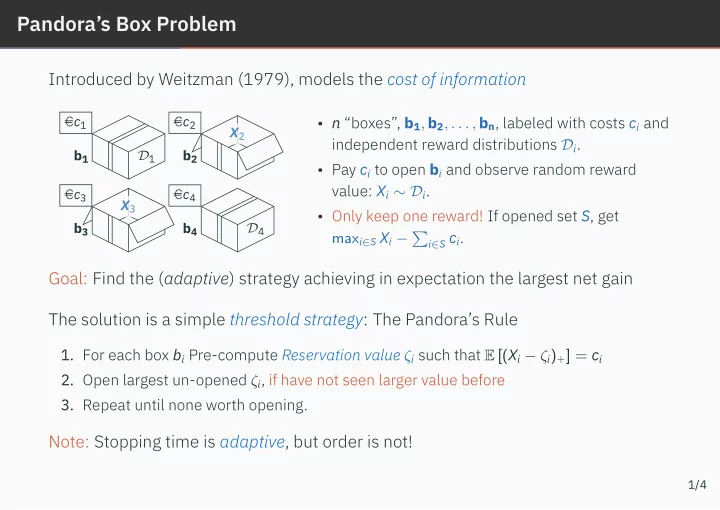
Introduced by Weitzman (1979), models the cost of information

D1 A Cc1 b1 X2 A Cc2 b2 X3 A Cc3 b3 D4 A Cc4 b4

  • n “boxes”, b1, b2, . . . , bn, labeled with costs ci and

independent reward distributions Di.

  • Pay ci to open bi and observe random reward

value: Xi ∼ Di.

  • Only keep one reward! If opened set S, get

maxi∈S Xi −

i∈S ci.

Goal: Find the (adaptive) strategy achieving in expectation the largest net gain The solution is a simple threshold strategy: The Pandora’s Rule

  • 1. For each box bi Pre-compute Reservation value ζi such that E [(Xi − ζi)+] = ci
  • 2. Open largest un-opened ζi, if have not seen larger value before
  • 3. Repeat until none worth opening.

Note: Stopping time is adaptive, but order is not!

1/4

slide-2
SLIDE 2

Pandora’s Box with Order Constraints

This work “Pandora’s Box Problem with Order Constraints”

by Shant Boodaghians1, Federico Fusco2, Philip Lazos2, Stefano Leonardi2

Order Constraints: Modeled by a directed acyclic graph G

  • Models dependencies in information, e.g. stages of medical trials.
  • Can only open box after opening some parent
  • Forces going through high-cost to get high-reward, risky

Our Results: general DAGs

  • In general, no fixed-order strategy, hard to approximate∗.
  • We show how to build a 2-approximation∗ via “adaptivity gap” result

* Approximation model: Strategy π is β-approximation of the optimal solution π∗ if E   max

i∈S(π∗) Xi −

  • i∈S(π)

ci   ≥ E  β−1 · max

i∈S(π∗) Xi −

  • i∈S(π∗)

ci  

1 Univerisy of Illinois at Urbana-Champagne, 2 Sapienza University of Rome

2/4

slide-3
SLIDE 3

Pandora’s Box on a tree

Special Case: The graph modeling the order constraint is a rooted tree Challenges:

  • Depth The value of a box depends from the

possibilities its opening makes accessible.

  • Breath Distant directions of exploration must be

compared at every time step. Our Results: Trees and Forests

  • There exists a threshold strategy which is optimal
  • The thresholds can be computed in polynomial time and space
  • The threshold of a box depends only on the subtree of the descendants
  • The same results hold for forests

3/4

slide-4
SLIDE 4

Generalized Reservation Value

The thresholds for the optimal strategy on trees are defined similarly to the ζ of Weitzman original solution Generalized reservation value: consider the subtree of the descendants as a macro-box, whose random cost and reward are given implicitly by an optimal strategy π∗ E

  • max

j∈S(π∗) Xj − zi

  • +
  • = E

 

j∈S(π∗)

cj  

bi

Algorithmic Idea

  • Reduce trees to lines recursively: from leaves to root.
  • Interleave progressively smallest linearized branches
  • Simple dynamic programs to compute Generalized Reservation values.

4/4