SLIDE 1
1 Systems Design & Programming CMPE 310
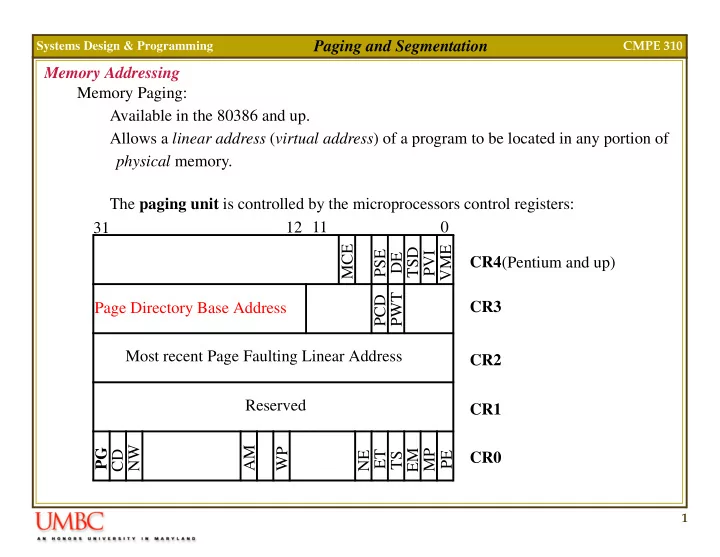
Paging and Segmentation Memory Addressing Memory Paging: Available in the 80386 and up. Allows a linear address (virtual address) of a program to be located in any portion of physical memory. The paging unit is controlled by the microprocessors control registers: 31 12 11 VME PVI TSD DE PSE MCE PWT PCD Page Directory Base Address Most recent Page Faulting Linear Address Reserved PE MP EM TS ET NE WP AM NW CD PG CR0 CR1 CR2 CR3 CR4(Pentium and up)
SLIDE 2
2 Systems Design & Programming CMPE 310
Paging and Segmentation Memory Addressing Memory Paging: The paging system operates in both real and protected mode. It is enabled by setting the PG bit to 1 (left most bit in CR0). (If set to 0, linear addresses are physical addresses). CR3 contains the page directory 'physical' base address. The value in this register is one of the few 'physical' addresses you will ever refer to in a running system. The page directory can reside at any 4K boundary since the low order 12 bits of the address are set to zero. The page directory contains 1024 directory entries of 4 bytes each. Each page directory entry addresses a page table that contains up to 1024 entries.
SLIDE 3
3 Systems Design & Programming CMPE 310
Paging and Segmentation Memory Addressing Memory Paging: The virtual address is broken into three pieces: Directory: Each page directory addresses a 4MB section of main mem. Page Table: Each page table entry addresses a 4KB section of main mem. Offset: Specifies the byte in the page. 11 12 21 22 31 Directory Page Table Offset 31 12 Physical Address Linear or Virtual Address Page Directory or Page Table Entry P W U PWT PCD A D Present Writable User defined Write through Cache disable Dirty (0 in page dir) Accessed
SLIDE 4
4 Systems Design & Programming CMPE 310
Paging and Segmentation Memory Addressing Memory Paging: 11 12 21 22 31 [00]0C [00]10 0x08A Virtual Address: CR3 00010 + + 0x00010030 0x05001 0x05000000 0x05001000 0x05001040 0x00020000 0x00021000 0x00030000 0x00030 + 0x0003008A [binary]hex 0x0301008A =0x030 *4 *4 =0x040
SLIDE 5
5 Systems Design & Programming CMPE 310
Paging and Segmentation Memory Addressing Memory Paging: The page directory is 4K bytes. Each page table is 4K bytes, and there are 1024 of them. If all 4GB of memory is paged, the overhead is 4MB! The current scheme requires three accesses to memory: One to the directory, one to the appropriate page table and (finally) one to the desired data or code item. Ouch! A Translation Look-aside Buffer (TLB) is used to cache page directory and page table entries to reduce the number of memory references. Plus the data cache is used to hold recently accessed memory blocks. System performance would be extremely bad without these features. Much more on this in OS (CMSC 421). Paging and Segmentation: These two addresses translation mechanism are typically combined.
SLIDE 6
6 Systems Design & Programming CMPE 310
Paging and Segmentation Segmentation and the User Application The application programmer loads segment register values as before in Real Mode, but the values that he/she puts in them are very different. Since knowledge of the GDT and LDT is not generally available at compile time, the programmer must use symbolic names. The loader is responsible for resolving the actual values at run time. In general, the segment values are 16-bit tags for the address spaces of the program. Instructions such as LDS (load DS), LAR (load access rights), LSL (load segment limit), VERR (verify for read) are available to retrieve descriptor attributes, if the process is privileged enough. Whenever a segment register is changed, sanity checks are performed before the descriptor is cached. The index is checked against the limit. Other checks are made depending on the segment type, e.g., data segments, DS can- not be loaded with pointers to execute-only descriptors, ... The present flag is checked. Otherwise, an exception is raised and nothing changes.
SLIDE 7
7 Systems Design & Programming CMPE 310
Paging and Segmentation Privilege Levels 0: highest privilege, 3: lowest privilege The privilege protection system plays a role for almost every instruction executed. Protection mechanisms check if the process is privileged enough to: Execute certain instructions, e.g., those that modify the Interrupt flag, alter the segmenta- tion, or affect the protection mechanism require PL 0. Reference data other than its own. References to data at higher privilege levels is not permitted. Transfer control to code other than its own. CALLs or JMPs to code with a different privilege level (higher or lower) is not permitted. Kernel (PL=0) System services (PL=1) OS extensions (PL=2) Applications (PL=3)
SLIDE 8
8 Systems Design & Programming CMPE 310
Paging and Segmentation Privilege Levels Privilege levels are assigned to segments, as we have seen, using the DPL (Descriptor Priv- ilege Level) field (bits 45 and 46). Define CPL as the Code Privilege Level of the process, which is the DPL of its code segment! Define RPL as the Requestor's Privilege Level. Privilege Level Definitions: When data selectors are loaded, the corresponding data segment's DPL is compared to the larger of your CPL or the selector's RPL. Therefore, you can use RPL to weaken your current privilege level, if you want. Segment Register, e.g. DS CS RPL CPL > of Descriptor Table EPL DPL check Exception 13 if EPL > DPL From code segment descriptor
SLIDE 9
9 Systems Design & Programming CMPE 310
Paging and Segmentation Privilege Levels CPL is defined by the descriptors, so access to them must be restricted. Privileged Instructions: Those that affect the segmentation and protection mechanisms (CPL=0 only). For example, LGDT, LTR, HLT. Those that alter the Interrupt flag (CPL <= IOPL field in EFLAGS). For example, CLI, STI (Note: only DPL 0 code can modify the IOPL fields.) Those that perform peripheral I/O (CPL <= IOPL field in EFLAGS). For example, IN, OUT. Privileged Data References: Two checks are made in this case: Trying to load the DS, ES, FS or GS register with a selector whose DPL is > the DPL of the code segment descriptor generates a general protection fault. Trying to use a data descriptor that has the proper privilege level can also be illegal, e.g. trying to write to a read-only segment. For SS, the rules are even more restrictive.
SLIDE 10
10 Systems Design & Programming CMPE 310
Paging and Segmentation Privilege Levels Privileged Code References: Transferring control to code in another segment is performed using the FAR forms of JMP, CALL and RET. These differ from intra-segment (NEAR) transfers in that they change both CS and EIP. The following checks are performed: The new selector must be a code segment (e.g. with execute attribute). CPL is set to the DPL (RPL is of no use here). The segment is present. The EIP is within the limits defined by the segment descriptor. The RPL field is always set to the CPL of the process, independent of what was actu- ally loaded. You can examine the RPL field of CS to determine your CPL.
SLIDE 11
11 Systems Design & Programming CMPE 310
Paging and Segmentation Changing CPL There are two ways to change your CPL: Conforming Code segments. Remember Types 6 and 7 defined in the AR byte of descriptor? Segments defined this way have no privilege level -- they conform to the level of the calling program. This mechanism is well suited to handle programs that share code but run at differ- ent privilege levels, e.g., shared libraries. Through special segment descriptors called Call Gates. Call Gate descriptor: Call gates act as an interface layer between code segments at different privilege levels. They define entry points in more privileged code to which control can be transferred. Destination Offset 15 39 16 40 Destination Selector (15-0) P0001100 47 Destination Offset (31-16) 63 36 000 31 32 WC
SLIDE 12 12 Systems Design & Programming CMPE 310
Paging and Segmentation Call Gates They must be referred to using FAR CALL instructions (no JMPs are allowed). Note, references to call gates are indistinguishable from other FALL CALLs in the program -- a segment and offset are still both given. However, in this case, both are ignored and the call gate data is used instead. Call Gate Mechanism: CALL seg:offset Gate Descriptor Code Descriptor Descriptor seg
DPL 0 code segment Dest Sel.
2 3 Higher privileged selector 4 + 1 Lower privileged selector ; EXTRN system:FAR ;... CALL system The linker or loader fills in the symbolic name “system” with the proper selector and an “dummy” offset. procedure code
SLIDE 13
13 Systems Design & Programming CMPE 310
Paging and Segmentation Call Gates Note that both the selector and offset are given in the call gate preventing lower privileged programs from jumping into the middle of higher privileged code. This mechanism makes the higher privileged code invisible to the caller. Call Gates have 'tolls' as well, making some or all of them inaccessible to lower privileged processes. The rule is that the Call Gate's DPL field (bits 45-46) MUST be >= (lower in privilege) than the process's CPL before the call. Moreover, the privileged code segment's DPL field MUST be <= the process's CPL before the call. Privileged Code DPL Max(RPL, CPL) Call Gate DPL ≤ ≤ PL 0 Code Gate PL 1 PL 2 PL 3 Code
SLIDE 14
14 Systems Design & Programming CMPE 310
Paging and Segmentation Call Gates Changing privilege levels requires a change in the stack as well (otherwise, the protection mechanism would be sabotaged). Stack segment DPLs MUST match the CPL of the process. This happens transparently to the program code on both sides of the call gate! Where does the new stack come from? From yet another descriptor, Task State Segment (TSS) descriptor, and a special seg- ment, the TSS. The TSS stores the state of all tasks in the system and is described using a TSS descriptor. The processor saves all the information it needs to know about a task in the TSS. Limit 15 39 16 40 Base (15-0) (23-0) P0001001 47 48 (19- 55 56 Base (31-24) 16) 51 52 63 G000 Lim