Page 1 1 Midterm 1 Topics Covered Review: Rendering Pipeline - - PDF document

page 1
SMART_READER_LITE
LIVE PREVIEW

Page 1 1 Midterm 1 Topics Covered Review: Rendering Pipeline - - PDF document

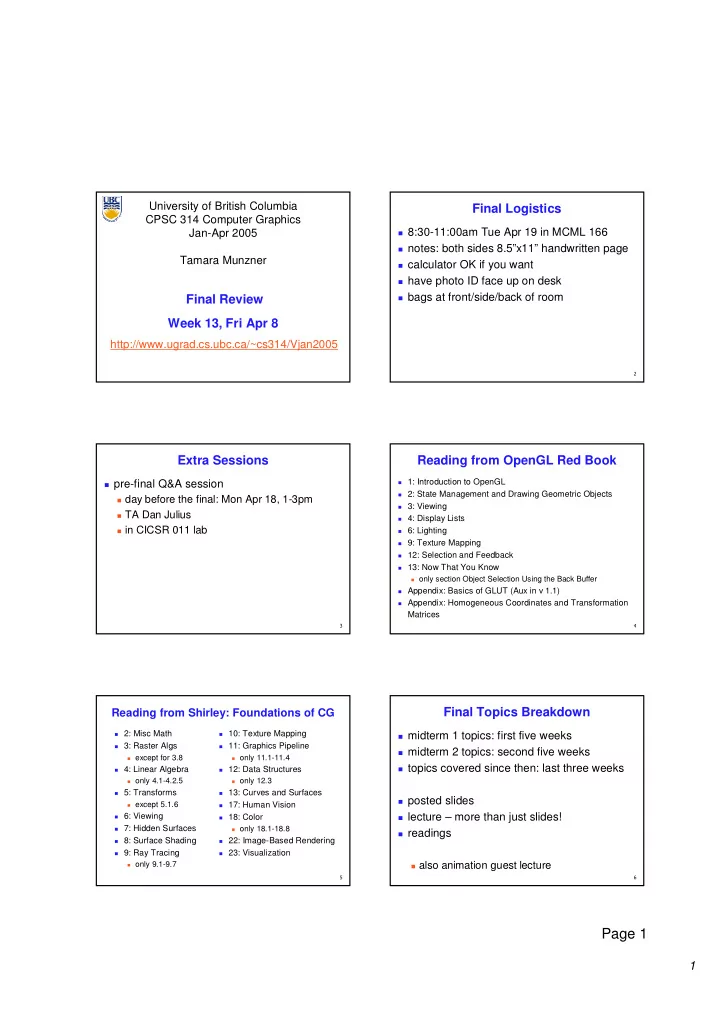
University of British Columbia Final Logistics CPSC 314 Computer Graphics 8:30-11:00am Tue Apr 19 in MCML 166 Jan-Apr 2005 notes: both sides 8.5x11 handwritten page Tamara Munzner calculator OK if you want have photo ID


slide-1
SLIDE 1

1

Page 1

University of British Columbia CPSC 314 Computer Graphics Jan-Apr 2005 Tamara Munzner http://www.ugrad.cs.ubc.ca/~cs314/Vjan2005

Final Review Week 13, Fri Apr 8

  • Final Logistics

8:30-11:00am Tue Apr 19 in MCML 166 notes: both sides 8.5”x11” handwritten page calculator OK if you want have photo ID face up on desk bags at front/side/back of room

  • Extra Sessions

pre-final Q&A session day before the final: Mon Apr 18, 1-3pm TA Dan Julius in CICSR 011 lab

  • Reading from OpenGL Red Book

1: Introduction to OpenGL 2: State Management and Drawing Geometric Objects 3: Viewing 4: Display Lists 6: Lighting 9: Texture Mapping 12: Selection and Feedback 13: Now That You Know

  • nly section Object Selection Using the Back Buffer

Appendix: Basics of GLUT (Aux in v 1.1) Appendix: Homogeneous Coordinates and Transformation

Matrices

  • Reading from Shirley: Foundations of CG

2: Misc Math 3: Raster Algs except for 3.8 4: Linear Algebra

  • nly 4.1-4.2.5

5: Transforms except 5.1.6 6: Viewing 7: Hidden Surfaces 8: Surface Shading 9: Ray Tracing

  • nly 9.1-9.7

10: Texture Mapping 11: Graphics Pipeline

  • nly 11.1-11.4

12: Data Structures

  • nly 12.3

13: Curves and Surfaces 17: Human Vision 18: Color

  • nly 18.1-18.8

22: Image-Based Rendering 23: Visualization

  • Final Topics Breakdown

midterm 1 topics: first five weeks midterm 2 topics: second five weeks topics covered since then: last three weeks posted slides lecture – more than just slides! readings also animation guest lecture

slide-2
SLIDE 2

2

Page 2

  • Midterm 1 Topics Covered

rendering pipeline projective rendering pipeline, coord. systems transformations viewing projections lighting shading barycentric coordinates

review was Wed Feb 9 http://www.cs.ubc.ca/~tmm/courses/314/Vjan2005/slides/week6.day2.6up.pdf

  • Review: Rendering Pipeline

pros and cons of pipeline approach Geometry Database Geometry Geometry Database Database Model/View Transform. Model/View Model/View Transform. Transform. Lighting Lighting Lighting Perspective Transform. Perspective Perspective Transform. Transform. Clipping Clipping Clipping Scan Conversion Scan Scan Conversion Conversion Depth Test Depth Depth Test Test Texturing Texturing Texturing Blending Blending Blending Frame- buffer Frame Frame- buffer buffer

  • Review: Projective Rendering Pipeline

OCS - object coordinate system WCS - world coordinate system VCS - viewing coordinate system CCS - clipping coordinate system NDCS - normalized device coordinate system DCS - device coordinate system

OCS OCS WCS WCS VCS VCS CCS CCS NDCS NDCS DCS DCS

modeling modeling transformation transformation viewing viewing transformation transformation projection projection transformation transformation viewport viewport transformation transformation alter w alter w / w / w

  • bject

world viewing/ camera device normalized device clipping

perspective perspective division division glVertex3f(x,y,z) glVertex3f(x,y,z) glTranslatef(x,y,z glTranslatef(x,y,z) ) glRotatef(th,x,y,z glRotatef(th,x,y,z) ) .... .... gluLookAt gluLookAt(...) (...) glFrustum glFrustum(...) (...) glutInitWindowSize(w,h glutInitWindowSize(w,h) ) glViewport(x,y,a,b glViewport(x,y,a,b) )

  • Review: Transformations, Homog. Coords
  • =
  • 1

1 1 1 1 1 ' ' ' z y x c b a z y x translate(a,b,c) translate(a,b,c)

=

  • 1

1 cos sin sin cos 1 1 ' ' ' z y x z y x θ θ θ θ

) , ( Rotate θ x

  • =
  • 1

1 1 ' ' ' z y x c b a z y x scale(a,b,c) scale(a,b,c)

1 cos sin 1 sin cos θ θ θ θ

) , ( Rotate θ y

1 1 cos sin sin cos θ θ θ θ

) , ( Rotate θ z

y y w w w= w=1 1

⋅ w w y w x

⋅ w w y w x

  • 1

y x

  • 1

y x

  • Review: Transforming View Volumes

x z

NDCS

y

(-1,-1,-1) (1,1,1)

  • rthographic view volume
  • rthographic view volume

x z VCS y x=left y=top x=right z=-far z=-near y=bottom perspective view volume perspective view volume x=left x=right y=top y=bottom z=-near z=-far x VCS y

  • Review: Basic Perspective Projection

similar triangles similar triangles

→ = z y d y' z d y y ⋅ = '

z z P(x,y,z) P(x,y,z) P(x’,y’,d P(x’,y’,d) ) z=d z=d y y also also

z d x x ⋅ = '

nonuniform foreshortening not affine

d z = '

but but

slide-3
SLIDE 3

3

Page 3

  • Review: Lighting

Idiffuse = kd Ilight (n • l)

n l θ R = 2 ( N (N · L)) – L

Ispecular = ksIlight(v•r)nshiny

Itotal = ksIambient + Ii(

i=1 #lights

  • kd(n•li) + ks(v•ri)nshiny )

reflection equations full Phong lighting model

combine ambient, diffuse, specular

components

  • Review: Shading Models

flat shading compute Phong lighting once for entire

polygon

Gouraud shading compute Phong lighting at the vertices and

interpolate lighting values across polygon

Phong shading compute averaged vertex normals interpolate normals across polygon and

perform Phong lighting across polygon

  • Review: Barycentric Coordinates

weighted combination of vertices

3 2 1

P P P P ⋅ + ⋅ + ⋅ = γ β α

1

P

3

P

2

P P

(1,0,0) (1,0,0) (0,1,0) (0,1,0) (0,0,1) (0,0,1)

5 . = β 1 = β = β 1 , , 1 ≤ ≤ = + + γ β α γ β α

“ “convex combination convex combination

  • f points”
  • f points”
  • Midterm 2 Topics Covered

color rasterization/scan conversion clipping visibility / hidden surfaces texturing procedural approaches advanced rendering sampling/antialiasing animation picking review was Fri Mar 18 http://www.cs.ubc.ca/~tmm/courses/314/Vjan2005/slides/week10.day3.6up.pdf

  • Review: Color

color perception

color is combination of

stimuli from 3 cones

metamer: identically

perceived color caused by very different spectra

simple model: based on

RGB triples

component-wise

multiplication of colors

(a0,a1,a2) * (b0,b1,b2) =

(a0*b0, a1*b1, a2*b2)

  • Review: Scan Conversion

lines: midpoint algorithm

  • ptimized: Bresenham

polygons flood fill scanline algorithms parity test for general case

1 2 3 4 5=0 P

slide-4
SLIDE 4

4

Page 4

  • Review: Clipping

Cohen Sutherland lines: combining trivial accepts/rejects trivially accept lines: both endpoints inside all edges

  • utcode test: OC(p1)== 0 && OC(p2)==0

trivially reject lines: both endpoints outside same edge

  • utcode test: OC(p1) & OC(p2))!= 0 reject
  • therwise, reduce to trivial: splitting into two segments

Sutherman-Hodgeman polygons

for each viewport edge: clip polygon against edge process input edge list to make output edge list inside or outside status between each vertex pair

  • Review: Visibility

painter’s algorithm

back to front, incorrect

BSP trees

build, then traverse

Warnock’s algorithm

subdivide viewport

Z-buffer

depth buffer in addition to framebuffer

backface culling

  • ptimization for closed objects
  • Review: Procedural Approaches

Perlin noise

coherency: smooth not abrupt changes turbulence: multiple feature sizes

particle systems fractal landscapes L-systems

  • Review: Advanced Rendering

ray tracing reflection, refraction, hard shadows subsurface scattering marble, milk radiosity diffuse lighting, soft shadows image-based rendering store/access only pixels

  • Review: Recursive Ray Tracing

ray tracing can handle

reflection (chrome) refraction (glass) shadows

spawn secondary rays

reflection, refraction if another object is hit,

recurse to find its color

shadow cast ray from intersection

point to light source, check if intersects another object

projection reference point pixel positions

  • n projection

plane

  • Review: Sampling

Shannon Sampling Theorem

continuous signal can be completely recovered from

its samples iff sampling rate greater than twice maximum frequency present in signal

sample past Nyquist Rate to avoid aliasing

twice the highest frequency component in the

image’s spectrum

slide-5
SLIDE 5

5

Page 5

  • Review: Picking

manual ray intersection bounding extents backbuffer coding select/hit x VCS y

  • glTexCoord2d(4, 4);

glVertex3d (x, y, z); glTexCoord2d(1, 1); glVertex3d (x, y, z); (4,4) (4,0) (0,4) (0,0) (1,0) (0,0) (0,1) (1,1)

Review: Textures

  • Latest Topics Covered

collision detection modelling virtual trackballs scientific visualization information visualization graphics in movies

  • Collision Detection
  • Review: Collision Detection Algorithms

naive very expensive: O(n2) primary factor: geometry of colliding objects secondary factor: way in which objects move

  • ther factors: speed, simplicity, robustness
  • ptimizations

if more than one test available, with different costs:

how do you combine them?

how do you avoid unnecessary tests? how do you make tests cheaper?

  • Review: Fundamental Design Principles

fast simple tests first, eliminate many potential

collisions

exploit locality, eliminate many potential collisions use as much information as possible about geometry exploit coherence between successive tests specific techniques

collision proxies spatial data structures to localize finding precise collision times responding to collisions

slide-6
SLIDE 6

6

Page 6

  • Review: Collision Proxies

collision proxy (bounding volume) is piece of

geometry used to represent complex object for purposes of finding collision

good proxy: cheap to compute collisions for, tight fit

to the real geometry

proxies exploit facts about human perception

we are extraordinarily bad at determining correctness

  • f collision between two complex objects

the more stuff is happening, and the faster it happens,

the more problems we have detecting errors

  • Review: Trade-off in Choosing Proxies

increasing complexity & tightness of fit decreasing cost of (overlap tests + proxy update)

AABB OBB Sphere Convex Hull 6-dop

  • Review: Spatial Data Structures

uniform grids bounding volume hierarchies

  • ctrees

BSP trees kd-trees k-dops

  • Review: Exploiting Coherence

player normally doesn’t move far between

frames

track incremental changes, using previous

results instead of doing full search each time

keep track of entry and exit into cells through

portals

probably the same cells they intersect now

  • r at least they are close
  • Review: Precise Collisions

t=0 t=1 t=0.5 t=1 t=0.5 t=0.75 t=0.5 t=0.625 t=0.5625

hacked clean up simply move position so that objects just touch, leave time the

same

interval halving binary search through time to find exact collision point and time

  • Review: Temporal Sampling

temporal sampling aliasing: can miss collision completely!

slide-7
SLIDE 7

7

Page 7

  • Review: Managing Fast Moving Objects

several ways to do it, with increasing costs movement line: test line segment representing motion of

  • bject center

pros: works for large obstacles, cheap cons: may still miss collisions. how? conservative prediction: only move objects as far as you can

be sure to catch collision

increase temporal sampling rate pros: will find all collisions cons: may be expensive, how to pick step size space-time bounds: bound the object in space and time,

check bound

pros: will find all collisions cons: expensive, must bound motion

  • Modelling
  • Review: Splines

spline is parametric

curve defined by control points

knots: control points

that lie on curve

engineering drawing:

spline was flexible wood, control points were physical weights

A Duck (weight) Ducks trace out curve

  • Review: Hermite Spline

user provides endpoints derivatives at endpoints

[ ]

− − − ′ ′ = 1 1 2 1 1 1 1 3 2 3 2

2 3 1 1

t t t x x x x x

  • Review: Bézier Curves

four control points, two of which are knots more intuitive definition than derivatives curve will always remain within convex hull

(bounding region) defined by control points

  • Review: Basis Functions

point on curve obtained by multiplying each control

point by some basis function and summing

  • 0 .4
  • 0 .2
0 .2 0 .4 0 .6 0 .8 1 1 .2

x1 x0 x'1 x'0

slide-8
SLIDE 8

8

Page 8

  • Review: Comparing Hermite and Bézier

0.2 0.4 0.6 0.8 1 1.2 B0 B1 B2 B3

  • 0.4
  • 0.2
0.2 0.4 0.6 0.8 1 1.2

x1 x0 x'1 x'0

Bézier Hermite

  • Review: Sub-Dividing Bézier Curves

find the midpoint of the line joining M012, M123.

call it M0123

P0 P1 P2 P3 M01 M12 M23 M012 M123 M0123

  • Review: de Casteljau’s Algorithm

can find the point on Bézier curve for any parameter

value t with similar algorithm

for t=0.25, instead of taking midpoints take points 0.25 of the

way

P0 P1 P2 P3 M01 M12 M23 t=0.25

demo: www.saltire.com/applets/advanced_geometry/spline/spline.htm

  • Review: Continuity

continuity definitions C0: share join point C1: share continuous derivatives C2: share continuous second derivatives piecewise Bézier: no continuity guarantees

  • Review: B-Spline

C0, C1, and C2 continuous piecewise: locality of control point influence

  • Virtual Trackball
slide-9
SLIDE 9

9

Page 9

  • Review: Trackball Rotation

correspondence: moving point on plane from (x, 0, z) to (a, 0, c) moving point on ball from p1 =(x, y, z) to p2 =(a, b, c) correspondence: translating mouse from p1 (mouse down) to p2 (mouse up) rotating about axis n = p1 x p2by arccos(p1 • p2 / |p1| |p2|)

  • Scientific Visualization
  • Review: Volume Graphics

for some data, difficult to create polygonal mesh voxels: discrete representation of 3D object

volume rendering: create 2D image from 3D object

translate raw densities into colors and

transparencies

different aspects of the dataset can be emphasized

via changes in transfer functions

  • Review: Volume Graphics

pros formidable technique for data exploration cons rendering algorithm has high complexity! special purpose hardware costly (~$3K-$10K) volumetric human head (CT scan)

  • Review: Isosurfaces

2D scalar fields: isolines contour plots, level sets topographic maps 3D scalar fields: isosurfaces

  • Review: Isosurface Extraction

array of discrete point

samples at grid points

3D array: voxels find contours closed, continuous determined by iso-value several methods marching cubes is most

common

slide-10
SLIDE 10

10

Page 10

  • Review: Marching Cubes

create cube classify each voxel binary labeling of each voxel to

create index

use in array storing edge list all 256 cases can be derived

from 15 base cases

interpolate triangle vertex calculate the normal at each

cube vertex

render by standard methods

  • Review: Direct Volume Rendering Pipeline
  • do not compute surface
  • Review: Transfer Functions To Classify

map data value to color and opacity can be difficult, unintuitive, and slow

f α f α f α f α

Gordon Kindlmann

  • Review: Volume Rendering Algorithms

ray casting image order, forward viewing splatting

  • bject order, backward viewing

texture mapping

  • bject order

back-to-front compositing

  • Review: Ray Casting Traversal Schemes
  • !

""# $

  • Information Visualization
slide-11
SLIDE 11

11

Page 11

  • Review: Information Visualization

interactive visual representation of abstract data

help human perform some task more effectively

bridging many fields

graphics: interacting in realtime cognitive psych: finding appropriate representations HCI: using task to guide design and evaluation

external representation

reduces load on working memory

  • ffload cognition

familiar example: multiplication with pen/paper infovis example: topic graphs

  • Review: Overviews mantra
  • verview, zoom and filter, details-on-demand
  • Review: Overviews - SeeSoft

colored lines of code: lines one pixel high

  • Review: Focus+Context

integrate overview and details into single view

H3: 3D fisheye TreeJuxtaposer: stretch and squish SpaceTree: collapse/expand

  • Review: Preattentive Visual Channels: Popout

single channel processed in parallel for popout

visual attentional system not invoked speed independent of distractor count hue, shape, texture, length, width, size, orientation,

curvature, intersection, intensity, flicker, direction of motion, stereoscopic depth, lighting direction,...

multiple channels not parallel

search linear in number of

distractor objects

[Chris Healey, Preattentive Processing, www.csc.ncsu.edu/faculty/healey/PP]

  • Review: Data Type Affects Channel Ranking

spatial position best for all types

accuracy at judging magnitudes, from best to worst [Mackinlay, Automating the Design of Graphical Presentations of Relational Information, ACM TOG 5:2, 1986] [Card, Mackinlay, and Shneiderman. Readings in Information Visualization: Using Vision to Think. Morgan Kaufmann 1999. Chapter 1]

slide-12
SLIDE 12

12

Page 12

  • Review: Coloring Categorical Data

discrete small patches separated in space limited distinguishability: around 8-14 channel dynamic range: low choose bins explicitly for maximum mileage maximally discriminable colors from Ware maximal saturation for small areas

  • vs. minimal saturation for large areas

[Colin Ware, Information Visualization: Perception for Design. Morgan Kaufmann 1999. Figure 4.21]

  • Review: Rainbow Colormap Disadvantages

perceptually nonlinear segmentation, hue unordered (partial) solution perceptually isolinear map [Kindlmann, Reinhard, and Creem. Face-based Luminance Matching for Perceptual Colormap Generation.

  • Proc. Vis 02 www.cs.utah.edu/~gk/lumFace]

[Rogowitz and Treinish, How NOT to Lie with Visualization,www.research.ibm.com/dx/proceedings/pravda/truevis.htm

  • Review: Color Deficiency – vischeck.com

10% of males have red/green deficit

  • Review: Space vs. Time: Showing Change
  • Review: Space vs. Time: Showing Change
  • CG In Movies
slide-13
SLIDE 13

13

Page 13

  • Review: Character Development

300 drawings, 40 sculptures computer models

  • Review: Facial Animation, Lip Sync
  • Review: Matchmoving

CG camera must exactly match the real camera

position, rotation, focal length, aperature

easy when camera is instrumented

film scanned camera tracking data retrieved

  • nce shot is prepared, 2D images rendered and

composited with live action

  • Review: Shooting Film For CG

actors practice with maquettes maquettes replaced with laser

dots

lasers on when camera shutter

is closed

after each take, three extra shots

chrome ball for environment

map for Stuart’s eyes

white and gray balls for lighting

info

  • Review: Fur
  • Review: Cloth
slide-14
SLIDE 14

14

Page 14

  • Other Graphics Courses

424: Geometric Modelling 426: Computer Animation 514: Image-Based Rendering - Heidrich 526: Algorithmic Animation- van de Panne 533A: Digital Geometry - Sheffer 533B: Animation Physics - Bridson 533C: Information Visualization - Munzner