Page 1 Outline Perspective on Post- PC Era Background: Berkeley - - PDF document

page 1
SMART_READER_LITE
LIVE PREVIEW

Page 1 Outline Perspective on Post- PC Era Background: Berkeley - - PDF document

Berkeley Approach to Systems Find an important problem crossing HW/ SW Computers f or the Post- PC Era I nterf ace, with HW/ SW prototype at end Assemble a band of 3- 6 f aculty, 12- 20 grad Aaron Brown, J im Beck, Rich Martin,


slide-1
SLIDE 1

Page 1

Slide 1

Computers f or the Post- PC Era

Aaron Brown, J im Beck, Rich Martin, David Oppenheimer, K athy Yelick, and David Patterson http://iram.cs.berkeley.edu/istore 1999 Grad Visit Day

Slide 2

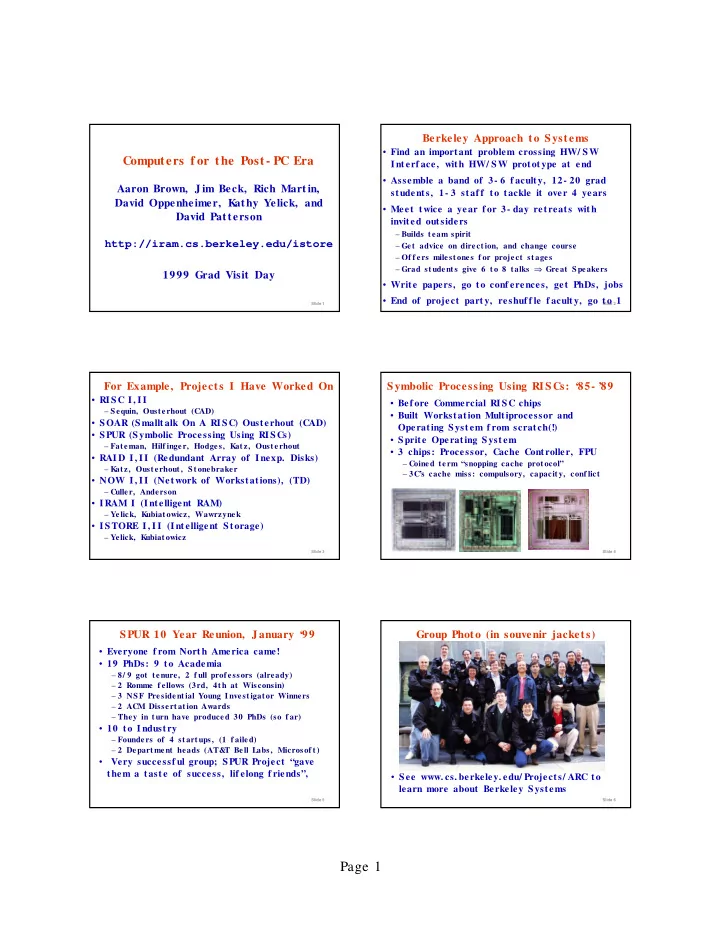
Berkeley Approach to Systems

  • Find an important problem crossing HW/ SW

I nterf ace, with HW/ SW prototype at end

  • Assemble a band of 3- 6 f aculty, 12- 20 grad

students, 1- 3 staf f to tackle it over 4 years

  • Meet twice a year f or 3- day retreats with

invited outsiders

– Builds team spirit – Get advice on direction, and change course – Of f ers milestones f or project stages – Grad students give 6 to 8 talks ⇒ Great Speakers

  • Write papers, go to conf erences, get PhDs, jobs
  • End of project party, reshuf f le f aculty, go to 1

Slide 3

For Example, Projects I Have Worked On

  • RI SC I , I I

– Sequin, Ousterhout (CAD)

  • SOAR (Smalltalk On A RI SC) Ousterhout (CAD)
  • SPUR (Symbolic Processing Using RI SCs)

– Fateman, Hilf inger, Hodges, K atz, Ousterhout

  • RAI D I , I I (Redundant Array of I nexp. Disks)

– K atz, Ousterhout, Stonebraker

  • NOW I , I I (Network of Workstations), (TD)

– Culler, Anderson

  • I RAM I (I ntelligent RAM)

– Yelick, K ubiatowicz, Wawrzynek

  • I STORE I , I I (I ntelligent Storage)

– Yelick, K ubiatowicz

Slide 4

Symbolic Processing Using RI SCs: ‘85- ’89

  • Bef ore Commercial RI SC chips
  • Built Workstation Multiprocessor and

Operating System f rom scratch(!)

  • Sprite Operating System
  • 3 chips: Processor, Cache Controller, FPU

– Coined term “snopping cache protocol” – 3C’s cache miss: compulsory, capacity, conf lict

Slide 5

SPUR 10 Year Reunion, J anuary ‘99

  • Everyone f rom North America came!
  • 19 PhDs: 9 to Academia

– 8/ 9 got tenure, 2 f ull prof essors (already) – 2 Romme f ellows (3rd, 4th at Wisconsin) – 3 NSF Presidential Young I nvestigator Winners – 2 ACM Dissertation Awards – They in turn have produced 30 PhDs (so f ar)

  • 10 to I ndustry

– Founders of 4 startups, (1 f ailed) – 2 Department heads (AT& T Bell Labs, Microsof t)

  • Very successf ul group; SPUR Project “gave

them a taste of success, lif elong f riends”,

Slide 6

Group Photo (in souvenir jackets)

  • See www. cs. berkeley. edu/ Projects/ ARC to

learn more about Berkeley Systems

slide-2
SLIDE 2

Page 2

Slide 7

Outline

  • Background: Berkeley Approach to

Systems

  • PostPC Motivation
  • PostPC Microprocessor: I RAM
  • PostPC I nf rastructure Motivation
  • PostPC I nf rastructure: I STORE
  • Hardware Architecture
  • Sof tware Architecture
  • Conclusions and Feedback

Slide 8

Perspective on Post- PC Era

  • PostPC Era will be driven by two technologies:

1) Mobile Consumer Electronic Devices –e. g. , successor to PDA, Cell phone, wearable computers 2) I nf rastructure to Support such Devices –e. g. , successor to Big Fat Web Servers, Database Servers

Slide 9

I ntelligent PDA ( 2003?)

Pilot PDA + gameboy, cell phone, radio, timer, camera, TV remote, am/ f m radio, garage door

  • pener, . . .

+ Wireless data (WWW) + Speech, vision recog.

+ Voice output f or

conversations Speech control +Vision to see, scan documents, read bar code, . . .

Slide 10

+ Vector Registers x ÷ Load/Store Vector 4 x 64

  • r

8 x 32

  • r

16 x 16 4 x 64 4 x 64 Queue Instruction

V- I RAM1: 0. 18 µm, Fast Logic, 200 MHz

  • 1. 6 GFLOPS(64b)/ 6. 4 GOPS(16b)/ 32MB

Memory Crossbar Switch 16K I cache16K D cache 2-way Superscalar Processor M M … M M M … M M M … M M M … M M M … M M M … M … M M … M M M … M M M … M M M … M 4 x 64 4 x 64 4 x 64 4 x 64 4 x 64

I/O I/O I/O I/O

Serial I/O

Slide 11

I RAM Vision Statement Microprocessor & DRAM

  • n a single chip:

–10X capacity vs. DRAM –on- chip memory latency 5- 10X, bandwidth 50- 100X –improve energy ef f iciency 2X- 4X (no of f - chip bus) –serial I / O 5- 10X v. buses –smaller board area/ volume –adjustable memory size/ width

D R A M f a b Proc Bus D R A M I / O I / O

$ $

Proc L2$ L

  • g

i c f a b Bus D R A M Bus I / O I / O

Slide 12

Outline

  • PostPC I nf rastructure Motivation and

Background: Berkeley’s Past

  • PostPC Motivation
  • PostPC Device Microprocessor: I RAM
  • PostPC I nf rastructure Motivation
  • I STORE Goals
  • Hardware Architecture
  • Sof tware Architecture
  • Conclusions and Feedback
slide-3
SLIDE 3

Page 3

Slide 13

Background: Tertiary Disk (part of NOW)

  • Tertiary Disk

(1997)

– cluster of 20 PCs hosting 364 3. 5” I BM disks (8. 4 GB) in 7 19”x 33” x 84” racks, or 3 TB. The 200MHz, 96 MB P6 PCs run FreeBSD and a switched 100Mb/ s Ethernet connects the hosts. Also 4 UPS units. – Hosts world’s largest art database:72, 000 images in cooperation with San Francisco Fine Arts Museum: Try www. thinker. org

Slide 14

Tertiary Disk HW Failure Experience

Reliability of hardware components (20 months)

7 I BM SCSI disk f ailures (out of 364, or 2% ) 6 I DE (internal) disk f ailures (out of 20, or 30% ) 1 SCSI controller f ailure (out of 44, or 2% ) 1 SCSI Cable (out of 39, or 3% ) 1 Ethernet card f ailure (out of 20, or 5% ) 1 Ethernet switch (out of 2, or 50% ) 3 enclosure power supplies (out of 92, or 3% ) 1 short power outage (covered by UPS)

Did not match expectations: SCSI disks more reliable than SCSI cables! Dif f erence between simulation and prototypes

Slide 15

Saw 2 Error Messages per Day

  • SCSI Error Messages:

– Time Outs : Response: a BUS RESET command – Parity: Cause of an aborted request

  • Data Disk Error Messages:

– Hardware Error : The command unsuccessf ully terminated due to a non- recoverable HW f ailure. – Medium Error : The operation was unsuccessf ul due to a f law in the medium (try reassigning sectors) – Recovered Error: The last command completed with the help of some error recovery at the target – Not Ready: The drive cannot be accessed

Slide 16

SCSI Time Outs + Hardware Failures (m11)

2 4 6 8 10 8/17/98 0:00 8/19/98 0:00 8/21/98 0:00 8/23/98 0:00 8/25/98 0:00 8/27/98 0:00

SCSI Bus 0 Disks

SCSI Time Outs

1 2 3 4 5 6 7 8 9 10

8/15/98 0:00 8/17/98 0:00 8/19/98 0:00 8/21/98 0:00 8/23/98 0:00 8/25/98 0:00 8/27/98 0:00 8/29/98 0:00 8/31/98 0:00 SCSI Bus 0 Disks Disk Hardware Failures SCSI Time Outs

SCSI Bus 0

Slide 17

Can we predict a disk f ailure?

  • Yes, look f or Hardware Error messages

–These messages lasted f or 8 days between: »8- 17- 98 and 8- 25- 98

–On disk 9 there were:

»1763 Hardware Error Messages, and »297 SCSI Timed Out Messages

  • On 8- 28- 98: Disk 9 on SCSI Bus 0 of

m11 was “f ired”, i. e. appeared it was about to f ail, so it was swapped

Slide 18

SCSI Bus 2

5 10 15 9/2/98 0:00 9/12/98 0:00 9/22/98 0:00 10/2/98 0:00 10/12/9 8 0:00 10/22/9 8 0:00

SCSI Bus 2 Disks

SCSI Parity Errors

SCSI Bus 2 Parity Errors (m2)

slide-4
SLIDE 4

Page 4

Slide 19

Can We Predict Other K inds of Failures?

  • Yes, the f lurry of parity errors on m2
  • ccurred between:

– 1- 1- 98 and 2- 3- 98, as well as – 9- 3- 98 and 10- 12- 98

  • On 11- 24- 98

–m2 had a bad enclosure ⇒ cables or connections def ective –The enclosure was then replaced

Slide 20

Lessons f rom Tertiary Disk Project

  • Maintenance is hard on current systems

– Hard to know what is going on, who is to blame

  • Everything can break

– I ts not what you expect in advance – Follow rule of no single point of f ailure

  • Nothing f ails f ast

– Eventually behaves bad enough that operator “f ires” poor perf ormer, but it doesn’t “quit”

  • Most f ailures may be predicted

Slide 21

Outline

  • Background: Berkeley Approach to

Systems

  • PostPC Motivation
  • PostPC Microprocessor: I RAM
  • PostPC I nf rastructure Motivation
  • PostPC I nf rastructure: I STORE
  • Hardware Architecture
  • Sof tware Architecture
  • Conclusions and Feedback

Slide 22

easy to measure

Storage Priorities: Research v. Users Current Research Priorities 1) Perf ormance 1’) Cost 3) Scalability 4) Availability 10) Maintainability I STORE Priorities 1) Maintainability 2) Availability 3) Scalability 4) Perf ormance 4’) Cost

}

Slide 23

I ntelligent Storage Project Goals

  • I STORE: a hardware/ sof tware

architecture f or building scaleable, self - maintaining storage

–An int rospect ive system: it monitors itself and acts on its observations

  • Self - maintenance: does not rely on

administrators to conf igure, monitor, or tune system

Slide 24

Self - maintenance

  • Failure management

– devices must f ail f ast without interrupting service – predict f ailures and initiate replacement – f ailures ⇒ immediate human intervention

  • System upgrades and scaling

– new hardware automatically incorporated without interruption – new devices immediately improve perf ormance or repair f ailures

  • Perf ormance management

– system must adapt to changes in workload or access patterns

slide-5
SLIDE 5

Page 5

Slide 25

I STORE- I Hardware

  • I STORE uses “intelligent” hardware

I ntelligent Chassis: scaleable, redundant, f ast network + UPS Device CPU, memory, NI

I ntelligent Disk “Brick”: a disk, plus a f ast embedded CPU, memory, and redundant network interf aces

Slide 26

I STORE- I : 2H99?

  • I ntelligent disk

– Portable PC Hardware: Pentium I I , DRAM – Low Prof ile SCSI Disk (9 to 18 GB) – 4 100- Mbit/ s Ethernet links per node – Placed inside Half - height canister – Monitor Processor/ path to power of f components?

  • I ntelligent Chassis

– 64 nodes: 8 enclosures, 8 nodes/ enclosure

» 64 x 4 or 256 Ethernet ports

– 2 levels of Ethernet switches: 14 small, 2 large

» Small: 20 100- Mbit/ s + 2 1- Gbit; Large: 25 1- Gbit

– Enclosure sensing, UPS, redundant PS, f ans, . . .

Slide 27

Disk Limit

  • Continued advance in capacity (60%

/ yr) and bandwidth (40% / yr)

  • Slow improvement in seek, rotation (8%

/ yr)

  • Time to read whole disk

Year Sequentially Randomly (1 sector/ seek) 1990 4 minutes 6 hours 1999 35 minutes 1 week(!)

  • 3. 5” f orm f actor make sense in 5- 7 years?

Slide 28

2006 I STORE

  • I BM MicroDrive

– 1. 7” x 1. 4” x 0. 2” – 1999: 340 MB, 5400 RPM, 5 MB/ s, 15 ms seek – 2006: 9 GB, 50 MB/ s?

  • I STORE node

– MicroDrive + I RAM

  • Crossbar switches growing by Moore’s Law

– 16 x 16 in 1999 ⇒ 64 x 64 in 2005

  • I STORE rack (19” x 33” x 84”)

– 1 tray (3” high) ⇒ 16 x 32 ⇒ 512 I STORE nodes – 20 trays+switches+UPS ⇒ 10, 240 I STORE nodes(!)

Slide 29

Sof tware Motivation

  • Data- intensive network- based services

are becoming the most important application f or high- end computing

  • But servers f or them are too hard to

manage!

  • We need single- purpose, introspective

storage appliances

– single- purpose: cust omized f or one applicat ion – introspective: self -monit or ing and adapt ive

» with respect to component f ailures, addition of new hardware resources, load imbalance, workload changes, . . .

  • But introspective systems are hard to

build!

Slide 30

I ntrospective Storage Service

  • Single- purpose, introspective storage

– single- purpose: cust omized f or one applicat ion – introspective: self -monit or ing and adapt ive

  • Sof tware : t oolkit f or def ining and implement ing

applicat ion-specif ic monit oring and adapt at ion

– base layer supplies repository f or monitoring data, mechanisms f or invoking reaction code – f or common adaptation goals, appliance designer’s policy statements guide automatic generation of adaptation algorithms

  • Hardware: int elligent devices wit h int egrat ed

self -monit oring

slide-6
SLIDE 6

Page 6

Slide 31

Base Layer: Views and Triggers

  • Monitoring data is stored in a dynamic system

database

– device status, access patterns, perf . stats, . . .

  • System supports views over the data . . .

– applications select and aggregate data of interest – def ined using SQL- like declarative language

  • . . . as well as application- def ined triggers

that specif y interesting situations as predicates over these views

– triggers invoke application- specif ic reaction code when the predicate is satisf ied – def ined using SQL- like declarative language

Slide 32

From Policy Statements to Adaptation Algorithms

  • For common adaptation goals, designer can

write simple policy statements

  • Runtime integrity constraints over data stored

in the DB

  • System automatically generates appropriate

views, triggers, & adaptation code templates

  • claim: doable f or common adaptation

mechanisms needed by data- intensive network services

– component f ailure, data hot- spots, integration of new hardware resources, . . .

Slide 33

Conclusion and Status 1/ 2

  • I RAM attractive f or both drivers of PostPC

Era: Mobile Consumer Electronic Devices and Scaleable I nf rastructure

– Small size, low power, high bandwidth

  • I STORE: hardware/ sof tware architecture f or

single- use, introspective storage appliances

  • Based on

– intelligent, self - monitoring hardware – a virtual database of system status and statistics – a sof tware toolkit that uses a domain- specif ic declarative language to specif y integrity constraints

  • 1st HW Prototype being constructed;

1st SW Prototype just starting

Slide 34

I STORE Conclusion 2/ 2

  • Qualitative Change f or every f actor 10X

Quantitative Change –Then what is implication of 100X?

  • PostPC Servers no longer “Binary” ?

(1 perf ect, 0 broken)

–inf rastructure never perf ect, never broken

  • PostPC I nf rastructure Based on

Probability Theory (>0, <1), not Logic Theory (true or f alse)?

  • Look to Biology, Economics f or usef ul

models? http://iram.cs.berkeley.edu/istore

Slide 35

I nterested in Participating?

  • Project just getting f ormed
  • Contact us if you’re interested:

http://iram.cs.berkeley.edu/istore email: patterson@cs.berkeley.edu

  • Thanks f or support: DARPA
  • Thanks f or advice/ inspiration:

Dave Anderson (Seagate), Greg Papadopolous (Sun), Mike Ziegler (HP)

Slide 36

Backup Slides

slide-7
SLIDE 7

Page 7

Slide 37

Post PC Motivation

  • Next generation f ixes problems of last gen.
  • 1960s: batch processing + slow turnaround

⇒ Timesharing –15- 20 years of perf ormance improvement, cost reduction (minicomputers, semiconductor memory)

  • 1980s: Time sharing + inconsistent response

times ⇒ Workstations/ Personal Computers –15- 20 years of perf ormance improvement, cost reduction (microprocessors, DRAM memory, disk)

  • 2000s: PCs + dif f iculty of use/ high cost of

Slide 38

User Decision Support Demand

  • vs. Processor speed

1 10 100 1996 1997 1998 1999 2000

CPU speed 2X / 18 months Database demand: 2X / 9-12 months Database-Proc. Performance Gap: “Greg’s Law” “Moore’s Law”

Slide 39

State of the Art: Seagate Cheetah 36

–36. 4 GB, 3. 5 inch disk –12 platters, 24 surf aces –10, 000 RPM –18. 3 to 28 MB/ s internal media transf er rate –9772 cylinders (tracks), (71, 132, 960 sectors total) –Avg. seek: read 5. 2 ms, write

  • 6. 0 ms (Max. seek: 12/ 13, 1

track: 0. 6/ 0. 9 ms) –$ 2100 or 17MB/ $ (6¢/ MB) (list price) –0. 15 ms controller time

source: www.seagate.com

Slide 40

Disk Limit: I / O Buses CPU

Memory bus

Memory C

External I/O bus (SCSI)

C

(PCI)

C

Internal I/O bus

C

I Multiple copies of data,

SW layers

  • Bus rate vs. Disk rate

– SCSI : Ultra2 (40 MHz), Wide (16 bit): 80 MByte/ s – FC- AL: 1 Gbit/ s = 125 MByte/ s (single disk in 2002)

I Cannot use 100% of bus H Queuing Theory (<

70%)

H Command overhead

(Effective size = size x 1.2)

Controllers (15 disks)

Slide 41

Other (Potential) Benef its of I STORE

  • Scalability: add processing power, memory,

network bandwidth as add disks

  • Smaller f ootprint vs. traditional server/ disk
  • Less power

– embedded processors vs. servers – spin down idle disks?

  • For decision- support or web- service

applications, potentially better perf ormance than traditional servers

Slide 42

Related Work

  • I STORE adds to several recent research

ef f orts

  • Active Disks, NASD (UCSB, CMU)
  • Network service appliances (Net App, Snap!,

Q ube, ...)

  • High availability systems (Compaq/ Tandem, ...)
  • Adaptive systems (HP Aut oRAI D, M/ S

Aut oAdmin, M/ S Millennium)

  • Plug- and- play system construction (J ini, PC

Plug&Play, ...)

slide-8
SLIDE 8

Page 8

Slide 43

New Architecture Directions f or PostPC Mobile Devices

  • “…

media processing will become the dominant f orce in computer arch. & MPU design. ”

  • “. . . new media- rich applications. . . involve

signif icant real- time processing of continuous media streams, & make heavy use of vectors of packed 8- , 16- , and 32- bit integer and Fl. Pt. ”

  • Needs include real- time response, continuous

media data types, f ine grain parallelism, coarse grain parallelism, memory BW

– “How Multimedia Workloads Will Change Processor Design”, Dief endorf f & Dubey, I EEE Comput er (9/ 97)

Slide 44

I STORE and I RAM

  • I STORE relies on intelligent devices
  • I RAM is an easy way to add intelligence to a

device

– embedded, low- power CPU meets size and power constraints – integrated DRAM reduces chip count – f ast network interf ace (serial lines) meets connectivity needs

  • I nitial I STORE prototype won’t use I RAM

– will use collection of commodity components that approximate I RAM f unctionality, not size/ power