PA-GD: On the Convergence of Perturbed Alternating Gradient Descent - - PowerPoint PPT Presentation

pa gd on the convergence of perturbed alternating
SMART_READER_LITE
LIVE PREVIEW

PA-GD: On the Convergence of Perturbed Alternating Gradient Descent - - PowerPoint PPT Presentation

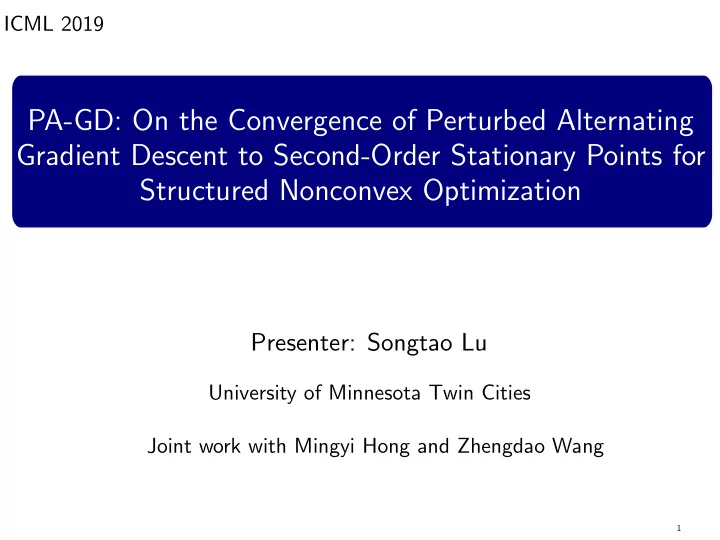
ICML 2019 PA-GD: On the Convergence of Perturbed Alternating Gradient Descent to Second-Order Stationary Points for Structured Nonconvex Optimization Presenter: Songtao Lu University of Minnesota Twin Cities Joint work with Mingyi Hong and


slide-1
SLIDE 1

1

Presenter: Songtao Lu

University of Minnesota Twin Cities ICML 2019 Joint work with Mingyi Hong and Zhengdao Wang

PA-GD: On the Convergence of Perturbed Alternating Gradient Descent to Second-Order Stationary Points for Structured Nonconvex Optimization

slide-2
SLIDE 2

2

Co-authors

Mingyi Hong Zhengdao Wang University of Minnesota Iowa State University

slide-3
SLIDE 3

3

Agenda

  • What we plan to achieve:

– Random perturbation: Convergence rate of alternating gradient descent (A-GD) to second-order stationary points (SOSPs) with high probability

  • Motivation

– A class of structured non-convex problems

  • Numerical Results

– Two-layer linear neural networks: – Matrix factorization

  • Concluding Remarks
slide-4
SLIDE 4

4

Block Structured Nonconvex Optimization

  • Consider the following problem

P : minimize

x,y

f(x, y)

  • f(x, y): Rd → R is a smooth nonconvex function

– x ∈ Rdx – y ∈ Rdy – d = dx + dy

slide-5
SLIDE 5

5

Motivation: Nice Landscapes

  • There are some nice/benign block structured problems [R.

Ge et al., 2017, J. Lee et al., 2018] – All local minima are global minima – Saddle points: very poor compared with local minima – Every saddle point: strict (Hessian matrix has at least

  • ne negative eigenvalue)
  • High dimensional problems: strict saddle points common

M: indefinite

[0, 0]T [0, 0]T [0, 0]T

minimize

x∈R2×1 xx

T − M2

F

local maximum strict saddle local minimum

slide-6
SLIDE 6

6

Optimality Conditions

  • Common definition of SOSPs
  • Common definition of first-order stationary points (FOSPs)

∇f(x, y) ≤ ǫ where ǫ > 0, then (x, y) is an ǫ-FOSP. If the following holds ∇f(x, y) ≤ ǫ, and λmin(∇2f(x, y)) ≥ −γ where ǫ, γ > 0, then (x, y) is an (ǫ, γ)-SOSP.

slide-7
SLIDE 7

7

Literature

Algorithms with convergence guarantees to SOSPs:

  • Second-order methods (one block)

– Trust region method [Conn et al., 2000] – Cubic regularized Newton’s method [Nesterov & Polyak, 2006] – Hybrid of first-order and second-order method [Reddi et al., 2018]

  • First-order methods (one block)

– Perturbed gradient descent (PGD) [Jin et al., 2017] – Stochastic first order method (NEgative-curvature-Originated-from-Noise, NEON, [Xu et al., 2017]) – Neon2 (finding local minima via first-order oracles) [Allen-Zhu et al., 2017] – Accelerated methods [Carmon et al., 2016][Jin et al., 2018][Xu et al., 2018] – Many more

slide-8
SLIDE 8

8

Literature

  • Block structured nonconvex optimization (asymptotic) :

– Block coordinate descent (BCD) [Song et al., 2017][Lee et al., 2017] – Alternating direction methods of multipliers (ADMM) [Hong et al., 2018]

  • Gradient descent can take exponential number of iterations to escape

saddle points [Du et al., 2017]

  • But none of these work has shown the convergence rate of block

coordinate descent to SOSPs, even for the two-block case.

slide-9
SLIDE 9

9

Motivation: Block Structured Nonconvex Problems

  • Many problems have block structures in nature.
  • We can have faster numerical convergence rates by

leveraging block structures of the problem.

slide-10
SLIDE 10

10

Motivation: Block Structured Nonconvex Problems

  • Matrix Factorization [Jain et al., 2013]

minimize

X∈Rn×k,Y∈Rm×k

1 2XY

T − M2

F

  • Matrix Sensing [Sun et al., 2014]

minimize

X∈Rn×k,Y∈Rm×k

1 2A(XY

T − M)2

F

A: linear measurement operator and satisfies the restricted isometry property (RIP) condition

slide-11
SLIDE 11

11

Motivation of This Work

Can we solve the nice block structured nonconvex problems to SOSP?

slide-12
SLIDE 12

12

Alternating Gradient Descent

x(t+1) = x(t) − η∇xf(x(t), y(t)) (1) y(t+1) = y(t) − η∇yf(x(t+1), y(t)) (2)

  • Iterates of A-GD [Bertsekas 1999]:
  • Step-size: η ≤ 1/Lmax
slide-13
SLIDE 13

13

Motivation of Alternating Gradient Descent

minimize

x1,x2

x

TMx

M = 1 a a 1

  • Whole problem: L = 1 + a
  • Block-wise: Lmax = 1

a = 1000

A-GD GD

slide-14
SLIDE 14

14

Motivation of Alernating Gradient Descent

  • A-GD:

– numerically good – may take a long time to escape from saddle points

  • PA-GD: numerically good and convergence rate guarantees
slide-15
SLIDE 15

15

Matrix Factorization

Convergence comparison between GD and PA-GD for learning a two-layer neural network, where ǫ = 10−10, gth = ǫ/10, tth = 10/ǫ1/2, r = ǫ/10.

A two-layer linear neural network: minimize

U∈Rn×k,V∈Rm×k l

  • i=1
  • yi − UVT

xi2

2 =

Y − UVT X2

F,

(3)

Y and X: n = 100, m = 40, k = 20, l = 20, CN(0, 1)

Proposed Gradient Descent

slide-16
SLIDE 16

16

Connection with Existing Works

Algorithm Iterations (ǫ, γ)-SOSP NEON+SGD [Xu and Yang, 2017] NEON2+SGD [Allen-Zhu and Li, 2017] NEON+ [Xu et al, 2017] PGD [Jin et al, 2017]

(ǫ, ǫ1/2) (ǫ, ǫ1/2) (ǫ, ǫ1/2) (ǫ, ǫ1/2)

  • O(1/ǫ4)
  • O(1/ǫ4)
  • O(1/ǫ7/4)
  • O(1/ǫ2)

Convergence rates of algorithms to SOSPs with the first order information, where p ≥ 4. PA-GD [This Work]

  • O(1/ǫ2)

(ǫ, ǫ1/2)

Accelerated PGD [Jin et al, 2018]

  • O(1/ǫ7/4)

(ǫ, ǫ1/2)

BCD [Song et al, 2017] BCD [Lee et al, 2017]

N/A N/A

(0, 0) (0, 0)

slide-17
SLIDE 17

17

Connection with Existing Works

Alternating gradient descent Gradient descent Asymptotic convergence to SOSPs Convergence rate to SOSPs This Work Jin, et al, 2017 Lee, et al, 2017 Lee, et al, 2017 Song, et al, 2017

slide-18
SLIDE 18

18

Challenge of the Problem

  • Consider a biconvex objective function

f(x, y) = [x, y] 1 2 2 1 x y

  • Variable Coupling
  • Block-wise: convex
  • Whole problem: nonconvex !
slide-19
SLIDE 19

19

Adding Random Noise

  • Initialize iterates at (0, 0)

A-GD A-GD + random noise

slide-20
SLIDE 20

20

Perturbed Gradient Descent

For t = 1, . . . , Step 1: Gradient descent Step 2: If the size of gradient is small (near saddle points) Step 3: If no decrease after perturbation over tth iterations return Add perturbation (extract negative curvature)

  • Perturbed gradient descent [Jin, et al 2017]
slide-21
SLIDE 21

21

Perturbed Alternating Gradient Descent

Input: z(1), η, r, gth, fth, tth Let z(t) = x(t) y(t)

  • For t = 1, . . . ,

Update x(t+1) by A-GD If ∇xf(x(t), y(t))2 + ∇yf(x(t+1), y(t))2 ≤ g2

th

and t − tpert > tth EndIf If t − tpert = tth and f(z(t)) − f( z(tpert)) > −fth return z(tpert) EndIf Add random perturbation to z(t) Update x(t+1) by A-GD

Thresholds:

  • gth: gradient size
  • fth: objective value
  • tth: number of iteration

Update y(t+1) by A-GD

slide-22
SLIDE 22

22

Perturbed Alternating Gradient Descent

  • z(t) ← z(t) and tpert ← t

z(t) = z(t) + ξ(t), random noise ξ(t) follows uniform distribution in the interval [0, r]

  • Add perturbation
  • tth: the minimum number of iterations between

adding two perturbations

slide-23
SLIDE 23

23

Main Assumptions

  • A1. Function f(x): smooth and has Lipschitz continuous gradient:

∇f(x) − ∇f(x′) ≤Lx − x′, ∀x, x′

  • A2. Function f(x): smooth and has block-wise Lipschitz continuous

gradient: ∇xf(x, y) − ∇xf(x′, y) ≤Lxx − x′, ∀x, x′ ∇yf(x, y) − ∇yf(x, y′) ≤Lyy − y′, ∀y, y′. Further, let Lmax := max{Lx, Ly} ≤ L.

  • A3. Function f(x) has Lipschitz continuous Hessian

∇2f(x) − ∇2f(x′) ≤ ρx − x′, ∀ x, x′

slide-24
SLIDE 24

24

Convergence Rate

Theorem 1. Under assumptions [A1]-[A3], when step-size η ≤ 1/Lmax, with high probability the iterates generated by PA-GD converge to an ǫ-SOSP (x, y) satisfying ∇f(x, y) ≤ ǫ, and λmin(∇2f(x, y)) ≥ −√ρǫ in the following number of iterations:

  • O

1 ǫ2

  • (4)

where O hides factor polylog(d).

slide-25
SLIDE 25

25

Convergence Analysis is Challenging (One Block)

  • The recursion of gradient descent (Mean Value Theorem):

x(t+1) = x(t) − η∇xf(x(t)) (5) = x(t) − η∇xf(0) − η 1 ∇2f(θx(t))dθ

  • x(t)

(6)

  • W.L.O.G set x(1) = 0

where θ ∈ [0, 1]

slide-26
SLIDE 26

26

Convergence Analysis is Challenging (Two Blocks)

  • The recursion of A-GD (Mean Value Theorem):

z(t+1) =

  • x(t+1)

y(t+1)

  • =
  • x(t)

y(t)

  • − η
  • ∇xf(x(t), y(t))

∇yf(x(t+1), y(t))

  • (7)

= z(t) − η∇f(0) − η 1 H(t)

l dθz(t+1) − η

1 H(t)

u dθz(t)

(8)

  • Recall: z(t) :=
  • x(t)

y(t)

  • and W.L.O.G set z(1) = 0

where θ ∈ [0, 1] H(t)

l

:=    ∇2

xyf(θx(t+1), θy(t)) 0

   H(t)

u :=

   ∇2

xxf(θx(t), θy(t))

∇2

xyf(θx(t), θy(t))

∇2

yyf(θx(t+1), θy(t))

   .

slide-27
SLIDE 27

27

Idea of Proof

  • Let z∗ be a strict saddle point, H = ∇2f(z∗) and z(1) = 0.
  • The dynamic of the perturbed gradient descent iterates:
  • The dynamic of the PA-GD iterates:

z(t+1) = (I − ηH)z(t) − η∆(t)z(t) − η∇f(0) (9) z(t+1) = M−1Tz(t) − ηM−1∆(t)

u z(t) − ηM−1∆(t) l z(t+1)

(10) M := I + ηHl, T := I − ηHu

Hu = ∇2

xxf(z∗)

∇2

xyf(z∗)

∇2

yyf(z∗)

  • Hl =
  • ∇2

yxf(z∗)

slide-28
SLIDE 28

28

Convergence Analysis

Lemma 1. Under assumptions [A1]–[A3], let H := ∇2f(z∗) denote the Hessian matrix at an ǫ-SOSP z where λmin(H) ≤ −γ and γ > 0. We have λmax(M−1T) > 1 + ηγ 1 + L/Lmax (11)

slide-29
SLIDE 29

29

Same Convergence Rate as GD and A-GD

Remark 1 Under assumptions [A1]-[A3], when the step-size is small enough, with high probability the iterates generated by gradient descent converge to an ǫ-FOSP x satisfying ∇f(x, y) ≤ ǫ in the following number of iterations: O 1 ǫ2

  • .

Remark 2 Comparison between PA-GD and GD (A-GD)

  • PA-GD has the same theoretical convergence rate as GD and A-GD up to

some logarithmic factor.

  • PA-GD can converge to SOSPs with provable convergence guarantee
slide-30
SLIDE 30

30

Numerical Results: Two-layer Linear Neural Network

  • Convergence comparison among GD, PGD and PA-GD for the two-layer

linear neural network, where ǫ = 10−10, gth = ǫ/10, tth = 10/ǫ1/2, r = ǫ/10.

Y and X are randomly generated with dimension n = 100, m = 40, k = 20, l = 20 and follow Gaussian distribution CN(0, 1) A two-layer linear neural network: minimize

U∈Rn×k,V∈Rm×k l

  • i=1
  • yi − UVT

xi2

2 =

Y − UVT X2

F,

(12)

  • Randomly initialize the algorithms around the origin
  • X := [

x1, . . . , xk] ∈ Rm×l: data matrix

  • Y := [

y1, . . . , yk] ∈ Rn×l: label matrix

slide-31
SLIDE 31

31

Numerical Results: Two-layer Linear Neural Network

  • Different step-sizes are used to show the best GD can achieve.

Gradient Descent: decrease

slide-32
SLIDE 32

32

Numerical Results: Two-layer Linear Neural Network

Perturbed Gradient Descent:

  • The same size-sizes used in PGD
slide-33
SLIDE 33

33

Numerical Results: Two-layer Linear Neural Network

Perturbed Alternating Gradient Descent:

  • The same size-sizes used in PA-GD
slide-34
SLIDE 34

34

Numerical Results: Matrix Factorization

  • Convergence comparison among GD, PGD and PA-GD for asymmetric

matrix factorization, where ǫ = 10−10, gth = ǫ/10, tth = 10/ǫ1/2, r = ǫ/10.

  • Ground truth: randomly generated matrix M∗ = U∗(V∗)T with

dimension n = 200, m = 20, k = 10 Consider the matrix factorization problem as the following [Zhu, et al.’ 17]: minimize

X∈Rn×k,Y∈Rm×k

1 2XYT − M∗2

F + µ

4XTX − YTY2

F

  • Randomly initialize the algorithms around the origin

where µ > 0.

slide-35
SLIDE 35

35

Numerical Results: Matrix Factorization

Gradient Descent: decrease

  • Different step-sizes are used to show the best GD can achieve.
slide-36
SLIDE 36

36

Numerical Results: Matrix Factorization

Perturbed Gradient Descent:

  • The same size-sizes used in PGD
slide-37
SLIDE 37

37

Numerical Results: Matrix Factorization

Perturbed Alternating Gradient Descent:

  • The same size-sizes used in PA-GD
slide-38
SLIDE 38

38

Conclusion, Ongoing Work and Open Problems

Conclusion:

  • We consider block structured nonconvex problems:

minimize

x,y

f(x, y)

  • Convergence rate of PA-GD to SOSPs

Ongoing work:

  • We consider nonconvex optimization problems with general

linear inequality constraints

  • Convergence rate of algorithms to SOSPs

Open Problems:

  • Convergence rate of multiple blocks of coordinate descent

algorithms (both unconstrained and constrained cases)

slide-39
SLIDE 39

39

Thank You!