= P ( t ) f ( x , y ) ds ( , t ) line A set of - - PowerPoint PPT Presentation

p t f x y ds t line a set of line integrals form a
SMART_READER_LITE
LIVE PREVIEW

= P ( t ) f ( x , y ) ds ( , t ) line A set of - - PowerPoint PPT Presentation

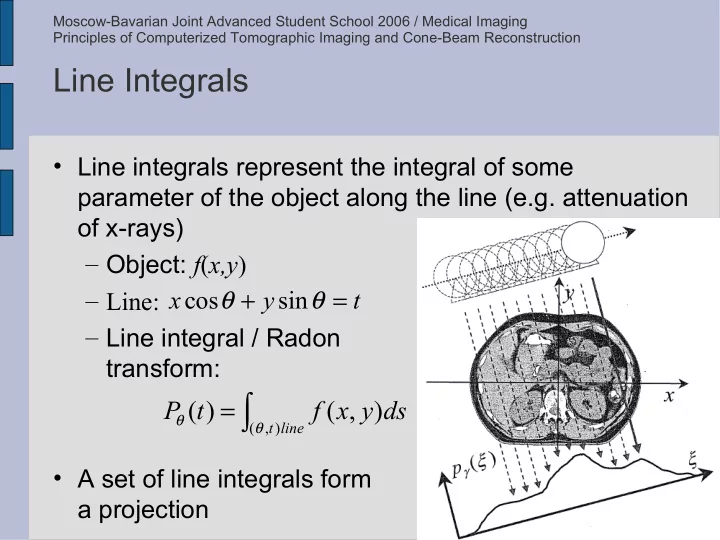
Moscow-Bavarian Joint Advanced Student School 2006 / Medical Imaging Principles of Computerized Tomographic Imaging and Cone-Beam Reconstruction Line Integrals Line integrals represent the integral of some parameter of the object along the


slide-1
SLIDE 1

Moscow-Bavarian Joint Advanced Student School 2006 / Medical Imaging Principles of Computerized Tomographic Imaging and Cone-Beam Reconstruction

Line Integrals

  • Line integrals represent the integral of some

parameter of the object along the line (e.g. attenuation

  • f x-rays)

– Object: f(x,y) – Line: – Line integral / Radon transform:

  • A set of line integrals form

a projection

=

line t

ds y x f t P

) , (

) , ( ) (

θ θ

t y x = + θ θ sin cos

slide-2
SLIDE 2

Moscow-Bavarian Joint Advanced Student School 2006 / Medical Imaging Principles of Computerized Tomographic Imaging and Cone-Beam Reconstruction

1st generation tomographs Rotation-translation pencil beam

  • Pencil beam, one detector
  • For one angle a set of parallel line integrals is taken

and form a projection. Then the angle is changed.

slide-3
SLIDE 3

Moscow-Bavarian Joint Advanced Student School 2006 / Medical Imaging Principles of Computerized Tomographic Imaging and Cone-Beam Reconstruction

2nd generation tomographs Rotation-translation fan beam

  • Fan beam (10°), ~30 detectors
  • Multiple line integrals along a fan are taken
  • simultaneously. Several parallel

steps are done for different angles

slide-4
SLIDE 4

Moscow-Bavarian Joint Advanced Student School 2006 / Medical Imaging Principles of Computerized Tomographic Imaging and Cone-Beam Reconstruction

3rd generation tomographs Rotation-rotation single slices

  • Fan beam (40°-60°), up to 1000 detectors
  • A projection used only line integrals following a fan. All

line integrals for one projection are taken simultaneously

  • No translation is necessary
slide-5
SLIDE 5

Moscow-Bavarian Joint Advanced Student School 2006 / Medical Imaging Principles of Computerized Tomographic Imaging and Cone-Beam Reconstruction

4th generation tomographs Rotation-fix closed detector array

  • Fan beam (40°-60°), up to 5000 fixed detectors
  • Rotation only, a translation is not necessary
slide-6
SLIDE 6

Moscow-Bavarian Joint Advanced Student School 2006 / Medical Imaging Principles of Computerized Tomographic Imaging and Cone-Beam Reconstruction

Purpose of tomography

  • Conventional X-Ray provides only

projections

– no spatial information – averaging of all slices

=> low contrast

  • Tomography tries to revert the

projection

slide-7
SLIDE 7

Moscow-Bavarian Joint Advanced Student School 2006 / Medical Imaging Principles of Computerized Tomographic Imaging and Cone-Beam Reconstruction

What is measured?

  • The beam intensity and therewith the loss of beam

intensity is measured

  • Loss of intensity due to:

– Photoelectric absorption – Compton effects – Pair production (PET)

  • Loss is energy-dependent
slide-8
SLIDE 8

Moscow-Bavarian Joint Advanced Student School 2006 / Medical Imaging Principles of Computerized Tomographic Imaging and Cone-Beam Reconstruction

What is measured?

  • μ is the attenuation coefficient of a material

representing the photon loss rate due to the Compton effect and photoelectric absorption. μ is given by

µ − = ∆ ⋅ ∆ x N N 1

slide-9
SLIDE 9

Moscow-Bavarian Joint Advanced Student School 2006 / Medical Imaging Principles of Computerized Tomographic Imaging and Cone-Beam Reconstruction

What is measured?

  • The intensity after passing through is given by:

,whereas μ is assumed to be constant.

  • As goes to zero we obtain

x ∆ x x N x N x x N ∆ − = ∆ + ) ( ) ( ) ( µ x ∆ ) ( ) ( ) ( lim x N dx dN x x N x x N

x

µ − = = ∆ − ∆ +

→ ∆

slide-10
SLIDE 10

Moscow-Bavarian Joint Advanced Student School 2006 / Medical Imaging Principles of Computerized Tomographic Imaging and Cone-Beam Reconstruction

What is measured?

  • Integration both sides

,we obtain

∫ ∫

− = dx x N dN µ ) (

C x N + − = µ ln

slide-11
SLIDE 11

Moscow-Bavarian Joint Advanced Student School 2006 / Medical Imaging Principles of Computerized Tomographic Imaging and Cone-Beam Reconstruction

What is measured?

  • The number of photons as function of the position is

given by: ,where Nin is the number of photons entering the

  • bject.
  • This is the Lambert-Beer law
  • This is only true for an x-ray beam consisting of

monochromatic photons and a constant μ.

[ ]

x N x N

in

µ − = exp ) (

slide-12
SLIDE 12

Moscow-Bavarian Joint Advanced Student School 2006 / Medical Imaging Principles of Computerized Tomographic Imaging and Cone-Beam Reconstruction

What is measured?

  • μ(x,y) denotes the attenuation coefficient of a body
  • The number of exiting photons is given by:
  • This is only true for an x-ray beam consisting of

monochromatic photons.

     − =

ray in d

ds y x N N ) , ( exp µ

slide-13
SLIDE 13

Moscow-Bavarian Joint Advanced Student School 2006 / Medical Imaging Principles of Computerized Tomographic Imaging and Cone-Beam Reconstruction

Monochromatic and polychromatic x-ray

  • Monochromatic: X-ray beam consists only of photons

with the same energy (in practice this type of x-ray is not used)

  • Polychromatic: X-ray consists
  • f a spectrum of photons with

different energy

  • Beam hardening => Artifacts

[ ]

∫ ∫ − = dE ds E y x E S N

in d

) , , ( exp ) ( µ

slide-14
SLIDE 14

Moscow-Bavarian Joint Advanced Student School 2006 / Medical Imaging Principles of Computerized Tomographic Imaging and Cone-Beam Reconstruction

Detectors

  • Xenon ionization detectors
  • X-ray photons enter the detector chamber and ionize
  • gas. The resulting current is measured.
  • Used in 3rd generation tomographs
slide-15
SLIDE 15

Moscow-Bavarian Joint Advanced Student School 2006 / Medical Imaging Principles of Computerized Tomographic Imaging and Cone-Beam Reconstruction

Detectors

  • Scintillation detectors: Using a

crystal the x-ray is transformed into photons with longer

  • wavelength. These are measured

using photo diodes.

  • Used in 4th generation

tomographs

slide-16
SLIDE 16

Moscow-Bavarian Joint Advanced Student School 2006 / Medical Imaging Principles of Computerized Tomographic Imaging and Cone-Beam Reconstruction

Hounsfield scale

  • Defined by Sir Godfrey Newbold Hounsfield
  • 0 Hounsfield Units (HU) defined as

radiodensity of distilled water

  • -1000 HU defined as radiodensity
  • f air
  • Corresponds to the linear

attenuation coefficient by:

  • 1000

Air

  • 100

Fat Water 22-32 White matter 36-46 Grey matter 56-76 Congealed blood 80-1000 Calcification 80-1000 Bone Approx. value Substance

1000 × − =

water water

H µ µ µ