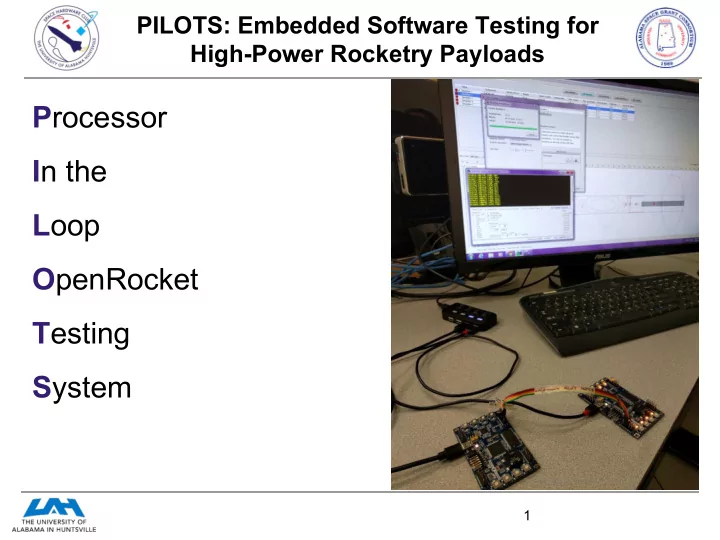
P rocessor I n the L oop O penRocket T esting S ystem 1 Who are we? - - PowerPoint PPT Presentation

p rocessor i n the l oop o penrocket t esting s ystem
SMART_READER_LITE
LIVE PREVIEW

P rocessor I n the L oop O penRocket T esting S ystem 1 Who are we? - - PowerPoint PPT Presentation

PILOTS: Embedded Software Testing for High-Power Rocketry Payloads P rocessor I n the L oop O penRocket T esting S ystem 1 Who are we? Daniel Corey Sarah Dangelo Junior Sophomore Mechanical Engineering Mechanical Engineering SHC 2016-2017


slide-1
SLIDE 1

1

PILOTS: Embedded Software Testing for High-Power Rocketry Payloads

Processor In the Loop OpenRocket Testing System

slide-2
SLIDE 2

2

Who are we?

Sarah Dangelo Sophomore Mechanical Engineering SHC CanSat Systems Engineer Daniel Corey Junior Mechanical Engineering SHC 2016-2017 Vice President March 4th launch of Awww, Thanks with data collection payloads

slide-3
SLIDE 3

What is the Space Hardware Club?

3

slide-4
SLIDE 4

What problem are we trying to solve?

4

Club-designed and built electronics are used in most projects Electrical systems can be tested on the ground, but software failures are very common and hard to test

A new multistage rocketry project requires more extensive testing

slide-5
SLIDE 5

Why not test software with real rockets?

5

  • Opportunities are infrequent and expensive
  • Software development usually involves very frequent testing

Failures can be dangerous and costly

Image credit: XB Software

Other failures can prevent a meaningful software test

slide-6
SLIDE 6

Why not recreate the environmental conditions of a rocket flight?

6 Testing a CanSat in a vacuum chamber

slide-7
SLIDE 7

Can we simulate a rocket flight?

7 Sensor emulating and rocket simulating board (left), CanSat electronics (right)

slide-8
SLIDE 8

How can we improve that?

8 Embedded Simulator OpenRocket 6 degrees of freedom simulation 4th-5th order Runge- Kutta (adaptive step size) Easy to change rocket design and parameters 1-axis simulation 4th order Runge-Kutta Rocket design in simulator code

slide-9
SLIDE 9

9

How did we change OpenRocket?

slide-10
SLIDE 10

10

How does the sensor emulator work?

Image credit: MS5607 datasheet

slide-11
SLIDE 11

11

What are our results so far?

slide-12
SLIDE 12

12

What are our results so far?

slide-13
SLIDE 13

13

What do we still plan to do?

More Sensors

  • MPU9250 Inertial

Measurement Unit

  • Other accelerometers
  • GPS
  • Analog sensors
  • More pressure sensors

Image credit: SparkFun Electronics

Features to Add

  • Sensor selection and configuration through

user interface

  • Binary feedback (ejection charges)
  • PWM feedback (servo motors)

Bugs to Fix

  • Limited SPI clock speeds
  • Static pressures on

supersonic flights

  • Parachute deployment via

ejection charge

  • Does not properly release

serial ports upon simulation completion

slide-14
SLIDE 14

14

Who would we like to thank?

  • The UAH Space Hardware Club
  • Dr. Francis Wessling, UAH SHC Advisor
  • Dr. Brian Landrum, UAH AIAA Advisor
  • Elena Pradhan