
SLIDE 1
JAVA Basics & OOP
Kuan-Ting Lai 2020/3/14
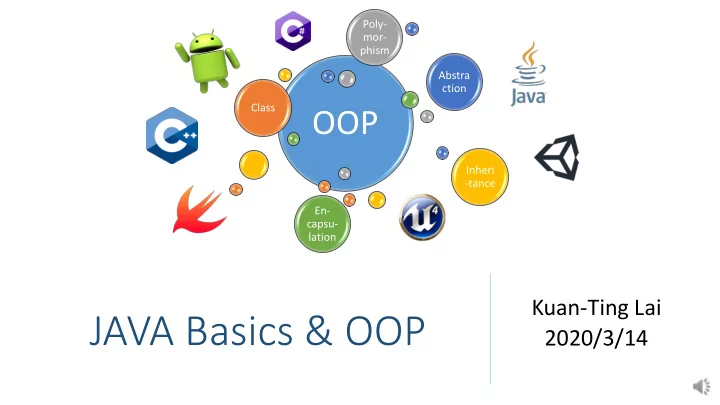
OOP
Class Abstra ction Inheri
- tance
En- capsu- lation Poly- mor- phism
JAVA Basics & OOP 2020/3/14 Write Once, Run Anywhere Java - - PowerPoint PPT Presentation
Poly- mor- phism Abstra ction Class OOP Inheri -tance En- capsu- lation Kuan-Ting Lai JAVA Basics & OOP 2020/3/14 Write Once, Run Anywhere Java Virtual Machine (JVM) http://net-informations.com/java/intro/jvm.htm Java Overview
Class Abstra ction Inheri
En- capsu- lation Poly- mor- phism
http://net-informations.com/java/intro/jvm.htm
called “Oak” initially
free and open-source
− 'C:\WINDOWS\SYSTEM32;c:\Program Files\java\jdk\bin’
− export PATH = /path/to/java:$PATH
C:\> javac MyFirstJavaProgram.java C:\> java MyFirstJavaProgram Hello World
public class MyFirstJavaProgram { public static void main(String []args) { System.out.println("Hello World"); // prints Hello World } }
− Example: class MyFirstJavaClass
− Example: public void myMethodName()
− MyFirstJavaProgram.java
− width, height
− total_shapes
− w, h
public class Shape { int width; int height; static int total_shapes = 0; void setWidth(int w) { width = w; } void setHeight(int h) { height = h; } }
public class Shape { int width; int height; public Shape(int a=0, int b=0) { width = a; height = b; } void setWidth(int w) { width = w; } void setHeight(int h) { height = h; } }
equivalent of a destructor in C++
at the discretion of the garbage collector
a close method and use finalize only for sanity checking (i.e. if close has not been called do it now and log an error).
protected void finalize( ) { // finalization code here } https://stackoverflow.com/questions/171952/is-there-a-destructor-for-java
the current class, with in an instance method or a constructor
class Student { int age; Student() { this(20); } Student(int age) { this.age = age; } }
public class SwappingExample { public static void main(String[] args) { int a = 30; int b = 45; System.out.println("Before swapping, a = " + a + " and b = " + b); // Invoke the swap method swapFunction(a, b); System.out.println("\n**Before and After swapping values will be same here**:"); System.out.println("After swapping, a = " + a + " and b = " + b); } public void swapFunction(int a, int b) { System.out.println("Before swapping(Inside), a = " + a + " b = " + b); // Swap n1 with n2 int c = a; a = b; b = c; System.out.println("After swapping(Inside), a = " + a + " b = " + b); } }
7.700000000000001
import java.io.*; public class ShapeTest { public static void main(String args[]) { Shape shape = new Shape(3.5, 2.2); System.out.println(shape.area()); } } public class Shape { double width = 0; double height = 0; Shape(double a, double b) { width = a; height = b; } double area() { return width * height; } }; Shape.java ShapeTest.java
− public, private, protected
− static, final, abstract − synchronized, volatile
public class className { // ... } private boolean myFlag; static final double weeks = 9.5; protected static final int BOXWIDTH = 42; public static void main(String[] arguments) { // body of method }
public class Test { public static void main(String args[]) { int [] numbers = {10, 20, 30, 40, 50}; for(int x : numbers ) { System.out.print( x ); System.out.print(","); } System.out.print("\n"); String [] names = {"James", "Larry", "Tom", "Lacy"}; for( String name : names ) { System.out.print( name ); System.out.print(","); } } }
if (….) { … } else if (….) { … } else { … }
switch (….) { case 0: … break; case 0: … break; default: … }
Exp1 ? Exp2 : Exp3;
Condition Conditional Code True False
these are not handled by the Java programs
− Example: JVM is out of memory
try { // Protected code } catch (ExceptionName e1) { // Catch block }
try { file = new FileInputStream(fileName); x = (byte)file.read(); } catch (FileNotFoundException f) { f.printStackTrace(); return -1; } catch (IOException i) { i.printStackTrace(); return -1; } finally { System.out.println("The finally statement is executed"); }
public class StringDemo { public static void main(String args[]) { char[] helloArray = { 'h', 'e', 'l', 'l', 'o', '.' }; String helloString = new String(helloArray); System.out.println( helloString ); } }
public class StringDemo { public static void main(String args[]) { String string1 = "saw I was "; System.out.println("Dot " + string1 + "Tod"); } }
Method Name Description int length() Returns the length of this string. char charAt(int index) Returns the character at the specified index. int compareTo(String anotherString) Compares two strings lexicographically. byte[] getBytes(String charsetName) Encodes this String into a sequence of bytes using the named charset, storing the result into a new byte array. int indexOf(int ch) Returns the index within this string of the first occurrence of the specified character. int lastIndexOf(int ch) Returns the index within this string of the last occurrence of the specified character, searching backward starting at the specified index. String replace(char oldChar, char newChar) Returns a new string resulting from replacing all
String substring(int beginIndex) Returns a new string that is a substring of this string. String[] split(String regex) Splits this string around matches of the given regular expression. String trim() Remove leading and trailing whitespace.
public class TestArray { public static void main(String[] args) { double[] myList = {1.9, 2.9, 3.4, 3.5}; // Print all the array elements for (int i = 0; i < myList.length; i++) { System.out.println(myList[i] + " "); } }
import java.util.Date; public class DateDemo { public static void main(String args[]) { // Instantiate a Date object Date date = new Date(); // display time and date using toString() System.out.println(date.toString()); } } C:> on May 04 09:51:52 CDT 2009 import java.util.*; import java.text.*; public class DateDemo { public static void main(String args[]) { Date dNow = new Date( ); SimpleDateFormat ft = new SimpleDateFormat ("E yyyy.MM.dd 'at' hh:mm:ss a zzz"); System.out.println("Current Date: " + ft.format(dNow)); } } C:> Current Date: Sun 2004.07.18 at 04:14:09 PM PDT
import java.io.*; public class CopyFile { public static void main(String args[]) throws IOException { FileInputStream in = null; FileOutputStream out = null; try { in = new FileInputStream("input.txt");
int c; while ((c = in.read()) != -1)
} finally { if (in != null) in.close(); if (out != null)
} } }
enum Level { LOW, MEDIUM, HIGH } public class MyClass { public static void main(String[] args) { Level myVar = Level.MEDIUM; System.out.println(myVar); } }
class SuperClass { ..... ..... } class SubClass extends SuperClass { ..... ..... }
https://stackoverflow.com/questions/180601/using-super-in-c
class Superclass { int age; Superclass(int age) { this.age = age; } public void getAge() { System.out.println("The value of the variable named age in super class is: " + age); } } public class Subclass extends Superclass { Subclass(int age) { super(age); } public static void main(String args[]) { Subclass s = new Subclass(24); s.getAge(); } }
public class Animal { } public class Mammal extends Animal { } public class Reptile extends Animal { } public class Dog extends Mammal { } class Animal class Mammel class Dog class Reptile
https://ramj2ee.blogspot.com/2015/08/java-tutorial-inheritance-has.html
class Animal {} class Mammal extends Animal {} public class Dog extends Mammal { public static void main(String args[]) { Mammal m = new Mammal(); Dog d = new Dog(); System.out.println(m instanceof Animal); System.out.println(d instanceof Mammal); System.out.println(d instanceof Animal); } }
class Animal { public void move() { System.out.println("Animals can move"); } } class Dog extends Animal { public void move() { System.out.println("Dogs can walk and run"); } } public class TestDog { public static void main(String args[]) { Animal a = new Animal(); // Animal reference and object Animal b = new Dog(); // Animal reference but Dog object a.move(); // runs the method in Animal class b.move(); // runs the method in Dog class } }
− if a class has at least one abstract method, then the class must be abstract − If a class is declared abstract, it cannot be instantiated − To use an abstract class, you have to inherit it from another class, provide implementations to the abstract methods in it.
public abstract class Shape { void setWidth(int w) { width = w; } void setHeight(int h) { height = h; } public abstract int area(); int width; int height; };
private.
methods to modify and view the variables values.
class Student { private String name; private String id; private int age; public int getAge() { return age; } public String getName() { return name; } public String getId() { return id; } public void setAge(int newAge) { age = newAge; } public void setName(String newName) { name = newName; } public void setId(String newId) { id = newId; } }
are abstract
instance fields, only static and final field
interfaces
interface Animal { public void eat(); public void travel(); } public class MammalInt implements Animal { public void eat() { System.out.println("Mammal eats"); } public void travel() { System.out.println("Mammal travels"); } public static void main(String args[]) { MammalInt m = new MammalInt(); m.eat(); m.travel(); } }
public interface Hockey extends Sports, Event package java.util; public interface EventListener {}
− .\com\apple\computers\Dell.java
package com.apple.computers; public class Dell { … } …
− javac -d destination_folder file_name.java
− import java.lang.String − import java.lang.*