
7/18/16 1
Liang, Introduction to Java Programming, Tenth Edition, (c) 2015 Pearson Education, Inc. All rights reserved.
1
Chapter 1: Introduction to Computers, Programs, and Java
CS1: Java Programming Colorado State University
Original slides by Daniel Liang Modified slides by Chris Wilcox
Liang, Introduction to Java Programming, Tenth Edition, (c) 2015 Pearson Education, Inc. All rights reserved.
2
Objectives
✦ To understand computer basics, programs, and operating systems (§§1.2–1.4). ✦ To describe the relationship between Java and the World Wide Web (§1.5). ✦ To understand the meaning of Java language specification, API, JDK, and IDE
(§1.6).
✦ To write a simple Java program (§1.7). ✦ To display output on the console (§1.7). ✦ To explain the basic syntax of a Java program (§1.7). ✦ To create, compile, and run Java programs (§1.8). ✦ To use sound Java programming style and document programs properly (§1.9). ✦ To explain the differences between syntax errors, runtime errors, and logic
errors (§1.10).
✦ To develop Java programs using NetBeans (§1.11). ✦ To develop Java programs using Eclipse (§1.12).
Liang, Introduction to Java Programming, Tenth Edition, (c) 2015 Pearson Education, Inc. All rights reserved.
3
What is a Computer?
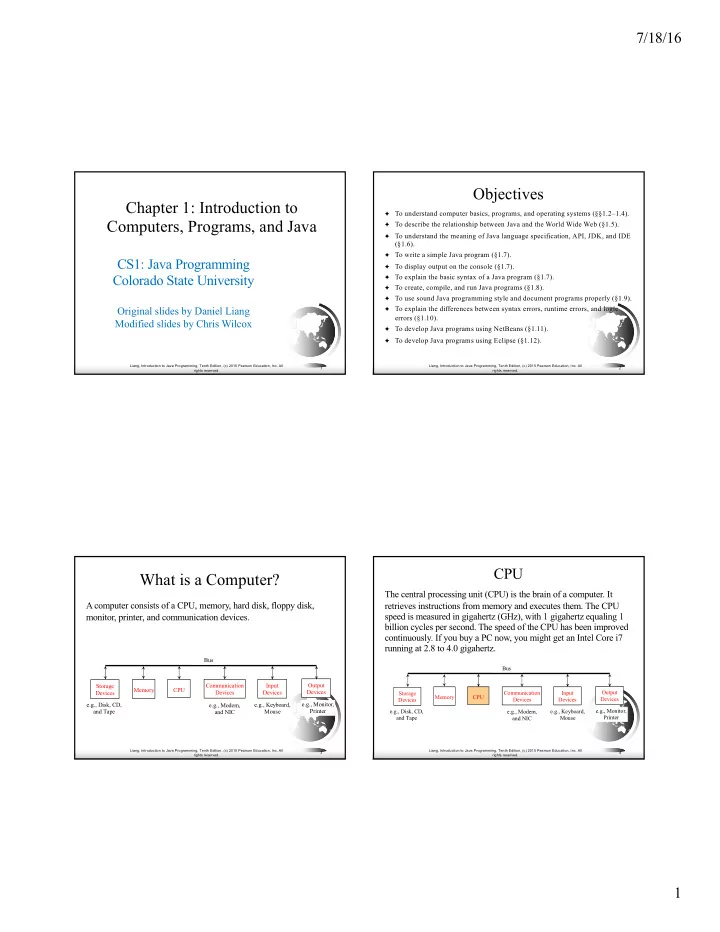
A computer consists of a CPU, memory, hard disk, floppy disk, monitor, printer, and communication devices.
CPU e.g., Disk, CD, and Tape Input Devices e.g., Keyboard, Mouse e.g., Monitor, Printer Communication Devices e.g., Modem, and NIC Storage Devices Memory Output Devices Bus
Liang, Introduction to Java Programming, Tenth Edition, (c) 2015 Pearson Education, Inc. All rights reserved.
4
CPU
The central processing unit (CPU) is the brain of a computer. It retrieves instructions from memory and executes them. The CPU speed is measured in gigahertz (GHz), with 1 gigahertz equaling 1 billion cycles per second. The speed of the CPU has been improved
- continuously. If you buy a PC now, you might get an Intel Core i7
running at 2.8 to 4.0 gigahertz.
CPU e.g., Disk, CD, and Tape Input Devices e.g., Keyboard, Mouse e.g., Monitor, Printer Communication Devices e.g., Modem, and NIC Storage Devices Memory Output Devices Bus