P R I VAT B A H N MAGAZIN 01/2009 October/November MAGAZIN R I - - PDF document

p
SMART_READER_LITE
LIVE PREVIEW

P R I VAT B A H N MAGAZIN 01/2009 October/November MAGAZIN R I - - PDF document

European_PriMa_Streifen_Blau:Eur P R I VAT B A H N MAGAZIN 01/2009 October/November MAGAZIN R I VAT B A H N P I TECHNOLOGY I LOGISTICS I COMPANIES I TRANSPORT POLICY I N O I T I D E N A E E U P R O Interview Michael


slide-1
SLIDE 1

PRIMA EUROPEAN EDITION 01.2009

1

E U R O P E A N E D I T I O N

European_PriMa_Streifen_Blau:Eur

R I VAT B A H N

MAGAZIN

01/2009 October/November

Vossloh locomotives

G6: With 3 axles through narrow bends

Interview

Michael Clausecker General Director of the Association of the Euro- pean Railway Industry

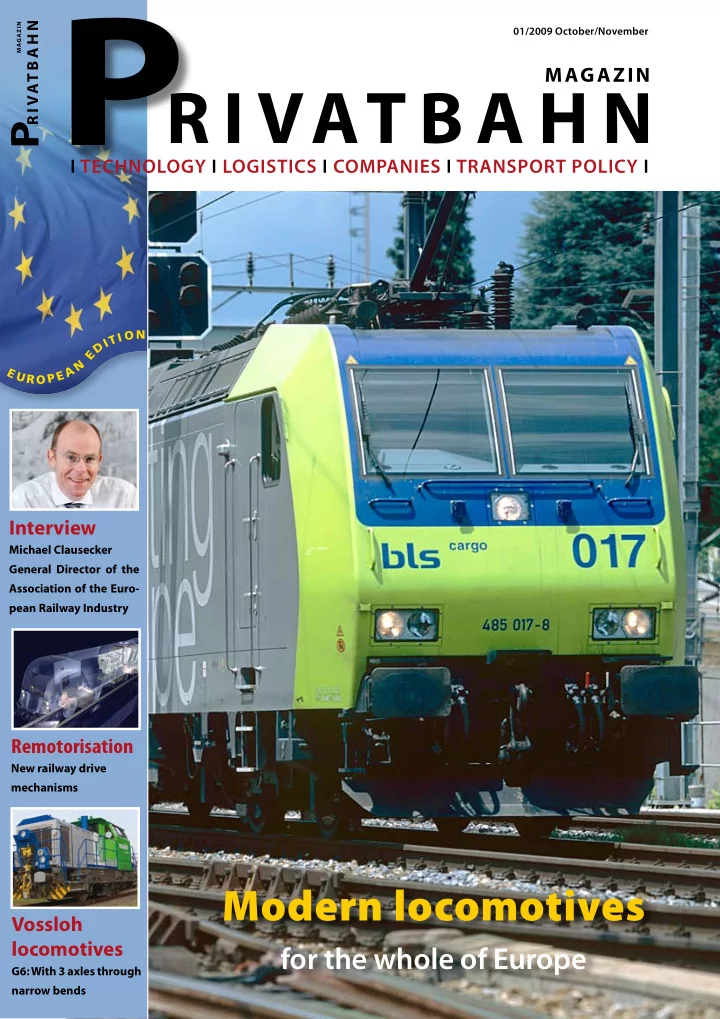
Modern locomotives

for the whole of Europe

Remotorisation

New railway drive mechanisms

P

R I VAT B A H N

P

MAGAZIN

I TECHNOLOGY I LOGISTICS I COMPANIES I TRANSPORT POLICY I

slide-2
SLIDE 2

PRIMA EUROPEAN EDITION 01.2009

12

PRIMA: Dr. Thomas, many traf- fjc services in the fjeld of the re- gional rail transport will be put

  • ut to tender in the years to come.

However, a recent call for tenders in Berlin/Brandenburg showed that there is no real competition effect at the moment as a result of the current crisis of the fjnancial

  • markets. Do you see any possibi-

lities to support the regional rail transport permanently so that the achievements of previous years are not at stake?

  • Dr. Frank Thomas: The recessi-
  • n in Germany and the negative

effects of the fjnancial crisis have clearly demonstrated that the German PTA’s have to reconsi- der certain elements of the tender process to stabilize and further increase the competition. One

  • f the key factors limiting the

competition in regional passen- ger transport is the lack of attrac- tive fjnancing and the mismatch between the concession periods and the useful life of respective rolling stock. Most train opera- tors will not have the capabilities to purchase new rolling stock and to take the asset risk, hence this development will need to be sup- ported by the PTA’s. This could be achieved e.g. by offering bankable further-use guarantees, the formation of rolling stock pools or other structures which allow the involvement of the fa- vourable fjnancing conditions or credit risk of the public sector. Furthermore it will be important that the PTAs will provide fair and attractive tender conditions (e.g. fmeet size, asset specifjcation, risk sharing mechanism) to create more competition. PRIMA: There are consistent calls for further-use guarantees for vehicles. How do you evalu- ate these claims?

  • Dr. Frank Thomas: We clearly

realize a need for residual value risks to be shared between the fjnanciers, the operator and the PTA’s. In comparison with the plain responsibility of the train

  • perator to procure the rolling

stock, the additional agreement of a “further-use guarantee” has the advantage, that the rolling stock may be used until full amortisati-

  • n. The minimisation of the risk
  • f further use after the expiry of

the concession agreement, gene-

  • Dr. Frank Thomas, partner of K&L Gates, in interview

„We need a push for more competition and better financing“

Frank Thomas joined K&L Gates as a partner in January 2009. Prior to joining the fjrm, he was a partner in the Frankfurt offjce of an international law fjrm. Dr. Thomas has extensive experience in structured fjnance, asset fjnance and equip- ment leasing with a particular focus on transport fjnance.

slide-3
SLIDE 3

PRIMA EUROPEAN EDITION 01.2009

13

rally leads to favourable fjnan- cing conditions. However, for the time being we have not seen any bankable redeployment gu- arantees in the market. Further- more there are certain insolven- cy law issues which needs to be considered when entering into a further-use guarantee. PRIMA: With regard to the eco- nomic crisis and the concomitant economic superiority of the na- tional railway, would it actually be appropriate to allude to a real competition at all?

  • Dr. Frank Thomas: It is obvi-
  • us that competition in regional

passenger transport in Germany has at least stagnated in the last 12 months. Deutsche Bahn as sta- te owned operator benefjts from the current market conditions and continues to dominate the market. However, according to offjcial fjgures of the Working Group of the PTAs for regional passenger rail transport (Bundesarbeitsge- meinschaft der Aufgabenträger des SPNV) the market share of private operators is approx. 16%. In compression to other Europe- an states this seems to be a good level of competition which of course needs to be further incre- ased over the next years. PRIMA: The freight traffjc has

  • problems. Which concrete con-

cepts to you see to help the rele- vant companies?

  • Dr. Frank Thomas: In the fjrst

instance it will be important to increase the industry production and the export in the EU back to normal conditions. In the short- run sale-and-lease-back trans- actions for freight wagons and locomotives might be advisable to free up capital and increase

  • liquidity. This could be for ex-

ample structured in the form of a German closed- end KG funds. Important aspects of operation are to ensure the non-discrimi- natory access to the rail network and the reduction of the technical deviations in the EU. PRIMA: The liberalization and the changing of the markets re- quire customized rolling stock

  • fjnancing. Which future leasing-

and fjnancing models do you think will prove most successful?

  • Dr. Frank Thomas: New rol-

ling stock will need fjnancing and much of this will also in the futu- re come through operating lease

  • structures. However, leasing has

established itself as a fmexible and important fjnancing tool during the past decade, so also fjnance leases, asset fjnance structures and to a limited amount tax leases will be used for fjnancing rolling stock in the future. Furthermore there will be a great demand for long term debt fjnancing and non- recourse facilities. By the way, we will discuss future leasing- and fjnancing models during our annual rail fjnance conference on

  • 5. November 2009 in Frankfurt.

The program can be downloaded

  • n our website ww.klgates.com.

PRIMA: Dr. Thomas, thank you very much for your time. Interview by Ulrich Vössing.

Deutsche Bahn as state owned operator benefjts from the current market condi- tions and continues to dominate the market. Picture: DB AG

Interview | Germany