
SLIDE 1
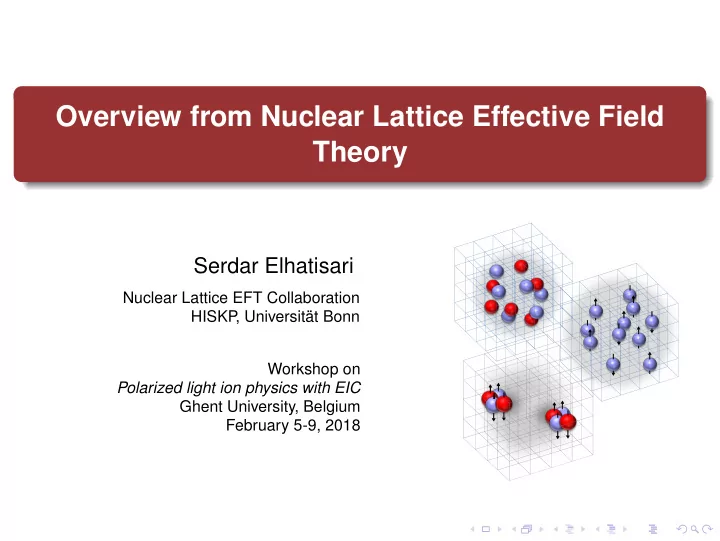
Overview from Nuclear Lattice Effective Field Theory
Serdar Elhatisari
Nuclear Lattice EFT Collaboration HISKP , Universität Bonn Workshop on Polarized light ion physics with EIC Ghent University, Belgium February 5-9, 2018
Overview from Nuclear Lattice Effective Field Theory Serdar - - PowerPoint PPT Presentation
Overview from Nuclear Lattice Effective Field Theory Serdar Elhatisari Nuclear Lattice EFT Collaboration HISKP , Universitt Bonn Workshop on Polarized light ion physics with EIC Ghent University, Belgium February 5-9, 2018 Nuclear
Serdar Elhatisari
Nuclear Lattice EFT Collaboration HISKP , Universität Bonn Workshop on Polarized light ion physics with EIC Ghent University, Belgium February 5-9, 2018
Nuclear Lattice Effective Field Theory collaboration
Serdar Elhatisari (Bonn) Evgeny Epelbaum (Bochum) Nico Klein (Bonn) Hermann Krebs (Bochum) Timo Lähde (Jülich) Dean Lee (MSU) Ning Li (MSU) Bing-Nan Lu (MSU) Thomas Luu (Jülich) Ulf-G. Meißner (Bonn/Jülich) Gautam Rupak (MSU) Gianluca Stellin (Bonn)
Outline
Introduction Lattice effective field theory Adiabatic projection method : scattering and reactions on the lattice Degree of locality of nuclear forces Nuclear clusters : probing for alpha clusters Pinhole Algorithm : density profiles for nuclei Summary
Ab initio nuclear structure and nuclear scattering
✷ nuclear structure :
4/4/2017 nuchart1.gif (1054×560) http://rarfaxp.riken.go.jp/~gibelin/Nuchart/nuchart1.gif 1/1
Source: rarfaxp.riken.go.jp/ gibelin/Nuchart/
✷ nuclear scattering : ... processes relevant for stellar astrophysics
✄ scattering of alpha particles : 4He+4He→4He+4He ✄ triple-alpha reaction : 4He + 4He + 4He → 12C + γ ✄ alpha capture on carbon : 4He + 12C → 16O + γ . . .
Progress in ab initio nuclear structure and nuclear scattering
Unexpectedly large charge radii of neutron-rich calcium isotopes.
Garcia Ruiz et al., Nature Phys. 12, 594 (2016).
Structure of 78Ni from first principles computations.
Hagen, Jansen, & Papenbrock, PRL 117, 172501 (2016).
A nucleus-dependent valence-space approach to nuclear structure.
Stroberg et al., PRL 118, 032502 (2017).
Ab initio many-body calculations of the 3H(d, n)4He and 3He(d, p)4He fusion.
Navratil & Quaglioni, PRL 108, 042503 (2012). 3He(α,γ)7Be and 3H(α,γ)7Li astrophysical S factors from the no-core shell model with
continuum Dohet-Eraly, J. et al. PLB B 757 (2016) 430-436. Elastic proton scattering of medium mass nuclei from coupled-cluster theory.
Hagen & Michel PRC 86, 021602 (2012).
Coupling the Lorentz Integral Transform (LIT) and the Coupled Cluster (CC) Methods.
Orlandini, G. et al. , Few Body Syst. 55, 907-911 (2014).
Nuclear LEFT: ab initio nuclear structure and scattering theory
✷ Lattice EFT calculations for A = 3, 4, 6, 12 nuclei, PRL 104 (2010) 142501 ✷ Ab initio calculation of the Hoyle state, PRL 106 (2011) 192501 ✷ Structure and rotations of the Hoyle state, PRL 109 (2012) 252501 ✷ Viability of Carbon-Based Life as a Function of the Light Quark Mass,
PRL 110 (2013) 112502
✷ Radiative capture reactions in lattice effective field theory,
PRL 111 (2013) 032502
✷ Ab initio calculation of the Spectrum and Structure of 16O,
PRL 112 (2014) 102501
✷ Ab initio alpha-alpha scattering, Nature 528, 111-114 (2015). ✷ Nuclear Binding Near a Quantum Phase Transition, PRL 117, 132501 (2016). ✷ Ab initio calculations of the isotopic dependence of nuclear clustering.
PRL 119, 222505 (2017).
! ! ! !λ E – EαA/4
αα∞ ααλ λ λ λ
25 Lattice effective field theory
Lattice effective field theory is a powerful numerical method formulated in the framework of chiral effective field theory. 𝑏 𝑀 Nucleons
Accessible by Lattice EFT
early universe gas of light nuclei heavy-ion collisions quark-gluon plasma excited nuclei neutron star core nuclear liquid superfluid
10
10
10
1 10 1 100 r
N
r [fm
] T [MeV]
neutron star crust
Accessible by Lattice QCD
Chiral EFT for nucleons: nuclear forces
Chiral effective field theory organizes the nuclear interactions as an expansion in powers of momenta and other low energy scales such as the pion mass (Q/Λχ) .
2
N LO N LO
3
NLO LO 3N force 4N force 2N force
Ordonez et al. ’94; Friar & Coon ’94; Kaiser et al. ’97; Epelbaum et al. ’98,’03,’05,’15; Kaiser ’99-’01; Higa et al. ’03; ...
Chiral EFT for nucleons: NN scattering phase shifts
10 20 30 40 50 60 70 80 50 100 150 200
δ(1S0) [degrees] pCM [MeV]
NPWA LO NLO,N2LO N3LO 40 60 80 100 120 140 160 180 50 100 150 200
δ(3S1) [degrees] pCM [MeV]
2 4 6 8 10 50 100 150 200
ε1 [degrees] pCM [MeV]
2 4 6 8 10 50 100 150 200
ε2 [degrees] pCM [MeV]
5 10 50 100 150 200
δ(1P1) [degrees] pCM [MeV]
5 10 15 20 50 100 150 200
δ(3P0) [degrees] pCM [MeV]
5 50 100 150 200
δ(3P1) [degrees] pCM [MeV]
2 4 6 8 10 12 14 50 100 150 200
δ(3P2) [degrees] pCM [MeV]
2 4 6 8 10 50 100 150 200
δ(1D2) [degrees] pCM [MeV]
2 50 100 150 200
δ(3D1) [degrees] pCM [MeV]
2 4 6 8 10 12 14 16 50 100 150 200
δ(3D2) [degrees] pCM [MeV]
1 2 3 4 5 50 100 150 200
δ(3D3) [degrees] pCM [MeV]
Lattice Monte Carlo calculations
Transfer matrix operator formalism M = : exp(−H at) : Microscopic Hamiltonian H = Hfree + V Z(Lt) = Tr(MLt) = Dc Dc∗ exp[−S(c, c∗)]
Creutz, Found. Phys. 30 (2000) 487.
The exact equivalence of several different lattice formulations.
Lee, PRC 78:024001, (2008); Prog.Part.Nucl.Phys., 63:117-154 (2009)
e−E0 at = lim
Lt→∞ Z(Lt+1)/Z(Lt)
These amplitudes are computed with the Hybrid Monte Carlo methods.
Lattice Monte Carlo calculations
Nuclear forces posses approximate SU(4) symmetry. HSU(4) acts as an approximate and inexpensive low energy filter at few first/last time steps. Significant suppression of sign oscillations. Chen, Lee, Schäfer, PRL 93 (2004) 242302
|ψI(τ′) = [MSU(4)]L′
t |ψI
MSU(4) = : e−at HSU(4) : τ′ = L′
t at
For time steps in midsection, the full HLO Hamiltonian is used.
|ψI(τ) = [MLO]Lt |ψI(τ′) MLO = : e−at HLO : τ = Lt at
The ground state energy at LO can be extracted from
e−ELO at = lim
Lt→∞
Z(Lt+1)
LO
Z(Lt)
LO
= lim
Lt→∞
ψI(τ/2)|MLO|ψI(τ/2) ψI(τ/2)|ψI(τ/2)
Lattice Monte Carlo calculations
Higher order calculations (perturbative)
ho = NLO, NNLO, · · · Mho = : e−at(HLO+Vho) :
where the potential Vho is treated perturbatively. The higher order correction to the ground state energy can be extracted from
e−∆Eho at = Z(Lt+1)
ho
Z(Lt+1)
LO
= ψI(τ/2)|Mho|ψI(τ/2) ψI(τ/2)|MLO|ψI(τ/2)
Lattice Monte Carlo calculations
Compute observable O
The observable O at LO
O0,LO = lim
Lt→∞
ψI|[MLO]Lt O [MLO]Lt|ψI ψI|[MLO]2Lt+1|ψI
The observable O at (NLO, NNLO, · · · )
O0,ho = lim
Lt→∞
ψI|[MLO]Lt−1 Mho O [MLO]Lt|ψI ψI|[MLO]Lt Mho [MLO]Lt|ψI
Lattice EFT: (Euclidean time) projection Monte Carlo e−Hτ τ = Ltat
✷ evolve nucleons forward in Euclidean time ✷ allow them to interact 𝛒 𝛒
Euclidean time
𝑏 𝑀
Auxiliary field Monte Carlo
Use a Gaussian integral identity exp
2
2 =
2π
2 + √ C s
fluctuating background of pion fields and auxiliary fields.
𝛒 𝛒
Euclidean time
𝒕 𝒕𝑱 𝒕𝝆
Adiabatic projection method
Scattering and reactions on the lattice
The first part use Euclidean time projection to construct an ab initio low-energy cluster Hamiltonian, called the adiabatic Hamiltonian. The second part compute the two-cluster scattering phase shifts or reaction amplitudes using the adiabatic Hamiltonian.
Rupak, Lee., PRL 111 (2013) 032502. Pine, Lee, Rupak, EPJA 49 (2013) 151. SE, Lee, PRC 90, 064001 (2014). Rokash, Pine, SE, Lee, Epelbaum, Krebs, PRC 92,054612 (2015) SE, Lee, Meißner, Rupak, EPJA 52: 174 (2016)
−/2
0.5 1 10 20 30 40 50 60 R(p) 0 (r) r (fm) free
0.5 1 10 20 30 40 50 60 R(p) 0 (r) r (fm) interacting
0.5 1 10 20 30 40 50 60 R(p) 0 (r) r (fm) Rw
Adiabatic projection method
The method constructs a low energy effective theory for the clusters. Use initial states parameterized by the relative spatial separation between clusters, and project them in Euclidean time.
R = ∑
R1 ⊗ |
𝑆
𝑜𝑦, 𝑜𝑧 𝑜𝑦
′ , 𝑜𝑧 ′
Rτ = e−H τ | R
dressed cluster state The adiabatic projection in Euclidean time gives a systematically improvable description of the low- lying scattering cluster states. In the limit of large Euclidean projection time the description becomes exact.
Adiabatic projection method
| Rτ = e−H τ | R
dressed cluster state (not orthogonal) Hamiltonian matrix
[Hτ]
R, R′ = τ
R|H| R′τ
Norm matrix
[Nτ]
R, R′ = τ
R| R′τ [Ha
τ] R, R′ = ∑
R′′′
τ
R′′ [Hτ] R′′ R′′′
τ
R′
The structure of the adiabatic Hamiltonian,[Ha
τ] R, R′ , is similar to the Hamiltonian
matrix used in calculations of ab initio no-core shell model/resonating group method (NCSM/RGM) for nuclear scattering and reactions.
Navratil, Quaglioni, PRC 83, 044609 (2011). Navratil, Roth, Quaglioni, PLB 704, 379 (2011). Navratil, Quaglioni, PRL 108, 042503 (2012).
Adiabatic projection method
The radiative capture process p(n, γ)d.
10 20 50 70 100 10
10
10
10
δ = 0.6 δ = 0.4 δ = 0 δ = 0.6 δ = 0.4 δ = 0
10 20 50 70 100 p (MeV) 20 40 60 80
δ = 0.6 δ = 0.4 δ = 0 δ = 0.6 δ = 0.4 δ = 0
|M| (MeV−2) φ (deg) Rupak, Lee., PRL 111 (2013) 032502.
N − d scattering.
−90 −75 −60 −45 −30 −15 20 40 60 80 100 120 140
Quartet−S
Breakup −90 −75 −60 −45 −30 −15 20 40 60 80 100 120 140
Quartet−S
Breakup
p−d (EFT)
−90 −75 −60 −45 −30 −15 20 40 60 80 100 120 140
Quartet−S
Breakup
n−d (EFT)
−90 −75 −60 −45 −30 −15 20 40 60 80 100 120 140
Quartet−S
Breakup
n−d
−90 −75 −60 −45 −30 −15 20 40 60 80 100 120 140
Quartet−S
Breakup
p−d p (MeV) δ0 (degrees) SE, Lee, Meißner,Rupak. EPJ 52:174 (2016).
Alpha-alpha scattering
S-wave D-wave
δ0 (degrees) ELab (MeV) Afzal et al. LO (no Coulomb) NLO NNLO 40 80 120 160 200 2 4 6 8 10 12 δ0 (degrees) ELab (MeV) 40 80 120 160 200 2 4 6 8 10 12
δ0 (degrees) ELab (MeV) 120 150 180 1 2 3 δ0 (degrees) ELab (MeV)
Higa et al.
120 150 180 1 2 3
δ2 (degrees) ELab (MeV) Afzal et al. LO (no Coulomb) NLO NNLO 40 80 120 160 200 2 4 6 8 10 12 δ2 (degrees) ELab (MeV) 40 80 120 160 200 2 4 6 8 10 12 δ2 (degrees) ELab (MeV) 40 80 120 160 200 2 4 6 8 10 12
Afzal, Ahmad, Ali, Rev. Mod. Phys. 41, 247 (1969) Higa, Hammer, van Kolck, Nucl.Phys. A809, 171 (2008) SE, Lee, Rupak, Epelbaum, Krebs, Lähde, Luu, Meißner, Nature 528, 111-114 (2015)
Degree of locality of nuclear forces
Interaction A Interaction B
Nonlocal short-range interactions V(r, r′) One-pion exchange interaction (+ Coulomb interaction) Local short-range interactions V(r, r′) = U(r)δ(r − r′) Nonlocal short-range interactions V(r, r′) One-pion exchange interaction (+ Coulomb interaction)
r r r′
Local Nonlocal
Introducing the nonlocal short-range interactions reduce the Monte Carlo sign oscillation significantly.
Degree of locality of nuclear forces
Interaction A Interaction B
Nonlocal short-range interactions V(r, r′) One-pion exchange interaction (+ Coulomb interaction) Local short-range interactions V(r, r′) = U(r)δ(r − r′) Nonlocal short-range interactions V(r, r′) One-pion exchange interaction (+ Coulomb interaction)
20 40 60 80 50 100 150
a
60 120 180 50 100 150
b
5 50 100 150
c
5 10 15 50 100 150
d
Nijmegen PWA Continuum LO Lattice LO-A Lattice LO-B
50 100 150
δ or ε (deg) e
2 4 6 50 100 150
f
1 2 3 50 100 150
g
50 100 150
h
5 10 50 100 150
i
1 50 100 150
j
5 50 100 150
pcms (MeV) k
50 100 150
l
Nucleus A (LO) B (LO) A (LO + Coulomb) B (LO + Coulomb) Experiment
3H
3He
4He
Degree of locality of nuclear forces
4He – 4He S-wave scattering
δ0 (degrees) ELab (MeV) Afzal et al.
45 90 135 180 2 4 6 8 10 δ0 (degrees) ELab (MeV) A (LO) A (LO + Coulomb) B (LO) B (LO + Coulomb)
45 90 135 180 2 4 6 8 10
Nucleus A (LO) B (LO) A (LO + Coulomb) B (LO + Coulomb) Experiment
8Be
12C
16O
20Ne
SE, Li, Rokash, Alarcon, Du, Klein, Lu, Meißner, Epelbaum, Krebs, Lähde, Lee, Rupak, PRL 117, 132501 (2016)
Degree of locality of nuclear forces
Interaction A Interaction B
Nonlocal short-range interactions V(r, r′) One-pion exchange interaction (+ Coulomb interaction) Local short-range interactions V(r, r′) = U(r)δ(r − r′) Nonlocal short-range interactions V(r, r′) One-pion exchange interaction (+ Coulomb interaction)
20 40 2 2.5 3 3.5 4 4.5 5 5.5 6 VTB (MeV) r (fm) A (LO) B (LO) C (LO)
r r r′
Local Nonlocal
Tight-binding approximation
The alpha-alpha interaction is sensitive to the degree of locality of the interaction.
Nuclear binding near a quantum phase transition
Nucleus A (LO) B (LO) A (LO + Coulomb) B (LO + Coulomb) Experiment
4He
8Be
12C
16O
20Ne
E8Be E4He = 1.997(6) E12C E4He = 3.00(1) E16O E4He = 4.00(2) E20Ne E4He = 5.03(3)
Nuclear binding near a quantum phase transition
Nucleus A (LO) B (LO) A (LO + Coulomb) B (LO + Coulomb) Experiment
4He
8Be
12C
16O
20Ne
V = (1 − λ)VA + λVB
! ! ! !
λ E – EαA/4
αα∞ αα
λ λ λ λ
25
Ground state energies at LO
Nuclear clusters: probing for alpha clusters
ρ( n) : the total nucleon density operator on the lattice site n . ρ4 = ∑
: ρ4( n)/4! : is defined to construct a probe for alpha clusters . Similarly ρ3 is to construct a second probe for alpha clusters only in nuclei with even Z and even N where 3H and 3He clusters are not energetically favorable. ρ3 = ∑
: ρ3( n)/3! : ρ3 and ρ4 depend on the short-distance regulator, the lattice spacing a. However the regularization-scale dependence of ρ3 and ρ4 does not depend on the nucleus being considered. Therefore, by defining ρ3,α and ρ4,α as the corresponding values for the alpha particle, we consider the ratios ρ3/ρ3,α and ρ4/ρ4,α that are free from short-distance divergences and are model-independent quantities up to contributions from higher-dimensional op- erators in an operator product expansion.
Nuclear clusters: probing for alpha clusters
∆ρ3
α /Nα
the ρ3-entanglement of the alpha clusters , where ∆ρ3
α = ρ3/ρ3,α − Nα .
𝑂𝛽 = 4 𝑂𝛽 = 3 𝑂𝛽 = 2 𝑂𝛽 = 1
Nucleus
4,6,8He 8,10,12,14Be 12,14,16,18,20,22C 16,18,20,22,24,26,28O
∆
ρ3 α /Nα
0.0 − 0.03 0.20 − 0.35 0.25 − 0.50 0.50 − 0.75
Nuclear clusters: probing for alpha clusters
Our results show that the transition from cluster-like states in light systems to nuclear liquid-like states in heavier systems should not be viewed as a simple suppression of multi-nucleon short-distance correlations, but rather an increasing entanglement of the nucleons involved in the multi-nucleon correlations.
SE, Epelbaum, Krebs, Lähde, Lee, Li, Lu, Meißner, Rupak, PRL 119, 222505 (2017)
Density profiles for nuclei: pinhole algoritm
The simulations with auxiliary-field Monte Carlo methods involve quantum states that are super- position of many different center-of-mass positions. Therefore, the density distrubitions of the nucleons cannot be computed direclty. Consider a screen placed at the middle time step having pinholes with spin and isospin labels that allow nucleons with the corresponding spin and isospin to pass.
Euclidean time
𝜐𝑗 = 0 𝜐𝑗 = 𝜐 𝜐/2
𝑗1, 𝑘1 𝑗8, 𝑘8 𝑗5, 𝑘5 𝑗4, 𝑘4 𝑗6, 𝑘6 𝑗3, 𝑘3 𝑗7, 𝑘7 𝑗2, 𝑘2
Density profiles for nuclei: pinhole algoritm
This opaque screen corresponds to the insertion of the normal-ordered A-body density operator,
ρi1,j1,...,iA,jA( n1, . . . , nA) = : ρi1,j1( n1) . . . ρiA,jA( nA) :
where ρi,j(
n) = a†
i,j(
n)ai,j( n) is the density operator for nucleon with spin i and isospin j.
We performe Monte Carlo sampling of the amplitude,
Ai1,j1,...,iA,jA( n1, . . . , nA, Lt) = ψI(τ)|ρi1,j1,...,iA,jA( n1, . . . , nA)|ψI(τ)
Euclidean time
𝜐𝑗 = 0 𝜐𝑗 = 𝜐 𝜐/2
𝑗1, 𝑘1 𝑗8, 𝑘8 𝑗5, 𝑘5 𝑗4, 𝑘4 𝑗6, 𝑘6 𝑗3, 𝑘3 𝑗7, 𝑘7 𝑗2, 𝑘2
Pinhole algoritm: proton and neutron densities
Pinhole algoritm: 12C and 14C electric form factor
The magnitude of the 12C electric form factor
0.5 1 1.5 2 2.5 3 q (fm-1) 10-4 10-3 10-2 10-1 100 |F(q)| experiment Lt = 7 Lt = 9 Lt = 11 Lt = 13 Lt = 15
The magnitude of the 14C electric form factor
0.5 1 1.5 2 2.5 3 q (fm-1) 10-4 10-3 10-2 10-1 100 |F(q)| experiment Lt = 7 Lt = 9 Lt = 11 Lt = 13 Lt = 15 SE, Epelbaum, Krebs, Lähde, Lee, Li, Lu, Meißner, Rupak, PRL 119, 222505 (2017)
Pinhole algoritm: measure of alpha cluster geometry
SE, Epelbaum, Krebs, Lähde, Lee, Li, Lu, Meißner, Rupak, PRL 119, 222505 (2017)
Summary
Scattering and reaction processes involving alpha particle are in reach of ab initio methods and this has opened the door towards using experimental data from collisions of heavier nuclei as input to improve ab initio nuclear structure theory. Understanding of the connection between the degree of locality of nuclear forces and nuclear structure has led to a more efficient set of lattice chiral EFT interactions (to be proven by the higher order corrections). The pinhole algorithm has been developed for the auxiliary-field Monte Carlo methods for the calculation of arbitrary density correlations with respect to the center of mass.