Over er-Archi ching T ng Topi opics: cs: V Var ariant ants - - PowerPoint PPT Presentation

over er archi ching t ng topi opics cs v var ariant ants
SMART_READER_LITE
LIVE PREVIEW

Over er-Archi ching T ng Topi opics: cs: V Var ariant ants - - PowerPoint PPT Presentation

Over er-Archi ching T ng Topi opics: cs: V Var ariant ants Prioritizing functionalization which genes to focus on? Biological axes to organize activities for high throughput functional characterization (a la Nancy Cox


slide-1
SLIDE 1

Over er-Archi ching T ng Topi

  • pics:

cs: V Var ariant ants

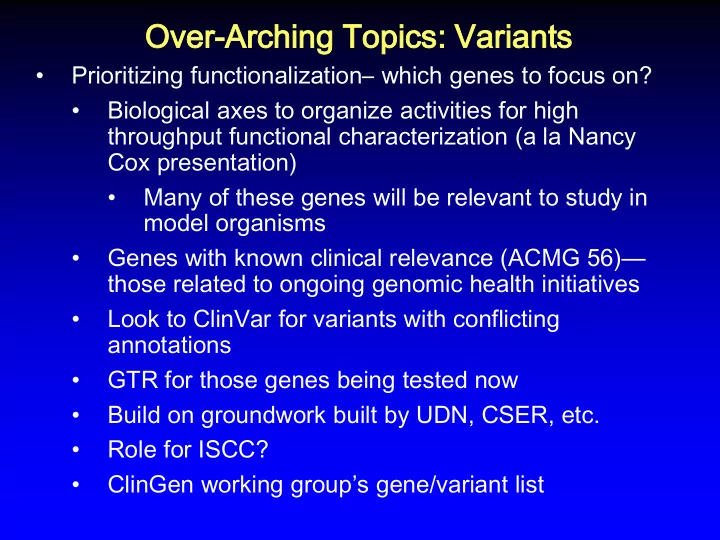
  • Prioritizing functionalization– which genes to focus on?
  • Biological axes to organize activities for high

throughput functional characterization (a la Nancy Cox presentation)

  • Many of these genes will be relevant to study in

model organisms

  • Genes with known clinical relevance (ACMG 56)—

those related to ongoing genomic health initiatives

  • Look to ClinVar for variants with conflicting

annotations

  • GTR for those genes being tested now
  • Build on groundwork built by UDN, CSER, etc.
  • Role for ISCC?
  • ClinGen working group’s gene/variant list
slide-2
SLIDE 2

Var ariant ants… c cont

  • ntinued

nued

  • What evidence to move variants from unknown to

known function class?

  • Domain of ACMG/AMP to develop evidence

guidelines

  • Our role is to build the resources to help these

groups with this process

  • Bring basic researchers to the table in

developing the guidelines

  • Infrastructure for bidirectional exchange of

phenotype/genotype

  • Evidence criteria to demonstrate clinical utility of

variants

  • Assays here should minimize inferential distance of

assay to disease phenotype (Les B)

slide-3
SLIDE 3

Over er-Archi ching T ng Topi

  • pics:

cs: P Phenot henotype pe

  • Need for deep phenotypes in those with unusual

genotypes

  • What is “deep” may change depending on patient

presentation, etc. – avoid unproductive diligence!

  • Work with journals on publishing guidelines for “minimal

phenotyping assays for X”

  • EMR phenotypes designed more for data-driven models
  • f clinical features, methods to functionalize, not billing
  • Engage pt-derived phenotyping in data collection tools
  • Common vocabularies, phenotype exchange formats,

mappings across vocabularies and databases/resources

  • Awareness and feedback from user communities

important

slide-4
SLIDE 4

Over er-Archi ching T ng Topi

  • pics:

cs: B Bridgi dging t ng the he Gap ap

  • Data sharing and resource integration
  • Increase awareness/use of available standards and

awareness

  • Integration of resources on variants
  • variant, functional predictions, phenotype

associations

  • Better understanding of perspectives: clinicians
  • If clinical study is only acceptable evidence for utility
  • f a variant, how to change this culture/mindset to

accept conditional probabilities

  • Make it clear what the evidence is
  • Make reports clearer
  • Use cases
slide-5
SLIDE 5

Over er-Archi ching T ng Topi

  • pics:

cs: B Bridgi dging t ng the he Gap ap (2) 2)

  • Better understanding of perspectives: basic sci
  • Increased awareness across communities of

standard and resources that do exist

  • Expand Matchmaker approach to other domains– “need

mouse model of variant X”

  • Innocentive challenge model?

Reach out to NSF and NIGMS

  • Enhanced interactions of bench and clinic
  • Major challenge is knowing what each other’s

questions are

  • Can start with developing/using agreed upon lines of

evidence and data standards

  • Share findings/results, not of use to a particular

research question but potentially useful to someone else

slide-6
SLIDE 6

Over er-Archi ching T ng Topi

  • pics:

cs: B Bridgi dging t ng the he Gap ap (3) 3)

  • How to foster opportunities for informal interactions
  • Chance meetings in the hotel lobby, flight delay

conversations

  • Help get workshop sessions approved at specialized

conferences

  • Often difficult to get approved for workshops on utility
  • f model organism databases at meetings like ASHG,

for example

  • Coursera course?
slide-7
SLIDE 7

Ses essi sion 1

  • n 1 – Magni

Magnitude ude of

  • f the

he Probl

  • blem

em

  • Evidence from animal models unlikely to

convince clinicians

  • w/o clinical studies even multiple lines of evidence is a hard sell
  • Getting access to full patient data critical for

basic labs

  • What to “put in medical record” and how to

reduce risk of misuse

  • not unique to genomics
  • Significant problem clinically is legacy of

portraying genetic results as definitive

  • Embrace ambiguity!
slide-8
SLIDE 8

Ses essi sion 2

  • n 2 – Vex

exing C ng Clini nical cal P Probl

  • blem

ems

  • How to expand to all infants in ICU: what

evidence needed to support it

  • Develop algorithms for when pts need

WES/WGS: 20K patients?

  • Pressure of DTC testing overshadowing settings

where have compelling case for implementation

  • How to quantify “inferential distance” from

experimental phenotype to clinical picture

  • Identify set of functional assays and specific

results that would move a variant’s classification to be more definitive

slide-9
SLIDE 9

Ses essi sion 3

  • n 3 – From V
  • m Var

ariant ant t to

  • Disea

sease se Mec Mechani hanism sms

  • Difficulty defining who’s unaffected as resolution of

phenotyping is so low

  • Next-gen phenotyping– specific to condition
  • Collecting phenotype data
  • “patient derived phenotyping” – DTC already engaged in this
  • Difficulties in extracting phenotyping data from EMR
  • Terminologies often designed for billing, not data mining

Harness ongoing “phenomic efforts” supported by NIH and integrate with genomic information

  • Involve clinicians to add clinical terms to existing model
  • rganism phenotype ontologies in systematic mapping

effort

slide-10
SLIDE 10

Ses essi sion 3

  • n 3 – From V
  • m Var

ariant ant t to

  • Disea

sease se Mec Mechani hanism sms ( (cont

  • nt)
  • Need explanatory algorithms of why computer

comes to given classification

  • More intensive study of very healthy elderly

individuals with genotyping, deep phenotyping

  • Genome-first approaches need much better

phenotyping

  • Much success in diagnosis with imprecise

diagnoses and imperfect clinicians of today

  • Must have dialogue between clinician and lab
slide-11
SLIDE 11

Ses essi sion 4

  • n 4 – Comput
  • mputat

ational

  • nal A

Appr pproache

  • aches t

s to

  • Var

ariant ant F Func unction P

  • n Predi

edict ction

  • n
  • Need to be able to link phenotypes to genotypes

in ExAC and similar databases; regulatory support for data aggregation

  • Need uniformly ascertained cases for wide

variety of diseases – NIH disease studies

  • Regulatory guidance on use of European

samples

  • How to prioritize genes for functional studies
  • Some index of clinical need over all genes?
  • Actionability?
slide-12
SLIDE 12

Ses essi sion 4

  • n 4 – Comput
  • mputat

ational

  • nal A

Appr pproache

  • aches t

s to

  • Var

ariant ant F Func unction P

  • n Predi

edict ction

  • n
  • Honest broker model needed for phenotype data

release; currently only entity with permission to store and share ExAC data is Broad

slide-13
SLIDE 13

Ses essi sion 5

  • n 5 – Func

unctional

  • nalizing V

ng VUSs

  • Lots of exciting technologies emerging for functionalizing

variants..need opportunities for interaction between technology developers and clinical researchers to “direct the ship” toward scaling technologies in ways that are relevant to clinical are needed

  • Prioritization of genes for characterization
  • Genes related to genomic health initiatives
  • Variants used in different contexts- diagnosis, possible

therapy, genetic basis of resilience

  • Need for standard vocabularies for functional

consequence/evidence nomenclature/variant nomenclature

  • Some efforts underway…how to raise awareness?
slide-14
SLIDE 14

Ses essi sion 5

  • n 5 – Func

unctional

  • nalizing V

ng VUSs ( s (cont

  • nt.)
  • Develop list of resources relevant to bridging the gap between

basic and clinical

  • Use a pathway context to assist in functional assertions
  • Link Model Organism Databases more closely with Clinical

Database

slide-15
SLIDE 15

Ses essi sion 6

  • n 6 – Biomedi
  • medical

cal P Phenot henotype pe Ont ntol

  • logi
  • gies

es

  • Standards for encoding and exchanging data
  • Standards exist for genes….but what about

environment, phenotypes

  • Computable evidence model can aid variant

interpretation

  • Share the processes for data integration and

resource development..as important as sharing data

  • Data submission/collection