Outline The Esterel Language Introduction to Esterel and Existing - - PowerPoint PPT Presentation

outline the esterel language
SMART_READER_LITE
LIVE PREVIEW

Outline The Esterel Language Introduction to Esterel and Existing - - PowerPoint PPT Presentation

Outline The Esterel Language Introduction to Esterel and Existing Compilers Developed by G erard Berry starting 1983 My Software Compiler [DAC 2000, TransCAD 2002] Originally for robotics applications Compiling Esterel My Hardware Compiler


slide-1
SLIDE 1

Compiling Esterel

Stephen A. Edwards Department of Computer Science, Columbia University www.cs.columbia.edu/˜sedwards sedwards@cs.columbia.edu

Outline

Introduction to Esterel and Existing Compilers My Software Compiler [DAC 2000, TransCAD 2002] My Hardware Compiler [SLAP 2002, IWLS 2002]

The Esterel Language

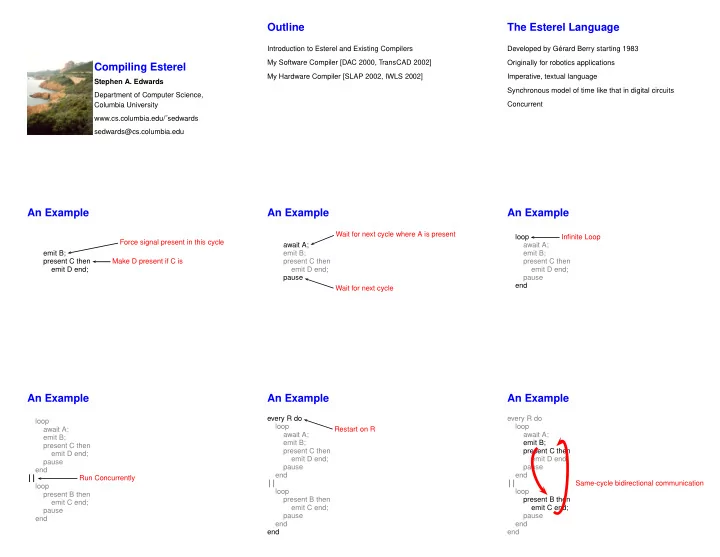
Developed by G´ erard Berry starting 1983 Originally for robotics applications Imperative, textual language Synchronous model of time like that in digital circuits Concurrent

An Example

emit B; Force signal present in this cycle present C then Make D present if C is emit D end;

An Example

await A; Wait for next cycle where A is present emit B; present C then emit D end; pause Wait for next cycle

An Example

loop Infinite Loop await A; emit B; present C then emit D end; pause end

An Example

loop await A; emit B; present C then emit D end; pause end || Run Concurrently loop present B then emit C end; pause end

An Example

every R do Restart on R loop await A; emit B; present C then emit D end; pause end || loop present B then emit C end; pause end end

An Example

every R do loop await A; emit B; present C then emit D end; pause end || Same-cycle bidirectional communication loop present B then emit C end; pause end end

slide-2
SLIDE 2

An Example

every R do loop await A; emit B; present C then emit D end; pause end || loop present B then emit C end; pause end end Good for hierarchical FSMs Bad at manipulating data Hardware Esterel variant proposed to address this

Automata Compilers

Esterel is a finite-state language, so build an automata: loop emit A; await C; emit B; pause end switch (s) { case 0: A = 1; s = 1; break; case 1: if (C) { B = 1; s = 0; } break; } V1, V2, V3 (INRIA/CMA) [Berry, Gonthier 1992] Fastest known code; great for programs with few states. Does not scale; concurrency causes state explosion.

Netlist-based Compilers

loop emit A; await C; emit B; pause end entry A C B A = entry || s2q; cf = !C && s1q; s1d = cf || A; B = s2d = C && s1q; Clean semantics, scales well, but inefficient. Can be 100 times slower than automata code.

Discrete-Event Based Compilers

SAXO-RT [Weil et al. 2000] Divides Esterel program into event functions dispatched by a fixed scheduler. loop emit A; await C; emit B; pause end

unsigned curr = 0x1; unsigned next = 0; static void f1() { A = 1; curr &= ˜0x1; next |= 0x2; } static void f2() { if (!C) return; B = 1; curr &= ˜0x2; next |= 0x1; } void tick() { if (curr & 0x1) f1(); if (curr & 0x2) f2(); curr |= next; next = 0; }

My Esterel Compiler for Software

Presented at DAC 2000 (also TransCAD 2002) Used inside Synopsys’ CoCentric System Studio to generate control code

Overview

every R do loop await A; emit B; present C then emit D end; pause end || loop present B then emit C end; pause end end R 1 s 2 A B B C C D s=2 s=1 R 1 s 2 A B t=0 t=1 B C t 1 C D s=2 s=1

if ((s0 & 3) == 1) { if (S) { s3 = 1; s2 = 1; s1 = 1; } else if (s1 >> 1) s1 = 3; else { if ((s3 & 3) == 1) { s3 = 2; t3 = L1; } else { t3 = L2; }

Esterel Concurrent Sequential C code Source CFG CFG

Translate every

every R do loop await A; emit B; present C then emit D end; pause end || loop present B then emit C end; pause end end R

Add Threads

every R do loop await A; emit B; present C then emit D end; pause end || loop present B then emit C end; pause end end R

Split at Pauses

every R do loop await A; emit B; present C then emit D end; pause end || loop present B then emit C end; pause end end R 1 s 2 s=2 s=1

slide-3
SLIDE 3

Add Code Between Pauses

every R do loop await A; emit B; present C then emit D end; pause end || loop present B then emit C end; pause end end R 1 s 2 A B C D s=2 s=1

Translate Second Thread

every R do loop await A; emit B; present C then emit D end; pause end || loop present B then emit C end; pause end end R 1 s 2 A B B C C D s=2 s=1

Finished Translating

every R do loop await A; emit B; present C then emit D end; pause end || loop present B then emit C end; pause end end R 1 s 2 A B B C C D s=2 s=1

Add Dependencies and Schedule

every R do loop await A; emit B; present C then emit D end; pause end || loop present B then emit C end; pause end end R 1 s 2 A B B C C D s=2 s=1

Run First Node

R 1 s 2 A B B C C D s=2 s=1 R

Run First Part of Left Thread

R 1 s 2 A B B C C D s=2 s=1 R 1 s 2 A B

Context Switch

R 1 s 2 A B B C C D s=2 s=1 R 1 s 2 A B t=0 t=1

Run Right Thread

R 1 s 2 A B B C C D s=2 s=1 R 1 s 2 A B t=0 t=1 B C

Context Switch

R 1 s 2 A B B C C D s=2 s=1 R 1 s 2 A B t=0 t=1 B C t 1

slide-4
SLIDE 4

Finish Left Thread

R 1 s 2 A B B C C D s=2 s=1 R 1 s 2 A B t=0 t=1 B C t 1 C D s=2 s=1

Completed Example

R 1 s 2 A B B C C D s=2 s=1 R 1 s 2 A B t=0 t=1 B C t 1 C D s=2 s=1

Size of Generated Code on an UltraSparc-II

4K 32K 256K 2M Automata Netlist OptNetlist ContextSwitch EventDriven 50 100 200 500 1000 2k 5k Nodes

Average Cycle Times on an UltraSparc-II

Automata Netlist OptNetlist ContextSwitch EventDriven 100us 10us 1us 0.1us 50 100 200 500 1000 2k 5k Nodes

Size of Generated Code on a Pentium

Automata Netlist OptNetlist ContextSwitch EventDriven 4K 32K 256K 50 100 200 500 1000 2k 5k Nodes

Average Cycle Times on a Pentium

Automata Netlist OptNetlist ContextSwitching EventDriven 1ms 100us 10us 1us 0.1us 50 100 200 500 1000 2k 5k Nodes

My Esterel Compiler for Hardware

The ESUIF Open Source Esterel Compiler (Work in Progress) Presented at SLAP 2002, IWLS 2002

Translation to CCFG

every S do await I; weak abort sustain R when immediate A; emit O || loop pause; pause; present R then emit A end end end

S s2 s3 I R R A A 1 1 2 O s3=1 s3=2 s2=0 s2=0 s2=1 s2=2 s2=1 s3=1

Translation to PDG

S s2 s3 I R R A A 1 1 2 O s3=1 s3=2 s2=0 s2=0 s2=1 s2=2 s2=1 s3=1

S s2=1 s3=1 s2 s3 s2=0 I s3=2 s2=1 R s3=1 A R 1 A 1 2 s2=1 O s2=0

slide-5
SLIDE 5

Translation to Circuitry

S s2=1 s3=1 s2 s3 s2=0 I s3=2 s2=1 R s3=1 A R 1 A 1 2 s2=1 O s2=0 Go S s2=1 s3=1 s2=0 I s3=2 s2=1 R s3=1 A R 1 A 1 2 s2=1 O s2=0

Summary

Introduction to Esterel and Existing Compilers Synchronous, Concurrent, Textual Language Automata, Netlist, and Control-based compilers My Software Compiler [DAC 2000, TransCAD 2002] Translate to Concurrent CFG, schedule, then synthesize Sequential CFG My Hardware Compiler: ESUIF [SLAP 2002, IWLS 2002] Translate CCFG to Program Dependence Graph Trivially translate PDG to circuitry Open-source, under development

Thanks For Your Attention

Stephen A. Edwards Department of Computer Science Columbia University www.cs.columbia.edu/˜sedwards sedwards@cs.columbia.edu