Outline Operating System Security, Buffer overflows Continued - - PDF document

outline operating system security
SMART_READER_LITE
LIVE PREVIEW

Outline Operating System Security, Buffer overflows Continued - - PDF document

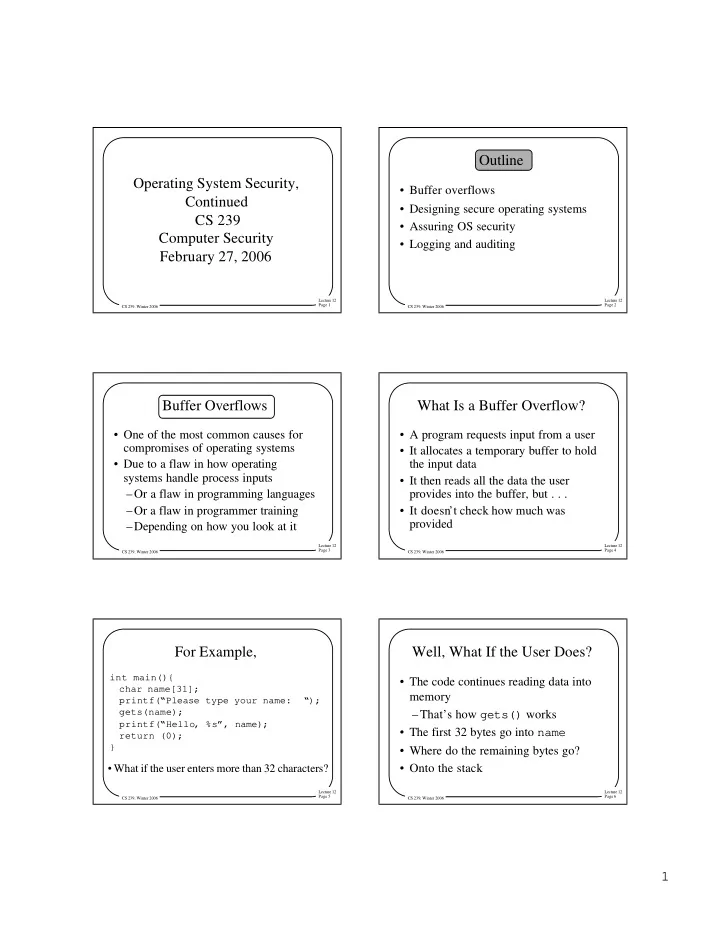
Outline Operating System Security, Buffer overflows Continued Designing secure operating systems CS 239 Assuring OS security Computer Security Logging and auditing February 27, 2006 Lecture 12 Lecture 12 Page 1 Page 2


slide-1
SLIDE 1

1

Lecture 12 Page 1 CS 239, Winter 2006

Operating System Security, Continued CS 239 Computer Security February 27, 2006

Lecture 12 Page 2 CS 239, Winter 2006

Outline

  • Buffer overflows
  • Designing secure operating systems
  • Assuring OS security
  • Logging and auditing

Lecture 12 Page 3 CS 239, Winter 2006

Buffer Overflows

  • One of the most common causes for

compromises of operating systems

  • Due to a flaw in how operating

systems handle process inputs –Or a flaw in programming languages –Or a flaw in programmer training –Depending on how you look at it

Lecture 12 Page 4 CS 239, Winter 2006

What Is a Buffer Overflow?

  • A program requests input from a user
  • It allocates a temporary buffer to hold

the input data

  • It then reads all the data the user

provides into the buffer, but . . .

  • It doesn’t check how much was

provided

Lecture 12 Page 5 CS 239, Winter 2006

For Example,

int main(){ char name[31]; printf(“Please type your name: “); gets(name); printf(“Hello, %s”, name); return (0); }

  • What if the user enters more than 32 characters?

Lecture 12 Page 6 CS 239, Winter 2006

Well, What If the User Does?

  • The code continues reading data into

memory –That’s how gets() works

  • The first 32 bytes go into name
  • Where do the remaining bytes go?
  • Onto the stack
slide-2
SLIDE 2

2

Lecture 12 Page 7 CS 239, Winter 2006

Munging the Stack

  • The temporary variable name is allocated
  • n the stack

– Close to the record of the function currently being run

  • The overflow will spill into whatever’s next
  • n the stack
  • Commonly, that’s effectively going to
  • verwrite the instruction pointer

Lecture 12 Page 8 CS 239, Winter 2006

Using Buffer Overflows to Compromise Security

  • Carefully choose what gets written into

the instruction pointer

  • So that the program jumps to

something you want to do –Under the identity of the program that’s running

  • Such as, execute a command shell

Lecture 12 Page 9 CS 239, Winter 2006

Effects of Buffer Overflows

  • Remote or unprivileged local user gets

to run a program with greater privileges

  • If buffer overflow is in a root program,

gets all privileges, essentially

  • Common mechanism to allow attackers

to break into machines

Lecture 12 Page 10 CS 239, Winter 2006

Are Buffer Overflows Common?

  • You bet!
  • Weekly occurrences in major

systems/applications

  • Probably one of the most common

security bugs

Lecture 12 Page 11 CS 239, Winter 2006

Some Recent Buffer Overflows

  • Windows Media Player Plug-In
  • Microsoft Windows Web Client
  • LibPNG Graphics Library
  • Metamail message processing
  • Blackberry Enterprise Server
  • And two others, just in last week’s

SANS vulnerability report

Lecture 12 Page 12 CS 239, Winter 2006

Fixing Buffer Overflows

  • Check the length of the input
  • Use programming languages that prevent them
  • Put in OS controls that prevent overwriting the

stack

  • Put things in different places on the stack, making

it hard to find the return pointer

  • Why aren’t these things commonly done?
  • Presumably because programmers and designers

neither know nor care about security

slide-3
SLIDE 3

3

Lecture 12 Page 13 CS 239, Winter 2006

Desired Security Features of a Normal OS

  • Authentication of users
  • Memory protection
  • File and I/O access control
  • General object access control
  • Enforcement of sharing
  • Fairness guarantees
  • Secure IPC and synchronization
  • Security of OS protection mechanisms

Lecture 12 Page 14 CS 239, Winter 2006

Extra Features for a Trusted OS

  • Mandatory and discretionary access

control

  • Object reuse protection
  • Complete mediation
  • Audit capabilities
  • Intruder detection capabilities

Lecture 12 Page 15 CS 239, Winter 2006

How To Achieve OS Security

  • Kernelized design
  • Separation and isolation mechanisms
  • Virtualization
  • Layered design

Lecture 12 Page 16 CS 239, Winter 2006

Advantages of Kernelization

  • Smaller amount of trusted code
  • Easier to check every access
  • Separation from other complex pieces
  • f the system
  • Easier to maintain and modify security

features

Lecture 12 Page 17 CS 239, Winter 2006

Reference Monitors

  • An important security concept for OS

design

  • A reference monitor is a subsystem

that controls access to objects –It provides (potentially) complete mediation

  • Very important to get this part right

Lecture 12 Page 18 CS 239, Winter 2006

Assurance of Trusted Operating Systems

  • How do I know that I should trust

someone’s operating system?

  • What methods can I use to achieve the

level of trust I require?

slide-4
SLIDE 4

4

Lecture 12 Page 19 CS 239, Winter 2006

Assurance Methods

  • Testing
  • Formal verification
  • Validation

Lecture 12 Page 20 CS 239, Winter 2006

Secure Operating System Standards

  • If I want to buy a secure operating

system, how do I compare options?

  • Use established standards for OS

security

  • Several standards exist

Lecture 12 Page 21 CS 239, Winter 2006

Some Security Standards

  • U.S. Orange Book
  • European ITSEC
  • U.S. Combined Federal Criteria
  • Common Criteria for Information

Technology Security Evaluation

Lecture 12 Page 22 CS 239, Winter 2006

The U.S. Orange Book

  • The earliest evaluation standard for

trusted operating systems

  • Defined by the Department of Defense

in the late 1970s

  • Now largely a historical artifact

Lecture 12 Page 23 CS 239, Winter 2006

Purpose of the Orange Book

  • To set standards by which OS security

could be evaluated

  • Fairly strong definitions of what features

and capabilities an OS had to have to achieve certain levels

  • Allowing “head-to-head” evaluation of

security of systems – And specification of requirements

Lecture 12 Page 24 CS 239, Winter 2006

Orange Book Security Divisions

  • A, B, C, and D

– In decreasing order of degree of security

  • Important subdivisions within some of the

divisions

  • Requires formal certification from the

government (NCSC) – Except for the D level

slide-5
SLIDE 5

5

Lecture 12 Page 25 CS 239, Winter 2006

Some Important Orange Book Divisions and Subdivisions

  • C2 - Controlled Access Protection
  • B1 - Labeled Security Protection
  • B2 - Structured Protection

Lecture 12 Page 26 CS 239, Winter 2006

The C2 Security Class

  • Discretionary access

–At fairly low granularity

  • Requires auditing of accesses
  • And password authentication and

protection of reused objects

  • Windows NT has been certified to this

class

Lecture 12 Page 27 CS 239, Winter 2006

The B1 Security Class

  • Includes mandatory access control

–Using Bell-La Padula model –Each subject and object is assigned a security level

  • Requires both hierarchical and non-

hierarchical access controls

Lecture 12 Page 28 CS 239, Winter 2006

The B3 Security Class

  • Requires careful security design

–With some level of verification

  • And extensive testing
  • Doesn’t require formal verification

–But does require “a convincing argument”

  • Trusted Mach is in this class

Lecture 12 Page 29 CS 239, Winter 2006

The Common Criteria

  • Modern international standards for

computer systems security

  • Covers more than just operating systems
  • Design based on lessons learned from

earlier security standards

  • Lengthy documents describe the Common

Criteria

Lecture 12 Page 30 CS 239, Winter 2006

Basics of Common Criteria Approach

  • Something of an alphabet soup –
  • The CC documents describe

–The Evaluation Assurance Levels (EAL)

  • The Common Evaluation Methodology

(CEM) details guidelines for evaluating systems

slide-6
SLIDE 6

6

Lecture 12 Page 31 CS 239, Winter 2006

Another Bowl of Common Criteria Alphabet Soup

  • TOE – Target of Evaluation
  • TSP – TOE Security Policy

– Security policy of system being evaluated

  • TSF – TOE Security Functions

– HW, SW used to enforce TSP

  • PP – Protection Profile

– Implementation-dependent set of security requirements

  • ST – Security Target

– Predefined sets of security requirements

Lecture 12 Page 32 CS 239, Winter 2006

What’s This All Mean?

  • Highly detailed methodology for

specifying : 1. What security goals a system has 2. What environment it operates in 3. What mechanisms it uses to achieve its security goals 4. Why anyone should believe it does so

Lecture 12 Page 33 CS 239, Winter 2006

Logging and Auditing

  • An important part of a complete

security solution

  • Practical security depends on knowing

what is happening in your system

  • Logging and auditing is required for

that purpose

Lecture 12 Page 34 CS 239, Winter 2006

Logging

  • No security system will stop all attacks

–Logging what has happened is vital to dealing with the holes

  • Logging also tells you when someone

is trying to break in –Perhaps giving you a chance to close possible holes

Lecture 12 Page 35 CS 239, Winter 2006

Access Logs

  • One example of what might be logged

for security purposes

  • Listing of which users accessed which
  • bjects

–And when and for how long

  • Especially important to log failures

Lecture 12 Page 36 CS 239, Winter 2006

Other Typical Logging Actions

  • Logging failed login attempts

– Can help detect intrusions or password crackers

  • Logging changes in program permissions

– Often done by intruders

  • Logging scans of ports known to be

dangerous

slide-7
SLIDE 7

7

Lecture 12 Page 37 CS 239, Winter 2006

Problems With Logging

  • Dealing with large volumes of data
  • Separating the wheat from the chaff

–Unless the log is very short, auditing it can be laborious

  • System overheads and costs

Lecture 12 Page 38 CS 239, Winter 2006

Log Security

  • If you use logs to detect intruders, smart

intruders will try to attack logs – Concealing their traces by erasing or modifying the log entries

  • Append-only access control helps a lot here
  • Or logging to hard copy
  • Or logging to a remote machine

Lecture 12 Page 39 CS 239, Winter 2006

Local Logging vs. Remote Logging

  • Should you log just on the machine

where the event occurs?

  • Or log it just at a central site?
  • Or both?

Lecture 12 Page 40 CS 239, Winter 2006

Local Logging

  • Only gives you the local picture
  • More likely to be compromised by attacker
  • Must share resources with everything else

machine does

  • Inherently distributed

– Which has its good points and bad points

Lecture 12 Page 41 CS 239, Winter 2006

Remote Logging

  • On centralized machine or through some

hierarchical arrangement

  • Can give combined view of what’s

happening in entire installation

  • Machine storing logs can be specialized for

that purpose

  • But what if it’s down or unreachable?
  • A goldmine for an attacker, if he can break

in

Lecture 12 Page 42 CS 239, Winter 2006

Desirable Characteristics of a Logging Machine

  • Devoted to that purpose

– Don’t run anything else on it

  • Highly secure

– Control logins – Limit all other forms of access

  • Reasonably well provisioned

– Especially with disk

slide-8
SLIDE 8

8

Lecture 12 Page 43 CS 239, Winter 2006

Auditing

  • Security mechanisms are great

– If you have proper policies to use them

  • Security policies are great

– If you follow them

  • For practical systems, proper policies and

consistent use are a major security problem

`

Lecture 12 Page 44 CS 239, Winter 2006

Auditing

  • A formal (or semi-formal) process of

verifying system security

  • “You may not do what I expect, but

you will do what I inspect.”

  • A requirement if you really want your

systems to run securely

Lecture 12 Page 45 CS 239, Winter 2006

Auditing Requirements

  • Knowledge

–Of the installation and general security issues

  • Independence
  • Trustworthiness
  • Ideally, big organizations should have

their own auditors

Lecture 12 Page 46 CS 239, Winter 2006

When Should You Audit?

  • Periodically
  • Shortly after making major system

changes –Especially those with security implications

  • When problems arise

–Internally or externally

Lecture 12 Page 47 CS 239, Winter 2006

Auditing and Logs

  • Logs are a major audit tool
  • Some examination can be done

automatically

  • But part of the purpose is to detect

things that automatic methods miss –So some logs should be audited by hand

Lecture 12 Page 48 CS 239, Winter 2006

A Typical Set of Audit Criteria

  • For a Unix system
  • Some sample criteria:

– All accounts have passwords – Limited use of setuid root – Display last login date on login – Limited write access to system files – No “.” in PATH variables

slide-9
SLIDE 9

9

Lecture 12 Page 49 CS 239, Winter 2006

What Does an Audit Cover?

  • Conformance to policy
  • Review of control structures
  • Examination of audit trail (logs)
  • User awareness of security
  • Physical controls
  • Software licensing and intellectual

property issues

Lecture 12 Page 50 CS 239, Winter 2006

Does Auditing Really Occur?

  • To some extent, yes
  • 2005 CSI/FBI report says 87% of

responding organizations did audits –Up from 82% in 2004

  • Doesn’t say much about the quality of

the audits

  • It’s easy to do a bad audit