Module 3: Operating-System Structures System Components Operating - - PowerPoint PPT Presentation

module 3 operating system structures
SMART_READER_LITE
LIVE PREVIEW

Module 3: Operating-System Structures System Components Operating - - PowerPoint PPT Presentation

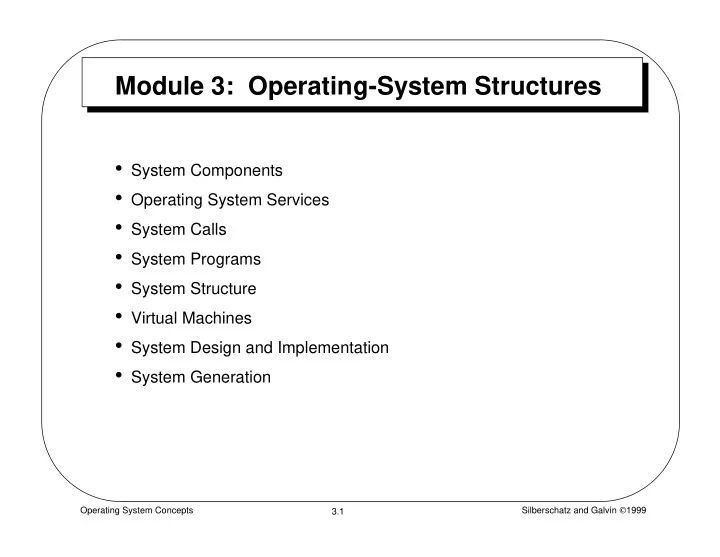
Module 3: Operating-System Structures System Components Operating System Services System Calls System Programs System Structure Virtual Machines System Design and Implementation System Generation Silberschatz and


slide-1
SLIDE 1

Operating System Concepts Silberschatz and Galvin 1999 3.1

Module 3: Operating-System Structures

  • System Components
  • Operating System Services
  • System Calls
  • System Programs
  • System Structure
  • Virtual Machines
  • System Design and Implementation
  • System Generation
slide-2
SLIDE 2

Operating System Concepts Silberschatz and Galvin 1999 3.2

Common System Components

  • Process Management
  • Main Memory Management
  • Secondary-Storage Management
  • I/O System Management
  • File Management
  • Protection System
  • Networking
  • Command-Interpreter System
slide-3
SLIDE 3

Operating System Concepts Silberschatz and Galvin 1999 3.3

Process Management

  • A process is a program in execution. A process needs certain

resources, including CPU time, memory, files, and I/O devices, to accomplish its task.

  • The operating system is responsible for the following activities in

connection with process management. – Process creation and deletion. – process suspension and resumption. – Provision of mechanisms for:

✴ process synchronization ✴ process communication

slide-4
SLIDE 4

Operating System Concepts Silberschatz and Galvin 1999 3.4

Main-Memory Management

  • Memory is a large array of words or bytes, each with its own
  • address. It is a repository of quickly accessible data shared by

the CPU and I/O devices.

  • Main memory is a volatile storage device. It loses its contents in

the case of system failure.

  • The operating system is responsible for the following activities in

connections with memory management: – Keep track of which parts of memory are currently being used and by whom. – Decide which processes to load when memory space becomes available. – Allocate and deallocate memory space as needed.

slide-5
SLIDE 5

Operating System Concepts Silberschatz and Galvin 1999 3.5

Secondary-Storage Management

  • Since main memory (primary storage) is volatile and too small to

accommodate all data and programs permanently, the computer system must provide secondary storage to back up main memory.

  • Most modern computer systems use disks as the principle on-line

storage medium, for both programs and data.

  • The operating system is responsible for the following activities in

connection with disk management: – Free space management – Storage allocation – Disk scheduling

slide-6
SLIDE 6

Operating System Concepts Silberschatz and Galvin 1999 3.6

I/O System Management

  • The I/O system consists of:

– A buffer-caching system – A general device-driver interface – Drivers for specific hardware devices

slide-7
SLIDE 7

Operating System Concepts Silberschatz and Galvin 1999 3.7

File Management

  • A file is a collection of related information defined by its creator.

Commonly, files represent programs (both source and object forms) and data.

  • The operating system is responsible for the following activities in

connections with file management: – File creation and deletion. – Directory creation and deletion. – Support of primitives for manipulating files and directories. – Mapping files onto secondary storage. – File backup on stable (nonvolatile) storage media.

slide-8
SLIDE 8

Operating System Concepts Silberschatz and Galvin 1999 3.8

Protection System

  • Protection refers to a mechanism for controlling access by

programs, processes, or users to both system and user resources.

  • The protection mechanism must:

– distinguish between authorized and unauthorized usage. – specify the controls to be imposed. – provide a means of enforcement.

slide-9
SLIDE 9

Operating System Concepts Silberschatz and Galvin 1999 3.9

Networking (Distributed Systems)

  • A distributed system is a collection processors that do not share

memory or a clock. Each processor has its own local memory.

  • The processors in the system are connected through a

communication network.

  • A distributed system provides user access to various system

resources.

  • Access to a shared resource allows:

– Computation speed-up – Increased data availability – Enhanced reliability

slide-10
SLIDE 10

Operating System Concepts Silberschatz and Galvin 1999 3.10

Command-Interpreter System

  • Many commands are given to the operating system by control

statements which deal with: – process creation and management – I/O handling – secondary-storage management – main-memory management – file-system access – protection – networking

slide-11
SLIDE 11

Operating System Concepts Silberschatz and Galvin 1999 3.11

Command-Interpreter System (Cont.)

  • The program that reads and interprets control statements is

called variously: – control-card interpreter – command-line interpreter – shell (in UNIX) Its function is to get and execute the next command statement.

slide-12
SLIDE 12

Operating System Concepts Silberschatz and Galvin 1999 3.12

Operating System Services

  • Program execution – system capability to load a program into

memory and to run it.

  • I/O operations – since user programs cannot execute I/O
  • perations directly, the operating system must provide some

means to perform I/O.

  • File-system manipulation – program capability to read, write,

create, and delete files.

  • Communications – exchange of information between processes

executing either on the same computer or on different systems tied together by a network. Implemented via shared memory or message passing.

  • Error detection – ensure correct computing by detecting errors in

the CPU and memory hardware, in I/O devices, or in user programs.

slide-13
SLIDE 13

Operating System Concepts Silberschatz and Galvin 1999 3.13

Additional Operating System Functions

Additional functions exist not for helping the user, but rather for ensuring efficient system operations.

  • Resource allocation – allocating resources to multiple users
  • r multiple jobs running at the same time.
  • Accounting – keep track of and record which users use how

much and what kinds of computer resources for account billing or for accumulating usage statistics.

  • Protection – ensuring that all access to system resources is

controlled.

slide-14
SLIDE 14

Operating System Concepts Silberschatz and Galvin 1999 3.14

System Calls

  • System calls provide the interface between a running program

and the operating system. – Generally available as assembly-language instructions. – Languages defined to replace assembly language for systems programming allow system calls to be made directly (e.g., C. Bliss, PL/360)

  • Three general methods are used to pass parameters between a

running program and the operating system. – Pass parameters in registers. – Store the parameters in a table in memory, and the table address is passed as a parameter in a register. – Push (store) the parameters onto the stack by the program, and pop off the stack by operating system.

slide-15
SLIDE 15

Operating System Concepts Silberschatz and Galvin 1999 3.15

Passing of Parameters As A Table

code for system call 13

  • perating system

user program use parameters from table X register X X: parameters for call load address X system call 13

slide-16
SLIDE 16

Operating System Concepts Silberschatz and Galvin 1999 3.16

MS-DOS Execution

(a)

free memory command interpreter kernel

(b)

free memory command interpreter kernel process

At System Start-up Running a Program

slide-17
SLIDE 17

Operating System Concepts Silberschatz and Galvin 1999 3.17

UNIX Running Multiple Programs

free memory interpreter kernel process D process C process B

slide-18
SLIDE 18

Operating System Concepts Silberschatz and Galvin 1999 3.18

Communication Models

process A

(a)

M process B M kernel M process A

(b)

process B kernel 1 2 shared memory 1 2

Msg Passing Shared Memory

slide-19
SLIDE 19

Operating System Concepts Silberschatz and Galvin 1999 3.19

System Programs

  • System programs provide a convenient environment for program

development and execution. The can be divided into: – File manipulation – Status information – File modification – Programming language support – Program loading and execution – Communications – Application programs

  • Most users’ view of the operation system is defined by system

programs, not the actual system calls.

slide-20
SLIDE 20

Operating System Concepts Silberschatz and Galvin 1999 3.20

System Structure – Simple Approach

  • MS-DOS – written to provide the most functionality in the least

space – not divided into modules – Although MS-DOS has some structure, its interfaces and levels of functionality are not well separated

slide-21
SLIDE 21

Operating System Concepts Silberschatz and Galvin 1999 3.21

MS-DOS Layer Structure

ROM BIOS device drivers application program MS-DOS device drivers resident system program

slide-22
SLIDE 22

Operating System Concepts Silberschatz and Galvin 1999 3.22

System Structure – Simple Approach (Cont.)

  • UNIX – limited by hardware functionality, the original UNIX
  • perating system had limited structuring. The UNIX OS consists
  • f two separable parts.

– Systems programs – The kernel

✴ Consists of everything below the system-call interface

and above the physical hardware

✴ Provides the file system, CPU scheduling, memory

management, and other operating-system functions; a large number of functions for one level.

slide-23
SLIDE 23

Operating System Concepts Silberschatz and Galvin 1999 3.23

UNIX System Structure

(the users) shells and commands compilers and interpreters system libraries system-call interface to the kernel kernel interface to the hardware file system swapping block I/O system disk and tape drivers CPU scheduling page replacement demand paging virtual memory signals terminal handling character I/O system terminal drivers device controllers disks and tapes memory controllers physical memory terminal controllers terminals

slide-24
SLIDE 24

Operating System Concepts Silberschatz and Galvin 1999 3.24

System Structure – Layered Approach

  • The operating system is divided into a number of layers (levels),

each built on top of lower layers. The bottom layer (layer 0), is the hardware; the highest (layer N) is the user interface.

  • With modularity, layers are selected such that each uses

functions (operations) and services of only lower-level layers.

slide-25
SLIDE 25

Operating System Concepts Silberschatz and Galvin 1999 3.25

An Operating System Layer

layer M – 1 layer M hidden

  • perations

. . . . . . . . .

new

  • perations

existing

  • perations
slide-26
SLIDE 26

Operating System Concepts Silberschatz and Galvin 1999 3.26

Layered Structure of the THE OS

  • A layered design was first used in THE operating system.

Its six layers are as follows:

layer 5: user programs layer 4: buffering for input and output layer 3: operator-console device driver layer 2: memory management layer 1: CPU scheduling layer 0: hardware

slide-27
SLIDE 27

Operating System Concepts Silberschatz and Galvin 1999 3.27

OS/2 Layer Structure

application application application subsystem subsystem subsystem API extension system kernel device driver

  • memory management
  • task dispatching
  • device management

application-programming interface device driver device driver device driver

slide-28
SLIDE 28

Operating System Concepts Silberschatz and Galvin 1999 3.28

Virtual Machines

  • A virtual machine takes the layered approach to its logical
  • conclusion. It treats hardware and the operating system kernel

as though they were all hardware.

  • A virtual machine provides an interface identical to the underlying

bare hardware.

  • The operating system creates the illusion of multiple processes,

each executing on its own processor with its own (virtual) memory.

slide-29
SLIDE 29

Operating System Concepts Silberschatz and Galvin 1999 3.29

Virtual Machines (Cont.)

  • The resources of the physical computer are shared to create the

virtual machines. – CPU scheduling can create the appearance that users have their own processor. – Spooling and a file system can provide virtual card readers and virtual line printers. – A normal user time-sharing terminal serves as the virtual machine operator’s console.

slide-30
SLIDE 30

Operating System Concepts Silberschatz and Galvin 1999 3.30

System Models

(a)

processes hardware kernel

(b)

processes hardware virtual machine programming interface processes processes kernel kernel kernel

Non-virtual Machine Virtual Machine

slide-31
SLIDE 31

Operating System Concepts Silberschatz and Galvin 1999 3.31

Advantages/Disadvantages of Virtual Machines

  • The virtual-machine concept provides complete protection of

system resources since each virtual machine is isolated from all

  • ther virtual machines. This isolation, however, permits no direct

sharing of resources.

  • A virtual-machine system is a perfect vehicle for operating-

systems research and development. System development is done on the virtual machine, instead of on a physical machine and so does not disrupt normal system operation.

  • The virtual machine concept is difficult to implement due to the

effort required to provide an exact duplicate to the underlying machine.

slide-32
SLIDE 32

Operating System Concepts Silberschatz and Galvin 1999 3.32

System Design Goals

  • User goals – operating system should be convenient to use, easy

to learn, reliable, safe, and fast.

  • System goals – operating system should be easy to design,

implement, and maintain, as well as flexible, reliable, error-free, and efficient.

slide-33
SLIDE 33

Operating System Concepts Silberschatz and Galvin 1999 3.33

Mechanisms and Policies

  • Mechanisms determine how to do something, policies decide

what will be done.

  • The separation of policy from mechanism is a very important

principle, it allows maximum flexibility if policy decisions are to be changed later.

slide-34
SLIDE 34

Operating System Concepts Silberschatz and Galvin 1999 3.34

System Implementation

  • Traditionally written in assembly language, operating systems

can now be written in higher-level languages.

  • Code written in a high-level language:

– can be written faster. – is more compact. – is easier to understand and debug.

  • An operating system is far easier to port (move to some other

hardware) if it is written in a high-level language.

slide-35
SLIDE 35

Operating System Concepts Silberschatz and Galvin 1999 3.35

System Generation (SYSGEN)

  • Operating systems are designed to run on any of a class of

machines; the system must be configured for each specific computer site.

  • SYSGEN program obtains information concering the specific

configuration of the hardware system.

  • Booting – starting a computer by loading the kernel.
  • Bootstrap program – code stored in ROM that is able to locate

the kernel, load it into memory, and start its execution.