SLIDE 1 BA (Hons) in Audio and Music Technology 147
6.15 Module 15: Research and Presentation
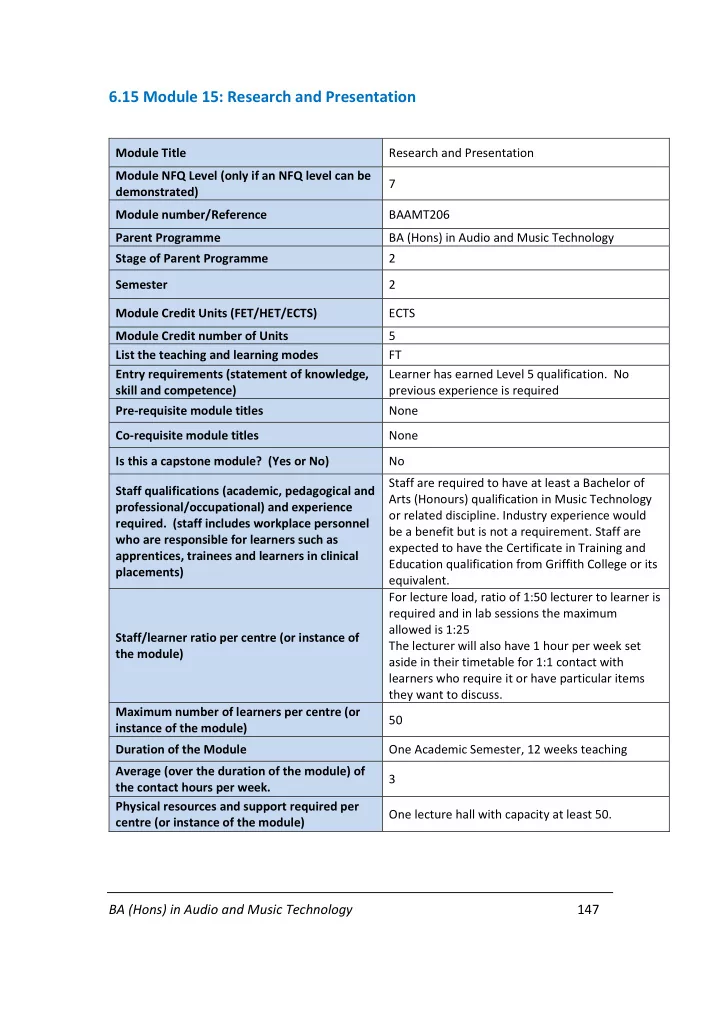
Module Title Research and Presentation Module NFQ Level (only if an NFQ level can be demonstrated) 7 Module number/Reference BAAMT206 Parent Programme BA (Hons) in Audio and Music Technology Stage of Parent Programme 2 Semester 2 Module Credit Units (FET/HET/ECTS) ECTS Module Credit number of Units 5 List the teaching and learning modes FT Entry requirements (statement of knowledge, skill and competence) Learner has earned Level 5 qualification. No previous experience is required Pre-requisite module titles None Co-requisite module titles None Is this a capstone module? (Yes or No) No Staff qualifications (academic, pedagogical and professional/occupational) and experience
- required. (staff includes workplace personnel
who are responsible for learners such as apprentices, trainees and learners in clinical placements) Staff are required to have at least a Bachelor of Arts (Honours) qualification in Music Technology
- r related discipline. Industry experience would
be a benefit but is not a requirement. Staff are expected to have the Certificate in Training and Education qualification from Griffith College or its equivalent. Staff/learner ratio per centre (or instance of the module) For lecture load, ratio of 1:50 lecturer to learner is required and in lab sessions the maximum allowed is 1:25 The lecturer will also have 1 hour per week set aside in their timetable for 1:1 contact with learners who require it or have particular items they want to discuss. Maximum number of learners per centre (or instance of the module) 50 Duration of the Module One Academic Semester, 12 weeks teaching Average (over the duration of the module) of the contact hours per week. 3 Physical resources and support required per centre (or instance of the module) One lecture hall with capacity at least 50.
SLIDE 2
BA (Hons) in Audio and Music Technology 148
Analysis of Required Learning Effort Effort while in contact with staff Classroom and Demonstrations Mentoring and small group tutoring Other (Specify) Directed e- learning (hours) Independent learning (hours) Other hours (specify) Work-based learning hours of learning effort Total Effort (hours) Hours Minimum ratio teacher/learner Hours Minimum ratio teacher/learner Hours Minimum ratio teacher/learner 24 1:50 12 1:25 89 125 Allocation of marks (within the module) Continuous Assessment Supervised Project(s) Proctored practical Proctored Written Examination Total Percentage contribution 80% 20% 100%
6.15.1 Module Aims and Objectives
This module aims to develop learners’ research skills, both in relation to their module related assignments and later in the completion of their final dissertation by research or practice. The module provides learners with the opportunity to learn specific research skills such as developing a research idea, investigating prior work in the area, writing a literature review and evaluating previous studies. The module aims to familiarise learners with the main research theories and concepts and enable learners to acquire skills in the research process including selecting and planning an appropriate research project, feasibility, execution, logging and tracking the practical process, data collection and analysis. The ultimate aim of the module is that learners will be able to conduct research effectively and to grasp the impact research can have.
SLIDE 3
BA (Hons) in Audio and Music Technology 149 6.15.2 Minimum Intended Module Learning Outcomes
On successful completion of this module the learner will be able to: MLO 15. 1 Demonstrate a detailed knowledge of the wide variety of information sources available to communication researchers. MLO 15. 2 Carry out the necessary preliminary investigations to support and underpin a proposal for research by practice and gather authoritative evidence to support findings. MLO 15.3 Recognise and apply ethical considerations to their research activities. MLO 15. 4 Assess, apply and interpret different quantitative and qualitative methods of research. MLO 15. 5 Assess the feasibility of a practical research project in terms of time, resources, cost, access to software and other resources. MLO 15. 6 Competently undertake, complete, and defend a detailed research proposal.
6.15.3 Rationale for inclusion of the module in the programme and its contribution to the overall IPLOs
This module serves to underpin the research required in the Dissertation module in Stage 3. Learners will develop necessary research and analytical skills required for an honours degree. The learning here helps in the leaner’s attainment of Programme Learning Outcome 8, while also serving to demonstrate attainment of outcome 4 and 8.
6.15.4 Information Provided to Learners about the Module
Learners enrolled on this module will receive a copy of the module descriptor and assignment briefs, including an outline of the criteria for assessment. Previous examples of assignments are also presented to the class.
6.15.5 Module Content, Organisation, and Structure
The organisation of the module is to deliver theory through one 2-hour lecture per week and a 1-hour tutorial. There will also be individual formative assessment with the tutor
SLIDE 4 BA (Hons) in Audio and Music Technology 150
Module Content Introduction to Research Methods
- Introduction of key words in research methods such as ‘quantitative’, ‘qualitative’ and
‘sample’ and explain what research involves.
- Description of common ethical principles and a discussion of how they can be applied
to research projects. Sourcing Information and Writing a Literature Review
- How to source information effectively. Planning effective searches on the internet,
evaluating documents and examining issues such as authenticity and credibility and using search engines effectively.
- Definition of and how to write a literature review.
- How to reference work and produce a bibliography correctly.
Developing a Research Idea
- Developing a research idea for research by practice, whether this involves technical,
musical, production or socio-cultural research.
- Interrogate the aims, objectives and goals of the research and develop research
questions for possible research area.
- Considering the research deliverables, in terms of feasibility with respect to resources,
time constraints, costs, access to technology, and the learner’s own level of experience in the field. Research Tools
- Interviewing, focus groups, survey research, logs and research diaries. Methods and
means of analysis of data. Writing a Research Proposal
- Developing a writing style suitable for a research proposal. Analysis of proposals and
common mistakes, which should be avoided.
6.15.6 Module Teaching and Learning Strategy
The module is delivered through a combination of lectures and tutorials. The tutorials will provide opportunity for both peer review individual formative assessment with the tutor enabling learners to develop their research proposal.
SLIDE 5 BA (Hons) in Audio and Music Technology 151
Activity Teaching / Learning Strategy Learning Environment Lecture (24 hours) Lectures / participative discussions / case studies of research proposals / lecturer support in development of research interests and questions / critique of preliminary proposals with formative feedback and peer evaluation College Tutorial (12 hours) Practicing research methods and using research databases / training in academic writing / participatory workshops and tutorials / preparation for detailed independent research College Assignment (48 hours) Practice learning and perfecting research methods, academic writing and presentation skills College Independent Work (41 hours) Directed and self-directed learning / home study / use of research resources Home / Study
6.15.7 Timetabling, Learner Effort and Credit
The module is timetabled as one 3-hour session to the whole class, consisting of one 2-hour lecture and a 1-hour tutorial. The number of credits assigned to this module is our assessment of the amount of learner effort required. It is our view that 5 ECTS of learner effort is required by learners coming new to the material to achieve the learning outcomes required.
6.15.8 Work-based Learning and Practice-placement
There is no work based learning or practical placement involved in the module.
6.15.9 E-Learning
The College VLE is used to disseminate notes, advice and online resources to support the
- learners. The learners are also given access to Lynda.com as a resource for reference.
6.15.10 Module Physical Resource Requirements
Requirements are for a fully equipped lecture hall and access for tutors to a meeting room when required, for individual formative assessments.
6.15.11 Reading lists and other learning materials
Recommended Reading Bell, J. & Waters, S. (2014) Doing your research project: a guide for first-time researchers, Maidenhead: Open University Press. Gallo, C. (2014) Talk like TED. Houndsmills Basingstoke: Macmillan.
SLIDE 6 BA (Hons) in Audio and Music Technology 152
Secondary Reading Bethel, E. (2014) Posters and presentations. Houndsmills Basingstoke: Palgrave Macmillan. Cresswell, J.W. (2013) Research design: qualitative, quantitative, and mixed method
- approaches. Thousand Oaks: Sage.
Duarte, N. (2009) Slide: ology: the art and science of creating great presentations. Sebastopol: O’Reilly. Thomas, G. (2011) Doing research. Houndsmills Basingstoke: Palgrave Macmillan. Williams, K. (2013) Planning your dissertation. Houndsmills Basingstoke: Palgrave Macmillan. Williams, K. & Carroll, J. (2009) Referencing and understanding plagiarism. Houndsmills Basingstoke: Palgrave Macmillan.
6.15.12 Specifications for Module Staffing Requirements
For each instance of the module, there will be one lecturer qualified to at least Bachelor of Arts (Honours) level in Music Technology or equivalent and with a relevant third level teaching qualification (e.g. Certificate in Training and Education). Depending on numbers a lab assistant may be required. Where this is the case the Assistant will be required to have a sound understanding of object oriented programming, either through industry experience or academic qualification. For example, a final year Bachelor of Music Production (Honours) learner may be suitable to assist the lecturer in lab sessions. Any lab assistant will work under the supervision of the lecture.
6.15.13 Module Assessment Strategy
Element No Weight Type Description Learning Outcomes Assessed 1 80% Written Proposal Learners will research and write a research proposal containing literature review and methodology section. As part of the proposal, learners will be required to attend scheduled meetings with a tutor for feedback. This will contribute to a continuous assessment element. 14.1 – 14.5 2 20% Presentation Presentation defending research proposal with question and answer section. 14.6
6.15.14 Sample Assessment Materials
Each participant will identify an area of research as negotiated with your tutor. You will then be required to conduct research appropriate to this level of study and disseminate the findings in the correct academic format. The document should be well structured and include a literature review, methodology, analysis, conclusion and bibliography.