VPP: The Standard of Excellence in Workplace Safety and Health
Module 3 Doing a Noise Audit This module and Module 2 provide the - - PowerPoint PPT Presentation
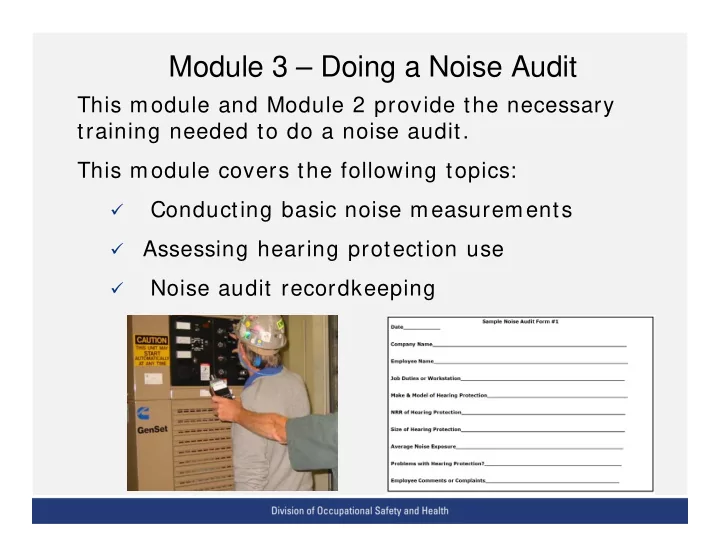
Module 3 Doing a Noise Audit This module and Module 2 provide the necessary training needed to do a noise audit. This module covers the following topics: Conducting basic noise measurements Assessing hearing protection use
VPP: The Standard of Excellence in Workplace Safety and Health
The following is needed to do a noise audit:
Audit form, checklists, clipboard, Previous noise measurement records, Hearing protection, Sound level meter.
A map or sketch of your workplace
- r jobsite showing noisy areas may
also be useful.
Photo by Justin Suter in Creative Commons
VPP: The Standard of Excellence in Workplace Safety and Health
The following employees should be checked during a noise audit:
workers who you know or suspect are exposed to noise above 85 decibels, workers wearing hearing protection, and are: present on the day of the audit, working at normal or full production level.
Photo by Reid Rosenberg in Creative Commons
VPP: The Standard of Excellence in Workplace Safety and Health
Four things to check in a noise audit:
- 1. Has employee noise exposure changed? (requires a
noise measurement survey)
- 2. Is hearing protection appropriate for conditions?
- 3. Is hearing protection worn properly?
- 4. Are employees satisfied with their hearing
protection?
VPP: The Standard of Excellence in Workplace Safety and Health
Sound Level Meters
A sound level meter measures noise at any particular moment. They are good for spot checking and determining loudness of equipment. They are useful for noise audits.
VPP: The Standard of Excellence in Workplace Safety and Health
Taking Noise Measurements
Take noise readings with a sound level meter in noisy areas where employees work. Compare to previous noise survey. Determine if worker’s noise exposure has changed. Where noise is highly variable, you may need to take noise dosimeter readings.
Noise dosimeters
Taking sound level meter readings
VPP: The Standard of Excellence in Workplace Safety and Health
Take noise measurements at employee’s normal work location and near their ear. Take all readings in the “A- scale” and “slow response” mode. Estimate employees’ length of exposure.
Taking sound level meter measurements
Highly mobile or inaccessible employees may need noise dosimeter measurements.
VPP: The Standard of Excellence in Workplace Safety and Health
Sound level meter settings
A-scale Slow response
Two Examples
VPP: The Standard of Excellence in Workplace Safety and Health
Estimating average noise levels from sound level meter readings
If an employee is exposed to several different noise levels, you can estimate average noise level with the following formula: D = 100(C1/ T1 + C2/ T2… Cn/ Tn)
C = time at specific noise level T = reference duration # from Table HT-1
If D is greater than 50, than average noise level exposure of that employee is over 85 decibels
To use Table HT-1 in Noise Rule and see examples, click here
VPP: The Standard of Excellence in Workplace Safety and Health
Noise Dosimeters
Noise dosimeters are used to measure average noise levels. Dosimeters are worn by workers, usually for a full shift. Dosimeters are useful for highly variable noise exposure
- r very mobile workers.
L & I consultants can be requested to do this activity
VPP: The Standard of Excellence in Workplace Safety and Health
Noise Audit Procedures
Observe and talk to employees
Check what hearing protection is worn and how it is used. Make sure the hearing protection has the appropriate NRR rating for the job. Check hearing protection for cleanliness and need for repair or replacing. Ask employees if hearing protectors are comfortable and are protective enough. Note any other comments by employees.
VPP: The Standard of Excellence in Workplace Safety and Health
Hearing Protector Checklist
What to check for in earmuffs
Cover the whole ear? Positioned properly? Band snug, not too loose or tight? No interference from other PPE
- r glasses?
Comfortable to employee?
For a copy of checklist, click here
VPP: The Standard of Excellence in Workplace Safety and Health
Hearing Protector Checklist
What to check for in foam earplugs
Correct size? Inserted correctly? Properly seated? Clean? Comfortable to employee?
VPP: The Standard of Excellence in Workplace Safety and Health
Hearing Protector Checklist
Check following in preformed earplugs & earcaps: Preformed Earplugs correct size? inserted correctly? properly seated? clean? comfortable to employee? Earcaps noise level not above 95 decibels? other items same as earplugs
VPP: The Standard of Excellence in Workplace Safety and Health
Noise Audit Recordkeeping
Document Your Noise Audits
Audit records must be kept for each employee checked as long as they work for you. The following must be included in the records:
- make & model of hearing protectors,
- size of protectors,
- average noise exposure,
- any problems found with protectors,
- any comments from employees about protectors
Audit Recordkeeping Sample Form #1
For a pdf copy, click
- n this form
Audit Recordkeeping Sample Form #2
For a pdf copy, click on the form above
VPP: The Standard of Excellence in Workplace Safety and Health
Noise Audit Follow-up
Correct any hearing protection deficiencies
Hearing protection must be replaced if it: is the wrong size doesn’t fit properly is soiled, damaged or broken is uncomfortable to employee is not protective enough(noise level has increased) You must assure employees use hearing protectors that provide them the needed protection.
Replace these!
VPP: The Standard of Excellence in Workplace Safety and Health
Check Your Understanding
The following must be checked in a noise audit: a) How many employees are wearing earplugs, b) Current noise levels of machinery, c) Current noise exposure of employees, d) How well employees have been trained.
Question 1
VPP: The Standard of Excellence in Workplace Safety and Health
Check Your Understanding
Can a sound level meter be used to measure average noise level? a) Yes, it can do that. b) No, you must use a noise dosimeter. c) Yes, if you use a special formula. d) Yes, but only if you know how.
Question 2
VPP: The Standard of Excellence in Workplace Safety and Health