Outline of the WHO's Dose Assessment International Organizations - - PowerPoint PPT Presentation

outline of the who s dose assessment
SMART_READER_LITE
LIVE PREVIEW

Outline of the WHO's Dose Assessment International Organizations - - PowerPoint PPT Presentation

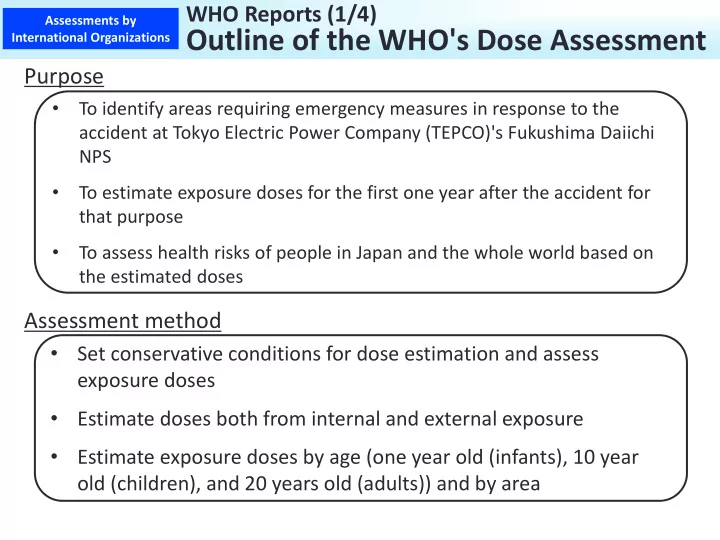
WHO Reports (1/4) Assessments by Outline of the WHO's Dose Assessment International Organizations Purpose To identify areas requiring emergency measures in response to the accident at Tokyo Electric Power Company (TEPCO)'s Fukushima


slide-1
SLIDE 1
  • To identify areas requiring emergency measures in response to the

accident at Tokyo Electric Power Company (TEPCO)'s Fukushima Daiichi NPS

  • To estimate exposure doses for the first one year after the accident for

that purpose

  • To assess health risks of people in Japan and the whole world based on

the estimated doses

  • Set conservative conditions for dose estimation and assess

exposure doses

  • Estimate doses both from internal and external exposure
  • Estimate exposure doses by age (one year old (infants), 10 year
  • ld (children), and 20 years old (adults)) and by area

Purpose Assessment method

Assessments by International Organizations

WHO Reports (1/4)

Outline of the WHO's Dose Assessment

slide-2
SLIDE 2
  • Doses due to internal exposure through inhalation and external exposure were

calculated based on the measurement data concerning radionuclides deposited on the ground surface.

  • Doses due to internal exposure through ingestion were calculated based on the

measurement data concerning foods.

  • The 20 km‐zone from the NPS was excluded.
  • For Deliberate Evacuation Areas, people were assumed to have stayed there for four

months after the accident.

All major exposure pathways were taken into consideration.

  • External exposure from groundshine*1
  • External exposure from cloudshine*2
  • Internal exposure through inhalation
  • Internal exposure through ingestion

Key points of effective dose estimation Exposure pathways

Assessments by International Organizations

WHO Reports (2/4)

Effective Dose Estimation Method

slide-3
SLIDE 3
  • Assuming that there is no threshold dose for radiation carcinogenesis, the linear model

and the linear quadratic model were adopted for dose‐response relationships for solid cancer and leukemia, respectively.

  • Dose and dose‐rate effectiveness factors (DDREF) were not applied.
  • People's exposure doses were below all thresholds of deterministic effects.
  • Even in the area where the highest exposure dose was estimated, no significant increase would be
  • bserved in risks of childhood thyroid cancer and other types of cancer or leukemia and increased

incidence of these diseases exceeding natural variation is hardly expected.

  • Risks of hereditary effects due to radiation exposure are further smaller than the risks of

generating cancer.

  • The results suggest that increases in the incidence of diseases attributable to the additional

radiation exposure are likely to remain below detectable levels.

  • Values in this Report are for roughly ascertaining current risk levels and are not

intended to predict future health effects. Assumptions for risk assessment Results Conclusion

Assessments by International Organizations

WHO Reports (3/4)

Summary of Health Risk Assessment

slide-4
SLIDE 4
  • Uncertainties concerning the estimation of radioactive concentrations in the

air based on measured values of radionuclides deposited on the ground surface

  • Uncertainties concerning compositions and chemical forms of radionuclides
  • Uncertainties due to a lower assumption of shielding effects of buildings
  • Uncertainties in internal dose coefficients due to unique metabolism of

radioactive materials in Japanese

  • Uncertainties concerning information on release of radioactive materials

(source terms) and the Atmospheric Transport and Dispersion Model (ATDM) simulation

  • Uncertainties due to assumptions for dose estimation for exposure through

ingestion of foods

Assessments by International Organizations

WHO Reports (4/4)

Evaluation of Uncertainties