Our Commitment to California Keeping our communities safe from - - PowerPoint PPT Presentation

our commitment to california
SMART_READER_LITE
LIVE PREVIEW

Our Commitment to California Keeping our communities safe from - - PowerPoint PPT Presentation

Our Commitment to California Keeping our communities safe from wildfires #PoweringThruTogether City of Camarillo August 26, 2020 W ILDFIRE P REPAREDNESS T IPS 1 Californias wildfire problem is serious and worsening. Ten of the 20


slide-1
SLIDE 1

Our Commitment to California

Keeping our communities safe from wildfires

City of Camarillo August 26, 2020
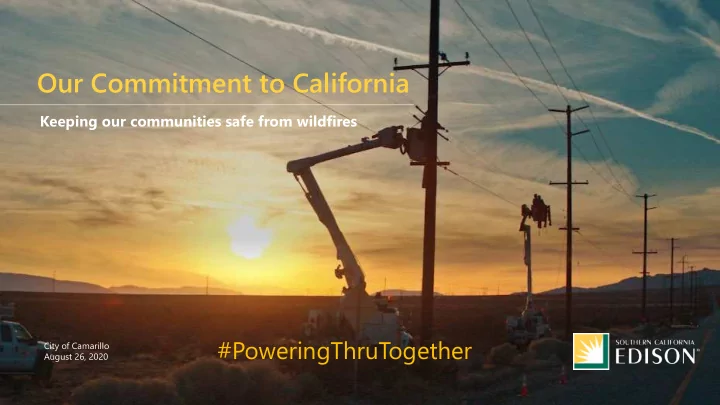
#PoweringThruTogether

slide-2
SLIDE 2

1

WILDFIRE PREPAREDNESS TIPS

slide-3
SLIDE 3

2

California’s wildfire problem is serious and worsening.

  • Ten of the 20 state’s most

destructive wildfires have happened since 2015

  • About a quarter of our

service area is located in high fire risk areas

Source: www.cpuc.ca.gov/FireThreatMaps

slide-4
SLIDE 4

WHAT WE LEARNED / WHAT’S NEW FOR 2020

Public Safety Power Shutoffs (PSPS)

  • Recognize the impact of PSPS events on customers but they are necessary to protect public safety
  • Found multiple instances of equipment damage and tree branches contacting power lines that could

have ignited a fire after a PSPS event

  • With the grid improvements SCE has made since last year, under the same weather conditions as 2019,

we expect to see a 30 percent reduction in the number of customers affected by future PSPS events

Wildfire Mitigation Tools

  • Implementing grid hardening activities and hi-tech tools and technologies
  • Improving our ability to sectionalize to reduce the number of people impacted

Customer Care Programs and Communications

  • Actively pursuing new programs to help customers
  • Improving website and communications capabilities to provide additional, timely information and

notifications

Stakeholder Engagement

  • Enhancing communication and collaboration with stakeholders and partners
  • Partnering with community-based organizations to better assist vulnerable customers

3

slide-5
SLIDE 5

MITIGATION STRATEGY BASED ON FIRE SCIENCE

Weather Conditions (Wind, Humidity) Vegetation & Structures Energy from Electrical Infrastructure Eliminating any side of the fire triangle can prevent ignitions

4

slide-6
SLIDE 6

5

OUR WILDFIRE MITIGATION PLAN

slide-7
SLIDE 7

6

  • Hazard tree removal (beyond traditional trim zone)
  • More than 20 in-house certified arborists
  • More than 650 vegetation management crews,

totaling nearly 1,500 workers

  • 1.1 million trees inspected annually; 500,000+

trees in high fire risk areas

  • 750,000 pruned per year
  • Vegetation removal at poles
  • LiDAR surveying

VEGETATION MANAGEMENT

slide-8
SLIDE 8

ADDITIONAL OPERATIONAL FLEXIBILITY

  • SCE developed plans to

sectionalize the circuits in the area to reduce the number of customers de- energized

  • By adding additional

weather stations and further dividing our grid into sections, we can reduce the number of customers de-energized (depending on weather and other conditions)

7

slide-9
SLIDE 9

8

PUBLIC SAFETY POWER SHUTOFF

  • De-energizing power lines to prevent ignitions
  • Used during elevated fire conditions
  • Primarily impacts circuits in high fire risk areas
  • Use of multiple methods to notify people in affected

areas before, during and after a de-energization event

slide-10
SLIDE 10

9

PSPS DECISION POINTS

Decision points include, but are not limited to:

  • NWS Red Flag Warnings
  • SCE meteorologists forecast

strong wind conditions in service area

  • SCE fire scientist assessment
  • f fire potential to include

consideration of weather and fuels

  • Impact of

de-energizing circuits on first responders and essential services

  • Real-time
  • bservations from

qualified electrical workers monitoring for hazardous conditions in the field

slide-11
SLIDE 11

10

PSPS TIMELINE

PLANNING AND MONITORING OUTAGE SCE will target the schedule above to notify customers. Sudden onset of hazardous conditions that jeopardize public safety may impact SCE’s ability to provide advanced notice to customers. Notifications can be provided via email, text, voice call, and TTY formats; zip code-level alerts; and NextDoor. POWER SHUTOFF (Statement) 3rd Notification Power Shutoff 4-7 DAYS AHEAD 3 DAYS AHEAD (Alert) 2 DAYS AHEAD (Alert) 1 DAY AHEAD (Alert) 1-4 HOURS BEFORE SHUTDOWN (Warning) SCE begins planning for potential PSPS SCE Incident Management Team activated Initial notifications to Local and Tribal Governments, Emergency Officials and First Responders. Critical Infrastructure and Service Providers Updates to notifications Initial notifications to customers not notified at 3 days ahead Update notification sent Imminent Shutdown notification POWER RESTORATION PREPARING FOR RE-ENERGIZATION (Statement) Notification Power Restored After Inspection Notification Before Re-Energization Occurs

slide-12
SLIDE 12

11

ENHANCEMENTS TO COMMUNICATIONS

Website Improvements

  • Dedicated PSPS page
  • Fire Weather and PSPS information
  • Increased capacity to handle website visits
  • Improved maps
  • Look up PSPS events and status by address
  • Maps showing locations of Community Resource

Centers and Community Crew Vehicles

  • Providing estimated restoration times

Notifications

  • Expanded notification alerts
  • Zip Code PSPS notifications
  • Nextdoor
  • Imminent notifications when possible
slide-13
SLIDE 13

12

CUSTOMER CARE PROGRAMS FOR YOUR COMMUNITY

Local Community Resources

  • Community Crew Vehicles (CCV) and Community Resource Centers (CRC)
  • May include water (including bulk potable water), ice, blankets, solar powered USB chargers,
  • nsite phone charging, outage information, and other resources

Rebates & Programs

  • Self-Generation Incentive Program (SGIP)
  • Rebates for whole home energy storage
  • $50 rebate for small appliance & device battery backup
  • $300-$500 generator rebate for well water dependent customers
  • Fully subsidized Critical Care customer battery back-up (income qualified)
slide-14
SLIDE 14

13

  • On-going community meetings held in high fire risk areas
  • Meetings with cities, counties and tribal governments
  • Outreach to essential service providers
  • Advertising campaign in market educating customers

about preparing PSPS

  • Letters communicating PSPS sent to all customers in our

service territory

TALKING WITH OUR COMMUNITIES

slide-15
SLIDE 15

14

  • Engaging with our most vulnerable customers
  • Partnering with community-based organizations and

community stakeholders such as Independent Living Centers and 211 organizations

  • Supporting resiliency, working with existing

philanthropic partners and deploying customer programs for PSPS preparedness, all-hazard awareness and emergency planning

  • Encouraging customers to sign up for medical baseline

and critical care programs

REACHING VULNERABLE COMMUNITIES

slide-16
SLIDE 16

15

INVESTING IN OUR COMMUNITIES

  • Keeping our communities safer through

wildfire mitigation and preparedness

  • First responder safety
  • Community readiness
  • Resiliency and disaster recovery
slide-17
SLIDE 17

16

GIVE FEEDBACK SIGN UP BE PREPARED

  • Provide us your feedback by

email, social media, or phone

  • Recordings of previous

community meetings available on our website

  • PSPS alerts
  • SCE’s Medical Baseline

program

  • SCE programs and rebates
  • Be prepared with a safety

preparedness plan, some basic supplies and advance planning

  • Power outage tips

Website: sce.com/wildfire Email: wildfireoutreach@sce.com Social Media: @SCE on Twitter & Facebook SCE Customer Support: 1-800-655-4555

slide-18
SLIDE 18

Additional Resources

slide-19
SLIDE 19

USEFUL INFORMATION

SCE Notifications

  • Sign up for PSPS alerts – sce.com/pspsalerts

Situational Awareness

  • PSPS maps and information – sce.com/psps
  • Role of weather in PSPS – sce.com/fireweather
  • CPUC wildfire maps – cpuc.ca.gov/wildfiresinfo
  • Fire cameras – alertwildfire.org

Preparedness

  • SCE outage tips – sce.com/outagetips
  • SCE emergency preparedness – sce.com/beprepared
  • SCE Medical Baseline Program – sce.com/medicalbaseline
  • CAL FIRE fire preparedness – readyforwildfire.org
  • Red Cross emergency preparedness –

redcross.org/prepare

  • FEMA emergency preparedness – ready.gov

Vegetation Management

  • Vegetation Management – sce.com/safety/power-lines;

contact 1-800-655-4555 or safetrees@sce.com Rebates

  • SCE Marketplace (rebates and programs) –

marketplace.sce.com

  • Self Generation Incentive Program (SGIP) –

sce.com/sgip or selfgenca.com Social Media

  • Follow @SCE on Twitter and Facebook

SCE Wildfire Web Page – sce.com/wildfire

18

slide-20
SLIDE 20

19

SCE COVID-19 CUSTOMER CARE PROGRAMS

Resource Description Link

Energy Assistance Fund (EAF) Income-qualified customers experiencing COVID- 19 financial hardship due to quarantine, illness, caring for loved ones or business closures can apply for assistance to pay their electric bill. sce.com/eaf California Alternate Rates for Energy (CARE)

  • r Family Electric Rate Assistance (FERA)

Programs The CARE program provides income-qualified households a discount of about 30% on monthly electric bills. FERA provides a reduced monthly discount of 18% for income-qualified households

  • f three or more.

sce.com/fera Medical Baseline Customers who use electrically operated medical devices in their homes are eligible and those enrolled will receive additional electricity per day at a discounted rate. sce.com/medicalbaseline Suspension of service disconnections for nonpayment, waiving late fees SCE has suspended service disconnections for nonpayment and is waiving late fees for residential and business customers impacted by the COVID-19 emergency. sce.com/billhelp Rate Plan Comparison Tool SCE offers several Time-of-Use rates that offer lower rates during daytime hours when people are now home. sce.com/rateplantool Budget Assistant You can also sign up for alerts if your next projected bill is expected to exceed your spending goal using SCE’s free Budget Assistant tool. sce.com/budgetassistant

www.sce.com/covid19

slide-21
SLIDE 21

POWER OUTAGE SAFETY TIPS

  • If you see a downed power line, do not touch it or anything in contact with it. Call 911 immediately.
  • Power outages in the area may impact traffic signals so motorists should use extreme caution and treat all intersections as four-way-stops.
  • Remember to check emergency supplies to be sure you have a battery-operated radio, a flashlight and fresh batteries.
  • Use flashlights instead of candles to avoid fire hazards in your home or business.
  • Consider using LED light bulbs with a battery backup, which can stay on during outages.
  • If you’re in a vehicle with a fallen power line on it, stay in the vehicle and remain calm until help arrives. It is OK to use your cellphone to call
  • 911. If you must leave the vehicle, remember to exit away from downed power lines and exit by jumping from the vehicle and landing with

both feet together. You must not touch the vehicle and the ground at the same time. Then proceed away from the vehicle by shuffling and not picking up your feet until you are several yards away.

  • If you use a generator, place it outdoors and plug individual appliances directly into it, using a heavy-duty extension cord. Connecting

generators directly to household circuits creates “backfeed,” which is dangerous to repair crews. Please consult the manufacturer’s manual for operating the generator.

  • If someone in your home is dependent on electric-powered, life-sustaining medical equipment, have an emergency plan that includes a

back-up power source, or make arrangements to relocate.

  • Do not use outdoor cooking equipment to cook indoors. Such equipment can release carbon monoxide and other toxic gases.
  • Use stairs instead of an elevator. Elevators are powered by electricity and may stop functioning during an outage. Be safe by taking the

stairs and use a flashlight when necessary.

  • For more information, visit sce.com/outagetips

20

slide-22
SLIDE 22

HOME GENERATOR TIPS

Using a backup source of power can keep you up and running during an outage, but generators can be dangerous if connected or used

  • improperly. Consult an electrician before you bring a generator home to determine the proper equipment and set you up safely.
  • 1. Equipment Options: Choose a generator for more power than you think you will need, depending on what lighting, appliances, and

equipment you plan to connect to the generator. Again, this is best determined by an electrician.

  • 2. Safety Hazards: Every year people die in portable generator-related incidents. The primary hazards to avoid when using a generator are

carbon monoxide (CO) poisoning, electric shock, electrocution and fire. Follow the directions supplied with the generator.

  • 3. Getting Hooked up: Connect electrical equipment to a portable generator using a heavy duty, outdoor extension cord that is rated more

than the sum of the connected appliance loads. Make sure the entire cord has no cuts or tears and that the plug has all three prongs, especially a grounding pin. Do not run portable generators indoors, and don’t connect a portable generator to your home’s electrical wiring or electrical panel as this can lead to serious injury or electrocution.

  • 4. Beware of Backfeeding: Never try to power the house wiring by plugging a generator into a wall outlet, otherwise known as

“backfeeding”. This is extremely dangerous and can electrocute utility workers and even neighbors. Electrocution is the fifth leading cause of all reported occupational deaths.

  • 5. Connect with an Electrician: If you decide to wire a generator directly to your home, California state law mandates that you notify

Southern California Edison. The only recommended method to connect a generator to house wiring is by having a qualified electrician install a power transfer switch, in compliance with national, state and local electrical codes. Find a licensed electrician to see if you can install the appropriate equipment.

  • 6. Portable vs. Permanent: Even a properly connected portable generator can become overloaded, become overheated and stress the

generator components, which can lead to generator failure. For power outages, permanently installed, stationary generators are better suited for providing backup power to a home or business. For more information, see the Understanding Backup Generation fact sheet.

21