Curriculum on Citizenship California Basics California Basics - - PowerPoint PPT Presentation

curriculum on citizenship
SMART_READER_LITE
LIVE PREVIEW

Curriculum on Citizenship California Basics California Basics - - PowerPoint PPT Presentation

Curriculum on Citizenship California Basics California Basics Agenda A1. California Geography A2. California Symbols A3. The People of California A4. Threats in California California Geography A1. Identify the key


slide-1
SLIDE 1

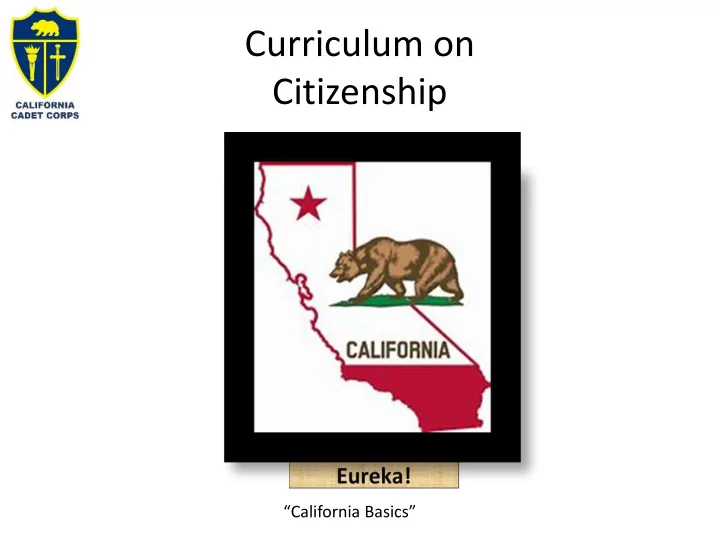
Curriculum on Citizenship

“California Basics”
slide-2
SLIDE 2

California Basics Agenda

  • A1. California Geography
  • A2. California Symbols
  • A3. The People of California
  • A4. Threats in California
slide-3
SLIDE 3

California Geography

  • A1. Identify the key geographic features of California.
slide-4
SLIDE 4

California Geography

  • California is 3rd largest US state
  • More people than any state
  • More diverse topography than most

– Mountains – Ocean – Rivers – Desert – Glaciers – Forests – Large cities – Millions of farmland acres

slide-5
SLIDE 5

California Geography

  • Borders 3 states (Oregon/Nevada/Arizona)
  • Borders Mexico & Pacific Ocean
  • Approx. 800 miles long x 250 miles wide
  • Highest point: Mount Whitney
  • Lowest point: Death Valley
slide-6
SLIDE 6

California Geography

  • Mountain Ranges:

– Klamath Mtns: high & forested – Coastal Mtns: parallel the coast – The Sierra Nevada Mtns: border w/Nevada – The Los Angeles/Transverse Ranges: run between Santa Barbara & San Diego – San Diego/Peninsular Ranges: SD County to Baja – Basin & Range Region: Narrow ranges & flat arid valleys (deserts)

slide-7
SLIDE 7

California Geography

  • The Central Valley

– Runs along middle of California – Between Coastal Ranges & the Sierra Nevada – Sacramento & San Joaquin Valleys

  • Comprise large part of farmland
slide-8
SLIDE 8

California Geography

  • The Central Valley (cont’d)

– Major Rivers:

  • Sacramento
  • San Joaquin
  • Colorado

– Major Lakes:

  • Lake Tahoe
  • Salton Sea
  • Owens Lake
  • Searles Lake
slide-9
SLIDE 9

California Geography

  • Frequent Earthquakes

– Major faults underground – Tectonic activity along coast – Historically significant:

  • 1906 San Francisco (magnitude 7.8 – 8.2)
  • 1971 San Fernando (mag. 6.6)
  • 1989 Loma Prieta (mag. 6.9 – 7.1
  • 1994 Northridge (mag. 6.7)
slide-10
SLIDE 10

California Geography

  • Largest Metropolitan Areas:

– Los Angeles – San/Francisco/Oakland – San Diego – Riverside/San Bernardino – Sacramento – San Jose

slide-11
SLIDE 11

California Geography

  • Diverse Climate

– Coastal & SoCal → Mediterranean

  • Moderately rainy winters
  • Mild, dry summers

– High Sierras → Warm summer/Winter snow – Desert Areas → Hot summer/Cold winter – Northern Coast → More rain than SoCal

slide-12
SLIDE 12

Check on Learning

  • 1. What states border California?
  • 2. Describe the Basin and Range Region? What

topography in California falls into this category?

  • 3. What are the three major rivers in

California?

  • 4. Name at least three key geographic features
  • f California?
slide-13
SLIDE 13

California Symbols

  • A2. Name 75% of the listed symbols of California.
slide-14
SLIDE 14

California Symbols

State Flag State Seal State Colors: Blue & Gold

slide-15
SLIDE 15

California Symbols

State Flower: The California Poppy State Insect: The Dogface Butterfly State Tree: The California Redwood

slide-16
SLIDE 16

California Symbols

State Fish: The Golden Trout State Animal: The Grizzly Bear State Fossil: The Saber-Toothed Cat

slide-17
SLIDE 17

California Symbols

State Reptile: The Desert Tortoise State Bird: The California Quail State Amphibian: The California Red-Legged Frog

slide-18
SLIDE 18

California Symbols

State Motto:

Eureka!

(Greek for “I have found it”) State Nickname: The Golden State

slide-19
SLIDE 19

Check on Learning

  • 1. What are our state colors?
  • 2. What two symbols are on our flag?
  • 3. What is our state motto? What does it

mean in English?

  • 4. What is our state animal?
  • 5. What is our state flower?
slide-20
SLIDE 20

The People of California

  • A3. Discuss details of the people of California, past and present.
slide-21
SLIDE 21

The People of California

  • Native people → Indian
  • Tribes or bands

– If cultural or linguistic connections, generally lived in small groups loosely tied together – Most: permanent location – Some: nomadic

slide-22
SLIDE 22

The People of California

slide-23
SLIDE 23

The People of California

  • Many native bands & cultures died out
  • Interaction w/European settlers
  • Catholic missions
  • Est. 275,000 natives pre-European settlers
  • Approx. 15,000 end of 19th Century
slide-24
SLIDE 24

The People of California

  • 1% of Californians are American Indians

– Apache/Cherokee/Choctaw/Creek/Hopi/Zuni/ Navajo/Blackfeet/Shoshone/Paiute/Pueblos/ Cahuilla/Chumash

  • Highest # of Native Americans than other

states

– More tribes, too

  • Live both on and off reservations

– reservation a.k.a. “rancheria”

slide-25
SLIDE 25

The People of California

slide-26
SLIDE 26

The People of California

  • Larger population than any other state
  • Diverse
  • Majority-minority

= majority of people are ethnic minorities

  • Increasingly Hispanic or Latino
  • Large % of Whites, Asians, & Blacks
  • Gender approx. 50/50 male/female
slide-27
SLIDE 27

The People of California

slide-28
SLIDE 28

The People of California

California Population as of April 2017 Population estimates, July 1, 2017, (V2017) 39,536,653 Population estimates base, April 1, 2010, (V2017) 37,254,518 Population, percent change – April 1, 2010 (estimates base) to July 1, 2017, (V2017) 6.10% Population, Census, April 1, 2010 37,253,956 Age and Sex Persons under 5 years 6.30% Persons under 18 years 22.90% Persons 65 years and over 13.90% Female persons 50.30% 0.503 Race and Hispanic Origin White alone 72.40% Black or African American alone 6.50% American Indian and Alaska Native alone 1.60% Asian alone 15.20% Native Hawaiian and Other Pacific Islander alone 0.05% Two or More Races 3.90% Hispanic or Latino 39.10% White alone, not Hispanic or Latino 37.20%

Source: US Census Bureau (Bureau, 2017)

slide-29
SLIDE 29

Check on Learning

  • 1. T/F: All native people of California lived

permanently in one place year-round.

  • 2. Why did many native cultures die out?
  • 3. Only

% of Californians today are American Indian.

  • 4. What does it mean that California is a

“majority-minority”?

slide-30
SLIDE 30

Threats in California

  • A4. Name the threats California faces.
slide-31
SLIDE 31

Threats in California

  • Catastrophic Events

– Earthquakes – Floods – Wildfires – Civil unrest

slide-32
SLIDE 32

Threats in California

  • National Guard (CACC’s parent organization)

– Helps deal with/recover from disaster – Prepares for & steps up when called is a significant mission

slide-33
SLIDE 33

Threats in California

  • Why so many earthquakes?

– Plate tectonics – Volcanic activity

  • Plate Tectonics

– Pacific Plate moving north – North American Plate moving south – Plates contact = friction

  • Friction creates fault
  • Earthquakes occur at fault
slide-34
SLIDE 34

Threats in California

  • San Andreas Fault

– The boundary line between Pacific & North American Plates – Runs along much of length of California

  • 100s of other smaller faults

– Approx. 200 potentially dangerous – 70% of population lives w/in 30 miles of a fault

slide-35
SLIDE 35

Threats in California

slide-36
SLIDE 36

Threats in California

  • Volcanic Activity (a result of plate tectonics)

– Most are small – Don’t cause damage – BUT…volcanic activity = earthquakes

  • Mammoth Lakes region
  • Mount Lassen
  • Mount Shasta
slide-37
SLIDE 37

Threats in California

slide-38
SLIDE 38

Threats in California

  • 2 or 3 large-scale earthquakes per year

– Magnitude of 5.5 or greater – Level at which moderate damage to structures can occur

  • Stringent building codes help prevent

damage

slide-39
SLIDE 39

Threats in California

  • Wildfires

– Lots of forested land → lightening starts fire – Drought → susceptible to burning – Arguments by some people:

  • Let smaller fires burn off dead vegetation to

prevent larger fires

  • Logging removes fuel, thus prevents fires

(But logging has been prevented in parts of California)

slide-40
SLIDE 40

Threats in California

  • El Niño

– Pacific Ocean temperatures ↑ off South America

  • Causes increased rainfall in SoCal
  • Eases drought

situation

slide-41
SLIDE 41

Threats in California

  • Too much rain or snow = flooding!

– Wildfires exacerbate

  • Vegetation keeps soil in place → burns off
  • Land susceptible to mudslides/extreme runoff

– Rivers → most common flood places

slide-42
SLIDE 42

Threats in California

  • Manmade disasters/civil disturbances

– 1965 riots in Watts (Los Angeles) – 1992 riots in Los Angeles (Rodney King) – San Bernardino Punk Riot of 2006 – 2007 MacArthur Park Rallies (regarding immigration) – 2009 & 2010 BART Police Shooting of Oscar Grant in Oakland (after incident and trial) – 2010 Santa Cruz May Day Riot – Black Lives Matter – Occupy Movement

slide-43
SLIDE 43

Threats in California

  • Riots

– People already angry about a situation – Something happens to tip anger over the top – People take to the streets

  • Protests

– People or authorities can become violent

  • People hurt, property damaged, problem not solved
slide-44
SLIDE 44

Threats in California

On a positive note…

  • CEOWORLD Magazine ranked California as

the state w/most diversity

– Diversity Measurements: culture/economic/household marital status & age groups/politics/religion/socioeconomics

  • And w/our diverse topography many think:

We’re a pretty great state!

slide-45
SLIDE 45

Check on Learning

  • 1. Name three threats in California.
  • 2. What CACC-affiliated organization helps our

state with disasters?

  • 3. What causes earthquakes in California?
  • 4. What is El Niño? What positive thing does it

do? What negative thing may it cause?