Orientation - an over view : words, self-referencing, and projection - - PDF document

orientation an over view words self referencing and
SMART_READER_LITE
LIVE PREVIEW

Orientation - an over view : words, self-referencing, and projection - - PDF document

Orientation - an over view : words, self-referencing, and projection Words render our representational worlds into walls of further representation we wander around and wonder at, within our reality. Beyond words, try


slide-1
SLIDE 1

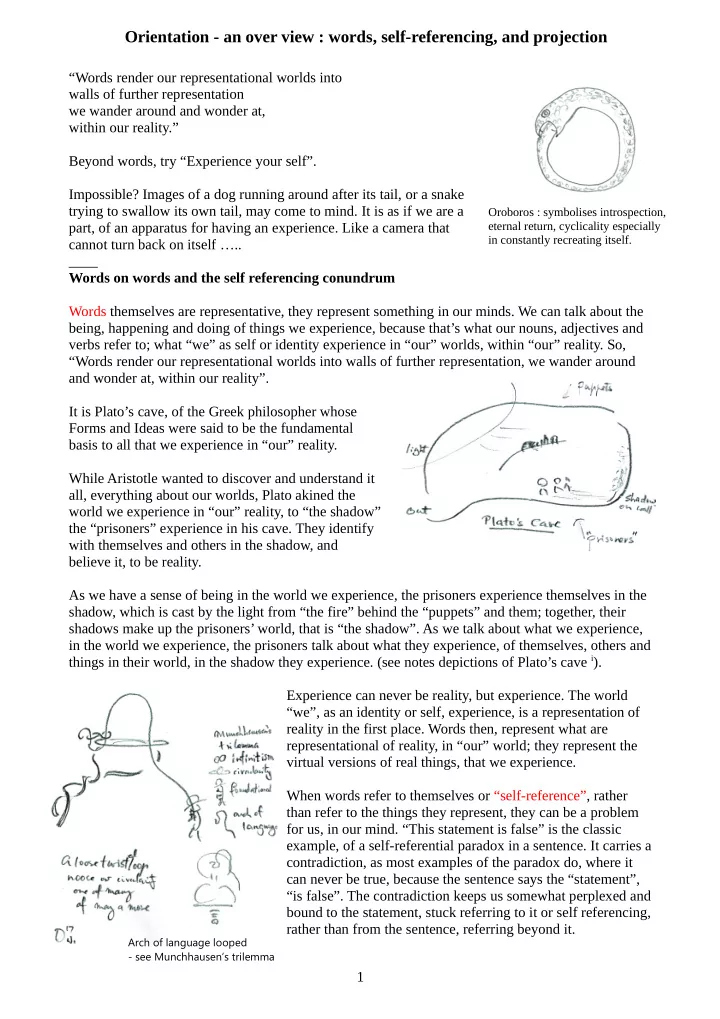
“Words render our representational worlds into walls of further representation we wander around and wonder at, within our reality.”  Beyond words, try “Experience your self”. Impossible? Images of a dog running around after its tail, or a snake trying to swallow its own tail, may come to mind. It is as if we are a part, of an apparatus for having an experience. Like a camera that cannot turn back on itself ….. ____ Words on words and the self referencing conundrum Words themselves are representative, they represent something in our minds. We can talk about the being, happening and doing of things we experience, because that’s what our nouns, adjectives and verbs refer to; what “we” as self or identity experience in “our” worlds, within “our” reality. So, “Words render our representational worlds into walls of further representation, we wander around and wonder at, within our reality”.  It is Plato’s cave, of the Greek philosopher whose Forms and Ideas were said to be the fundamental basis to all that we experience in “our” reality. While Aristotle wanted to discover and understand it all, everything about our worlds, Plato akined the world we experience in “our” reality, to “the shadow” the “prisoners” experience in his cave. They identify with themselves and others in the shadow, and believe it, to be reality. As we have a sense of being in the world we experience, the prisoners experience themselves in the shadow, which is cast by the light from “the fire” behind the “puppets” and them; together, their shadows make up the prisoners’ world, that is “the shadow”. As we talk about what we experience, in the world we experience, the prisoners talk about what they experience, of themselves, others and things in their world, in the shadow they experience. (see notes depictions of Plato’s cave i). Experience can never be reality, but experience. The world “we”, as an identity or self, experience, is a representation of reality in the first place. Words then, represent what are representational of reality, in “our” world; they represent the virtual versions of real things, that we experience. When words refer to themselves or “self-reference”, rather than refer to the things they represent, they can be a problem for us, in our mind. “This statement is false” is the classic example, of a self-referential paradox in a sentence. It carries a contradiction, as most examples of the paradox do, where it can never be true, because the sentence says the “statement”, “is false”. The contradiction keeps us somewhat perplexed and bound to the statement, stuck referring to it or self referencing, rather than from the sentence, referring beyond it. 1

Oroboros : symbolises introspection, eternal return, cyclicality especially in constantly recreating itself.

Orientation - an over view : words, self-referencing, and projection

Arch of language looped

  • see Munchhausen’s trilemma
slide-2
SLIDE 2

Self-referencing alone, even without a contradiction, can still give the same paradox. For example, “This refers to the word, this” or “to you reading, or to me typing, these words”. Left unresolved is,

  • ur having engaged with words in the first place. They expose the expectation that, in

communicating or expressing, a sentence should refer to things other than the sentence itself or what is in it. This expectation may vary with cultures, languages and situation, but it may be universal of putting things to words that, sentences should refer to what their words represent. All stories then, can be said to be circular and self referential : “Before any paradox, we reflect what is represented of reality in ‘what’ we experience, within our reality. Of conscious experience, we are held between incomplete bubbles that include ‘the world’ we experience. Gingerly balanced our inner and

  • uter worlds, their shells we

straddle, mush. In dribs and drabs we dabble and dribble, learn to babble and spit out our words, and live in them, words. A loose twist and loop noose our circularity as one of our many, of many more stories about ‘us’.” The paradox itself of self-referential sentences, penetrates into our reality beyond the words of the paradox, towards our very self, if, we let it. And sometimes it just hits us – the paradox, thick and mesmerising, like Homer Simpson’s “D’oh”. Comedy shares something of this 3-dimensional, self approaching and exposing complexity and substance or tangibility, that is also chaos or uncertainty. However, when we try to refer to our actual self, it is a deeper and more immediate concern, compared to the paradox of self-referential words – it is the “self referencing conundrum” (link to blog articles ii) for us, if I may coin a phrase. Try for your self, “Experience your self”. Impossible? Images of a dog running around after its tail, or a snake trying to swallow its own tail (Oroboros; top of p1), may apply. It is as if we are a part, of an apparatus for having an experience. Like a camera that cannot turn back on itself to take a picture of itself, and like its film, that in capturing an image, is “reflective” of what is in front of the focusing lens, it seems we cannot experience or capture our self – only of “other than self” can we experience and so reflect. There is no problem for us to think about or experience a concept or a sense of self. They are not our “actual” self however, and there remains, an inherent resistance to approaching and experiencing our self in the “usual” way we consider “direct”. We cannot see our self, only others. From where we face the world we can see and grasp, from this fair, functional and familiar front of ours, it is uncertainty, a conundrum, all the way, beyond language, beyond

  • context. We extend behind and in our depths to an empty existential

aloneness, or to a vague singular solipsistic beginning. What is self? What is anything? Where am I? Where do I come from? 2

Conscious Mind Body sense Conscious Mind Body sense

slide-3
SLIDE 3

What we are and, who must be there ...! We, as the subject in our reality, expect something other than self, to experience as the object iii. We have seen how self-referential sentences challenge this expectation we have in sentences too that, they refer to other than itself (self referential paradox p1). We seek outwards to the world, linear it seems but circular in fact because, we reflect in our experience (the experience itself), what we experience, which is in itself a representation, and not of reality in itself. In just what we reflect, our actual self and our greater whole is missing. There is something of the self or subjective in everything we experience, even in what we call the phenomenal or objective world; they are what “we” experience, in “our” reality. No longer can we presume upon a direct causality that separates the subject and object, as words would have us do, at least with modern languages, in their tendency to be precise (rather than dependant on context with

  • lder languages iv). Both scientists and philosophers are having to consider a counter-intuitive

subjectivity for quantum phenomena, for the very precise factors or ‘fine-tuning’ required in virtual simulations of the big bang (beginning of the universe) to work, and for even their raw data. I believe “we”, as self or identity, must learn, as the subject in “our” reality, to be a part of an integrative whole being. And that whole being is of Reality (more below). From our innocent and vague origins in the womb (solipsistic), overwhelmed by everything that is not self, we fall back into an existential darkness. Somehow we wait, while reflecting representations of other than self. What else but to meet the world, and reflect what we

  • experience. That’s what we do. A mirror symbolises a deity in various faiths including the

Shinto, where on entering an inner sanctum of its shrine, and opening the doors to a housing on an altar, we find a mirror disc facing us. There is more to our self, behind what we reflect of the world, beyond the self-referencing

  • conundrum. We are usually reminded of this from ‘out of left field’; the other-side, behind,

beyond, within, or underneath it all. But beyond our more, of our self and our reality, is a whole entity of “whom” all that is of “our” reality, is a part. Our reality is, a “projected” part of a whole being of reality. Projection refers to our placement in space, by our whole, through his or her CNS (Central Nervous System) or the brain and spinal cord. It means, we, as self or identity, are a projected part of our whole, of our whole being, whole self and whole body, who must be there, beyond projection, in reality. Projection allows us to distinguish our self from our Whole self, and our reality from Reality. Anything that is of our self are parts of our reality, which is a projected part of our Whole self, who in turn, is a part of Reality. “We” as self or identity, are a part of Reality, but only as a projected part

  • f our Whole being. Yet, as of the “prisoners” in Plato’s cave, who shunned the “sun light” of the

real world and scurried back to their “shadow”, we normally have no interest or concern for our whole self or Reality. As a part, we should consider our whole. Our whole carries us, and can validate us as a part, as only

  • ur whole can. However, we are normally tied up in our particular aspects within our reality,

identified in our self and with what we experience. Without any inkling of our whole, we are too easily isolated in this exclusive identification. We avoid our being a part, and deny our selves of our relation with our whole self unless, we consider our part and as projection, refer to our whole. We can approach our self as projection in projected space, and “capture” our self with a spatial “orientation”, because our reality occupies space as projection. Approaching our self cannot be “direct” of course, in our normal sense of experiencing and doing things. Otherwise, we are back 3

slide-4
SLIDE 4

again against the self referencing conundrum. Rather, we become projection, trusting our whole as we enter or step into our “actuality”, our existence in fact as projection. We can recognise parts of our reality, such as our conscious, mind, the world we may experience,

  • ur self, what we experience and deeper being. However, with a spatial orientation, we may also

appreciate where those parts are in space and in relation to each other, and how they occupy those places in certain “shapes”. Further more, in our “actuality” as a projected part, we can be in relation with our whole self. Again, we cannot be “direct” in introducing or referring to the whole self, because our whole is beyond our projected part, in reality. As projection, in our actuality, we must “refer to” or “orientate with” our whole, who is beyond our projected reality. Encompassing both prayer and meditation, and like communing with deity because, he or she is transcendent, beyond our reality, yet pervading

  • r immanent of it (our reality), as the divine is thought to be of creation v; our whole is our maker.

How to be in relation with our whole, should be a pre-eminent concern for “us”, being a part. (Whole body method vi). Yes, there are individual differences to “our” reality, yours and mine. But what is fundamental of 

  • ur reality is common to us universally. We are free, as a part of “our” whole being, who does not

 deny our individuality, but allows for all our parts. Through our relation with our whole, we integrate in our being/becoming a part, with his or her happening living being on Earth. And though a whole is always more than the sum of its parts, he or she (“our” whole) is more integrated and complete, with integrating rather than isolated

  • parts. (Part theoryvii)

Yes, self-referencing, because it is about our “actuality”, the fact

  • f our existence that includes
  • ur self, boundaries and

paradoxes, our conscious and witness, our all and our reality, as a projected part of our whole. The message must not only refer to our reality, but demonstrate our part and our relation with our 

  • whole. Its proof, is not just for us to measure (empirical) and consider in our mind, but is our

involvement and induction. Beyond words and their indication, instruction and self-referencing, is an enactment of our actuality as a part of our whole, and a process that comes of that. hc.r tt4r July17 Topics And notes viii 4

slide-5
SLIDE 5

i Plato’s cave :

To the right is an artist’s impression of Platro’s cave.

As often the case it seems, art, poetry and other intuitive modes of expression, present things to our cognitive mind, as if directly and accurately from our subconscious. Here this depiction nicely approximates our cognitive space in its “actuality” (as projected) and correlates in its layout and contents with the depictions below. First one to the left accommodates the artist’s impression and the second more directly indicates the aspects of our projected reality in their actuality. Some of the aspects and their correlation are our conscious that “reigns from above as if to shed light on

  • ur reality” with “the fire”, our mind and its “spread” with the part of the cave that accommodates the

“prisoners” and the “shadow” they experience, mind’s self (observer) is us looking into the cave depiction, centred on it, the identity having an experience with the “prisoners”, and our connection or “exit” to more of

  • ur whole, which correlates with the “ascent to sunlight” in Plato’s cave.

The world out there correlates with the “shadow cast on this wall” that is set to the right in line with the light from “the fire” in the cave depiction, where as in our case, of course our world we experience “comes around to the front for us to face” but from our right, as indicated in the depictions below. Our “actuality” is captured from behind in most of the depictions of our projected actuality presented here. Silhouette of the whole being is often included, as in the two (right and centre) below, so as to orientate our parts to our whole. Depth of our reality extend through the “lime stone extension”. They are our emotive, somatic and deeper intuitive and instinctive depths below our cognitive realm (the “cave”) above.

ii Self referencing conundrum : link to blog entries.

(https://realityhc.wordpress.com/?s=self+referencing+conundrum&submit=Search) iii Linear, subject/object : We do question the objectivity of what we experience. Whether it is true or certain,

  • r how we know and ask for example, “Does a tree fall in a forest, if no one sees it fall?”. But otherwise, we

insist on this linear dichotomy, of subject and object on the two ends of having an experience; we describe

  • ur reality as a dichotomy, even though there is a conscious by which we are conscious of this and we are

aware of it, as if witnessed (they make our reality more than a dichotomy). Also we by-pass and avoid the experience itself and our reflective self, and hold to what we reflect or experience.

From Great Dialogues of Plato (Warmington and Rouse, eds.) New York, Signet Classics: 1999. p. 316

slide-6
SLIDE 6

iv Modern languages : Old language of one another’s belonging, may be soft in their cognitive determination (when, what, who, why, how) compared to modern languages, but delivers for their native speakers a deep understanding and communication of their life together, within their language group. Much is left to and dependant on this context. The human origin of our talk lives on in the babble of the auctioneer, the sweat nothings murmured between loved ones, and our mother’s nursery rhymes and songs. v Cosmology, science, spirit, Mu and Kuu : A cosmology ensues from projection, an “Orientation”. Everything is a part of Reality. It is the one and

  • nly Entirety; and it includes our whole self (who projects our reality) and “our” reality, but only as a

projected part of our whole. Our whole self is of Reality, and, in his or her entirety or complete whole-ness, is touched by the rest of

  • Reality. In every direction from within our reality, is our whole. Sounds like our modern understanding about

the distances to the end of the universe, in all directions the same from our time and place? What the scientists say about the size of the universe may be true, and it is a description from within our reality, as they should qualify. However, there’s a whole being of reality who is missing, yet gives us our sense of the world, and our self that “observes” it. As “they” describe what they have come to understand, there is no good distinction between the world we experience and measure or monitor (with machines), and reality, without our whole in between. What we experience is not reality, but a projected version of reality from “aspects of reality” that we may claim to have sense organs for. We can only “claim” because, as self or identity in our projected reality, there is nothing solid about “us”, in projection. Rather, it is our whole self who has the eyes, ears and other sense

  • rgans, as well as the brain to receive nervous impulses from them to put together our phenomenal world, for

us to experience. It is just as inside Plato’s cave, where the “prisoners” experience and identify with the “shadow” - but projected by a whole being rather than cast by the light from the “fire”, and this is the basis for the subjectivity in our projected reality, our whole being, for what “we” experience in “our” reality. We do, as the scientist also, struggle to maintain objectivity, as we venture into the details and how, particularly for life, our self, and the minute and the enormous, from our time and space. It is hard not to feel like there must be something or someone behind all this. However, even with machines, to monitor and measure, that extend our senses, our theories, formulas, even consciousness, are within “our” reality. Reality itself must be more than the sum of its Newtonian, relativistic and quantum aspects and any other aspects we may realise and from our descriptive theories about them. Descriptive because beyond the atomic bomb, nuclear reactors and particle accelerators we have no application or means to test, and only observe according to our theories towards the quantum. There may be applications in yet defined realms of reality. Yet we are already narrowed in our dominant cognitive senses that are augmented by technology (targeted by them). Our worlds may seem to expand, like with telescopes, the internet or infra-red vision in the dark, but it is like looking through a hole in the wall that may gives us some sense that we did not have before of the world past the wall, but does not necessarily give us a better sense of being a part of reality. Further more, through all our time, our whole self is of reality, is present in the present, where our here and now and our reality is a projected part. Physicists may still consider a single formula for everything. However, our “everything” is a concept in

  • ur projected reality, as well as any theory or sense about reality. No application can come out of the

quantum quarters till we understand our being a part. Superfast computers to set up and mimic, or simulate virtually that aspect of reality where, the subject and object are entangled or connected, rather than displaced? Must we go beyond object/subject, inside/outside, Reality/virtuality splits? When as projection

  • ur splits, conundrums and self, others and the world we (as self) experience, are all parts of our reality, that

is in turn a projected part of our whole. Our true frontiers are behind and including where we front “our”

  • bjectivity, through our “actuality”.

Reality is the one and only Entirety, of everything and everywhere. I understand its oneness as God, All- Creation-God, is everywhere and everything, and is beyond each part and thing in Reality, as their whole. The spirit as the essence of All-Creation-God, is everywhere, in every part of each and every one and thing, and spot, of Reality. However, in our projected reality, we are displaced from our whole and Reality. Yet, we are given one spirit, one essence in projection of our whole and, of All Creation (one whole) and Reality (entirety). Their “weight” comes though to projection, through whole self, to manifest as one spirit within

  • ur projected reality.

Emptiness, kuu of Zen is the disassociations through which we have experience, between conscious,

slide-7
SLIDE 7

witness and self, and what is experienced. Nothingness, mu is the absence of our whole being of reality, displaced from our reality of projection, by projection. At his or her core, at the core on Nothingness, is the essences one, of All-Creation-God and our whole self and being, whole body and living entity of Earth. It is the spirit manifest one, God-essence despite projection, projected in our projected reality. vi Whole body method : How to introduce and “promote” the whole self, to develop and present more completely else where. Consequence of understanding our reality as a projected part, as Part theory, Complete whole body, and Cosmology are also. Our whole self is the trinity of our whole self, whole being and whole body, and is one. He or she is the

  • ne who is gendered, and who is in and of reality.

To introduce the whole self : Core is the reference, the other end the clue to our whole. Promote the whole self : So that there is something of our whole for our reality to be received by. Our whole is committed to our part, which in its normal state, has been isolated in its identification in its self and what it experiences. The whole self adjusts for it, and we must release our whole physically from so this adjustment, towards his or her “completeness”, of integrating parts. Goes with promoting our part, which apart from approaching and stepping into our “actuality”, involves extending our self spatially and according to “what happens” as we integrate. vii Part theory : Also to develop and present more completely elsewhere. Our reality is a projected part of our whole, projected through his or her CNS (Central Nervous System). Our whole is more than the sum of his or her parts, which include projected and solid body and organ parts. Reality in its entirety is more than the sum of its parts, which include whole entities and their parts. viii Topics i Plato’s cave Munchhausen’s trilemma (https://realityhc.wordpress.com/?s=Munchhausen%27s+trilemma=Search) Self-referencing paradox of sentences and conundrum of our self Solipsism, existentialism subjectivity, objectivity, reflective reality and our reality, Projection, CNS distinguish our self from our Whole self, and our reality from Reality Part theory, Whole body method vi Actuality, shapes Twisted loops, circular, open and extend science empiricism, materialism vs theoretical physics idealism and rationalism epistemology (knowing) and ontology (reality)