Ori Data Structures and Operations Data Structures and - - PDF document

ori
SMART_READER_LITE
LIVE PREVIEW

Ori Data Structures and Operations Data Structures and - - PDF document

Overview Motivation: The History of Origami Motivation: The History of Origami Previous Research Previous Research The Objective The Objective Ori Data Structures and Operations Data Structures and


slide-1
SLIDE 1

1

Ori

An Interactive Paper Folding Simulation

Purdue University CS 490T Tim Thirion, Darin Rajan, and Jennifer Lin

Overview

  • Motivation: The History of Origami

Motivation: The History of Origami

  • Previous Research

Previous Research

  • The Objective

The Objective

  • Data Structures and Operations

Data Structures and Operations

  • Implementation Issues

Implementation Issues

  • Demo

Demo

  • Conclusion

Conclusion

History

  • Originated in Japan several hundred years ago

Originated in Japan several hundred years ago

  • The practice of paper folding was divided into:

The practice of paper folding was divided into:

  • Recreational

Recreational

  • Ceremonial

Ceremonial

  • The name origami was coined in 1880 from the

The name origami was coined in 1880 from the words words oru

  • ru (to fold) and

(to fold) and kami kami (paper). Previously, the (paper). Previously, the art was called art was called orikata

  • rikata ("folded shapes").

("folded shapes").

  • Today, hobbyists and professional paper folders are

Today, hobbyists and professional paper folders are spread throughout the world spread throughout the world

Previous Research

  • Mathematical Research

Mathematical Research

  • Huzita’s

Huzita’s Axioms: Provide a generic Axioms: Provide a generic mathematical framework that describe all mathematical framework that describe all

  • rigam i folds.
  • rigam i folds.
  • Erik Demaine (MIT)

Erik Demaine (MIT) – – Developed several Developed several theorems related to paper folding and theorems related to paper folding and cutting. cutting.

  • Protein folding in

Protein folding in biochem istry. biochem istry.

  • Interactive Origami Simulations

Interactive Origami Simulations

  • Very few (is this a warning?)

Very few (is this a warning?)

  • Only a 2D application could be found

Only a 2D application could be found

Objective

  • To create a system that allows the user to

To create a system that allows the user to create simple, 3D origam i objects using an create simple, 3D origam i objects using an intuitive interface. intuitive interface.

  • The goal is to design a system such that basic

The goal is to design a system such that basic folds are immediately available and complex folds are immediately available and complex folds can be added. folds can be added.

Goal

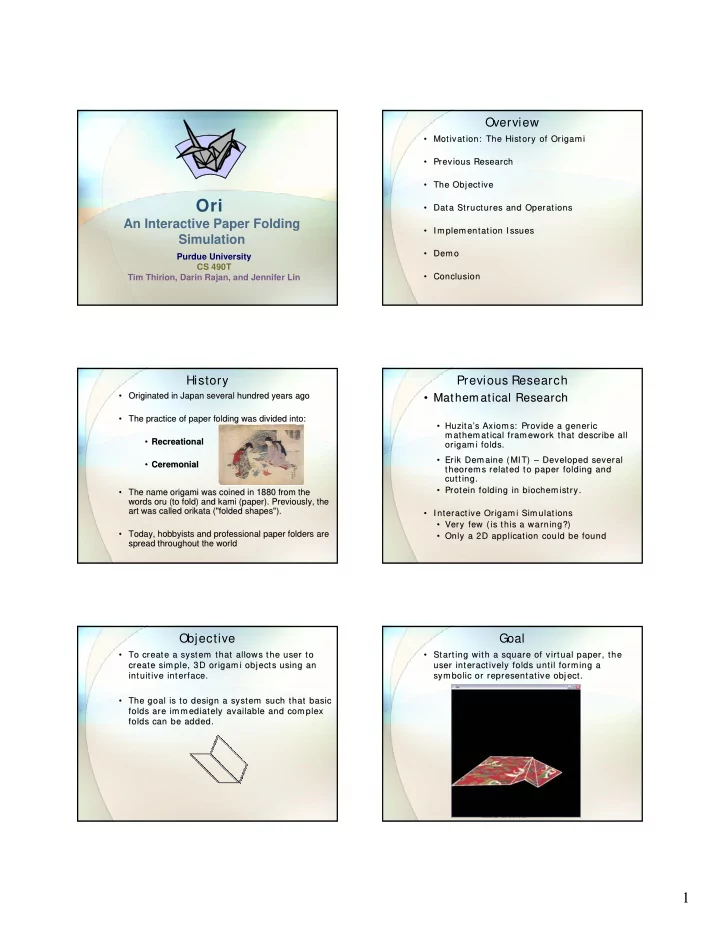
  • Starting with a square of virtual paper, the

Starting with a square of virtual paper, the user interactively folds until forming a user interactively folds until forming a symbolic or representative object. symbolic or representative object.

slide-2
SLIDE 2

2

Data Structures and Operations

  • How do we represent an origam i

How do we represent an origam i computationally? computationally?

  • Many different ways to do it

Many different ways to do it

  • Essentially an origam i is a set of polygons

Essentially an origam i is a set of polygons

  • Trees and lists are two ways of storing the

Trees and lists are two ways of storing the polygons. polygons.

  • This is a tough decision…

This is a tough decision…

Connectivity

  • Observation: An origam i is highly

Observation: An origam i is highly connected. connected.

  • It has three data components:

It has three data components:

  • Vertex

Vertex – – A point in space A point in space

  • Edge

Edge – – A connection between two A connection between two vertices vertices

  • Face

Face – – A sequence of edges that form a A sequence of edges that form a closed polygon closed polygon

  • An origam i is then approximated by a set of

An origam i is then approximated by a set of faces. faces.

Conceptual E xamples

  • A sequence of simple bends:

A sequence of simple bends:

  • Also, vertices keep track of the edges that are

Also, vertices keep track of the edges that are incident upon it. incident upon it.

  • Edges keep track of the faces to the left and to

Edges keep track of the faces to the left and to the right. the right.

  • A “Winged Edge Boundary Representation”

A “Winged Edge Boundary Representation”

The Three Core Operations

  • Make a fold line to divide a face into two.

Make a fold line to divide a face into two.

  • Select a vertex and use it to label all of the

Select a vertex and use it to label all of the vertices as being either fixed or moving. vertices as being either fixed or moving.

  • Rotate interactively all of the “moving”

Rotate interactively all of the “moving” vertices about the fold line. vertices about the fold line.

Complexity Issues Complexity Issues

  • It is difficult to determ ine if the sequence

It is difficult to determ ine if the sequence produced a fold acceptable to the rules of produced a fold acceptable to the rules of

  • rigam i:
  • rigam i:
  • It cannot self

It cannot self-

  • intersect.

intersect.

  • It cannot be cut.

It cannot be cut.

  • Many other constraints…

Many other constraints…

  • A few degenerate sequences can be

A few degenerate sequences can be determ ined from the input sequence and state determ ined from the input sequence and state

  • f the data structures.
  • f the data structures.

Complexity Issues Complexity Issues

  • Implementation of visual effects

Implementation of visual effects

  • Advanced lighting, advanced shading, and

Advanced lighting, advanced shading, and shadowing were completely dependent on shadowing were completely dependent on the origam i data structure. the origam i data structure.

  • As the data structure changed, the

As the data structure changed, the algorithm for these effects had to change algorithm for these effects had to change

  • Many are tough to find and rem edy.

Many are tough to find and rem edy.

  • Because of this, the sim ulation is often easily

Because of this, the sim ulation is often easily broken. broken.

  • Undo and Redo help tremendously when this

Undo and Redo help tremendously when this

  • ccurs.
  • ccurs.
slide-3
SLIDE 3

3

Demo Conclusion

  • Research in origami is geared toward

producing mathematical theorems, not interactive simulations.

  • For our system, simple folds are easy;

sequences of simple folds are difficult.

  • Trying to catch degenerate cases is difficult.
  • Debugging involves tracing through the entire

structure and discerning the unique circumstances that caused the crash.

Questions, Comments, Rotten Fruit?

  • tthirion@purdue.edu
  • rajand@purdue.edu
  • linjs@purdue.edu