Order of Presentations Team Topic 206-2 Evil neighbors - Securing - - PowerPoint PPT Presentation

order of presentations
SMART_READER_LITE
LIVE PREVIEW

Order of Presentations Team Topic 206-2 Evil neighbors - Securing - - PowerPoint PPT Presentation

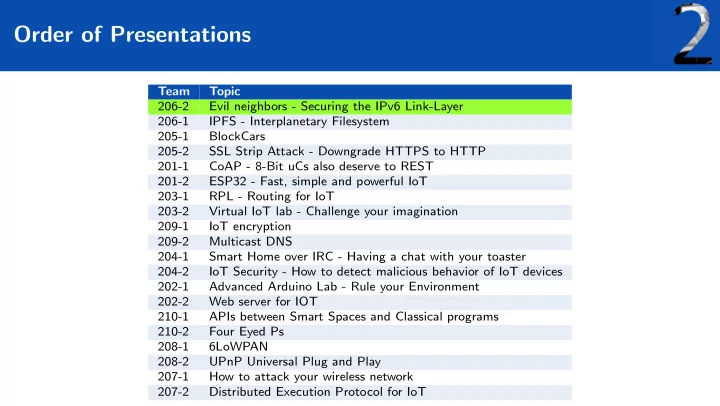
Order of Presentations Team Topic 206-2 Evil neighbors - Securing the IPv6 Link-Layer 206-1 IPFS - Interplanetary Filesystem 205-1 BlockCars 205-2 SSL Strip Attack - Downgrade HTTPS to HTTP 201-1 CoAP - 8-Bit uCs also deserve to REST


slide-1
SLIDE 1

Order of Presentations

Team Topic 206-2 Evil neighbors - Securing the IPv6 Link-Layer 206-1 IPFS - Interplanetary Filesystem 205-1 BlockCars 205-2 SSL Strip Attack - Downgrade HTTPS to HTTP 201-1 CoAP - 8-Bit uCs also deserve to REST 201-2 ESP32 - Fast, simple and powerful IoT 203-1 RPL - Routing for IoT 203-2 Virtual IoT lab - Challenge your imagination 209-1 IoT encryption 209-2 Multicast DNS 204-1 Smart Home over IRC - Having a chat with your toaster 204-2 IoT Security - How to detect malicious behavior of IoT devices 202-1 Advanced Arduino Lab - Rule your Environment 202-2 Web server for IOT 210-1 APIs between Smart Spaces and Classical programs 210-2 Four Eyed Ps 208-1 6LoWPAN 208-2 UPnP Universal Plug and Play 207-1 How to attack your wireless network 207-2 Distributed Execution Protocol for IoT

slide-2
SLIDE 2

iLab2 - Your own exercise Evil neighbors – Securing the IPv6 Link-Layer

Erik Pohle, Team 206

slide-3
SLIDE 3

Why should this topic be chosen?

Purpose A closer look into the SEcure Neighbor Discovery protocol (SEND) RFC 3971 IoT context: authenticate smart devices in the local network/ prevent rouge smart device from controlling the network SEND as example for authentication and certificate chains

slide-4
SLIDE 4

What will your students learn?

The following learning goals are covered in the Lecture PreLab Lab Revisit Router Solicitation and -Advertisement x x Examine vulnerabilities of unauthenticated Neighbour Discovery x x Understand how CGAs, CPS and CPAs authenticate nodes x x x Conduct Link-Local IPv6 address spoofing x Configure hosts and routers to use SEND x x

slide-5
SLIDE 5

Teaser practical part

rouge router sends false RAs PC1 communicates to PC2 and PC3 over rouge router (instead of router directly)

slide-6
SLIDE 6

Teaser practical part

router provides digitally signed RAs rouge router cannot impersonate router, PC1 or PC2

slide-7
SLIDE 7

Order of Presentations

Team Topic 206-2 Evil neighbors - Securing the IPv6 Link-Layer 206-1 IPFS - Interplanetary Filesystem 205-1 BlockCars 205-2 SSL Strip Attack - Downgrade HTTPS to HTTP 201-1 CoAP - 8-Bit uCs also deserve to REST 201-2 ESP32 - Fast, simple and powerful IoT 203-1 RPL - Routing for IoT 203-2 Virtual IoT lab - Challenge your imagination 209-1 IoT encryption 209-2 Multicast DNS 204-1 Smart Home over IRC - Having a chat with your toaster 204-2 IoT Security - How to detect malicious behavior of IoT devices 202-1 Advanced Arduino Lab - Rule your Environment 202-2 Web server for IOT 210-1 APIs between Smart Spaces and Classical programs 210-2 Four Eyed Ps 208-1 6LoWPAN 208-2 UPnP Universal Plug and Play 207-1 How to attack your wireless network 207-2 Distributed Execution Protocol for IoT

slide-8
SLIDE 8

reate your own exercise

IPFS - Interplanetary Filesystem

Markus Oberprieler, Team 206

1

slide-9
SLIDE 9
  • P2P Filesystem
  • Simple way to provide fles
  • Also accessible over HTTP-Gateways
  • Uses many interestnn concepts

(Content-based-adressinn, distributed-hash-tables,... )

  • Many possible usecases

(webhostnn, IoT,... )

2

slide-10
SLIDE 10

What Will Your Students Learn?

3

The Following Learning Goals are Covered in the Lecture PreLab Lab Understand what is possible with IPFS X X X Set up an multple IPFS-Peers in practce X X Understand how the underlyinn mechanics work X X Show how IPFS can be used in IoT X X Confnure multple nodes with diferent roles X X

slide-11
SLIDE 11

Teaser Practcal Part

4

Access the content over an IPFS – Gateway Address fles via Content-/ or Domain- based-adressinn IoT Device: Add fles pronrammatcally to IPFS Special confnuraton with sinnle link Subscribe to content without usinn IPFS

slide-12
SLIDE 12

Order of Presentations

Team Topic 206-2 Evil neighbors - Securing the IPv6 Link-Layer 206-1 IPFS - Interplanetary Filesystem 205-1 BlockCars 205-2 SSL Strip Attack - Downgrade HTTPS to HTTP 201-1 CoAP - 8-Bit uCs also deserve to REST 201-2 ESP32 - Fast, simple and powerful IoT 203-1 RPL - Routing for IoT 203-2 Virtual IoT lab - Challenge your imagination 209-1 IoT encryption 209-2 Multicast DNS 204-1 Smart Home over IRC - Having a chat with your toaster 204-2 IoT Security - How to detect malicious behavior of IoT devices 202-1 Advanced Arduino Lab - Rule your Environment 202-2 Web server for IOT 210-1 APIs between Smart Spaces and Classical programs 210-2 Four Eyed Ps 208-1 6LoWPAN 208-2 UPnP Universal Plug and Play 207-1 How to attack your wireless network 207-2 Distributed Execution Protocol for IoT

slide-13
SLIDE 13

create your own exercise

Block-cars

205 – Philippos Barabas

1

slide-14
SLIDE 14

Why Should This Topic be Chosen?

  • Blockchain is a very “hot” topic, but how can it

be combined with IoT?

  • Show that blockchain can be useful, not only

as a technology but also as a economical model

2

slide-15
SLIDE 15

What Will You Learn?

3

The Following Learning Goals will be Covered in the Lecture PreLab Lab What is Blockchain (security, decentralisation, etc.)? X X What are smart contracts and dApps? X X Ethereum tools (Truffle, Apache, Metamask, etc.) X X Create your first dApp X

slide-16
SLIDE 16

Teaser Practical Part

4

Blockchain

slide-17
SLIDE 17

Thank you for your attention!

slide-18
SLIDE 18

Order of Presentations

Team Topic 206-2 Evil neighbors - Securing the IPv6 Link-Layer 206-1 IPFS - Interplanetary Filesystem 205-1 BlockCars 205-2 SSL Strip Attack - Downgrade HTTPS to HTTP 201-1 CoAP - 8-Bit uCs also deserve to REST 201-2 ESP32 - Fast, simple and powerful IoT 203-1 RPL - Routing for IoT 203-2 Virtual IoT lab - Challenge your imagination 209-1 IoT encryption 209-2 Multicast DNS 204-1 Smart Home over IRC - Having a chat with your toaster 204-2 IoT Security - How to detect malicious behavior of IoT devices 202-1 Advanced Arduino Lab - Rule your Environment 202-2 Web server for IOT 210-1 APIs between Smart Spaces and Classical programs 210-2 Four Eyed Ps 208-1 6LoWPAN 208-2 UPnP Universal Plug and Play 207-1 How to attack your wireless network 207-2 Distributed Execution Protocol for IoT

slide-19
SLIDE 19

iLab2 - SSL Strip SSL Strip Attack Downgrade HTTPS to HTTP

Dominik Pham - Team 205

slide-20
SLIDE 20

Short Overview

SSL Strip is a MitM attack that downgrades HTTPS traffic to HTTP requires to redirect victim’s traffic to a malicious proxy server ↔ different attack vectors

slide-21
SLIDE 21

Example

slide-22
SLIDE 22

Why should this topic be chosen?

Purpose HTTP(S) is (still) essential for IoT devices Several general known vulnerabilities in standards are covered

slide-23
SLIDE 23

What will your students learn?

The following learning goals are covered in the Lecture PreLab Lab Understand how the SSL Strip attack works x x Learn about different attack vectors x x Configure an (Apache) webserver x x Intercept traffic with different methodologies x x Perform SSL Strip attack x x HSTS as countermeasure for the SSL Strip attack x x x Countermeasures for the different attack Vectors x x (x)

slide-24
SLIDE 24

Order of Presentations

Team Topic 206-2 Evil neighbors - Securing the IPv6 Link-Layer 206-1 IPFS - Interplanetary Filesystem 205-1 BlockCars 205-2 SSL Strip Attack - Downgrade HTTPS to HTTP 201-1 CoAP - 8-Bit uCs also deserve to REST 201-2 ESP32 - Fast, simple and powerful IoT 203-1 RPL - Routing for IoT 203-2 Virtual IoT lab - Challenge your imagination 209-1 IoT encryption 209-2 Multicast DNS 204-1 Smart Home over IRC - Having a chat with your toaster 204-2 IoT Security - How to detect malicious behavior of IoT devices 202-1 Advanced Arduino Lab - Rule your Environment 202-2 Web server for IOT 210-1 APIs between Smart Spaces and Classical programs 210-2 Four Eyed Ps 208-1 6LoWPAN 208-2 UPnP Universal Plug and Play 207-1 How to attack your wireless network 207-2 Distributed Execution Protocol for IoT

slide-25
SLIDE 25

iLab2 - Your own exercise CoAP 8-Bit µCs also deserve to REST

Andreas Schrägle, Julian Eder - Team 201

slide-26
SLIDE 26

Why should this topic be chosen?

Purpose CoAP is a specialized M2M protocol It works well over slow and unreliable network links Designed for constrained devices like an Arduino HTTP-like and RESTful

slide-27
SLIDE 27

What will your students learn?

The following learning goals are covered in the Lecture PreLab Lab Protocol basics, e.g. which transport layer it sits on ✓ ✓ The RESTful architecture ✓ ✓ ✓ A short look at transport security (DTLS) ✓ ✓ Understand the CoAP packet format ✓ ✓ ✓ Setting up a CoAP proxy (FreeCoAP or CoAPthon) ✓ ✓

slide-28
SLIDE 28

Teaser practical part

Server Client

Simple server ↔ client setup Potentially a router with intentional packet loss in-between

slide-29
SLIDE 29

Order of Presentations

Team Topic 206-2 Evil neighbors - Securing the IPv6 Link-Layer 206-1 IPFS - Interplanetary Filesystem 205-1 BlockCars 205-2 SSL Strip Attack - Downgrade HTTPS to HTTP 201-1 CoAP - 8-Bit uCs also deserve to REST 201-2 ESP32 - Fast, simple and powerful IoT 203-1 RPL - Routing for IoT 203-2 Virtual IoT lab - Challenge your imagination 209-1 IoT encryption 209-2 Multicast DNS 204-1 Smart Home over IRC - Having a chat with your toaster 204-2 IoT Security - How to detect malicious behavior of IoT devices 202-1 Advanced Arduino Lab - Rule your Environment 202-2 Web server for IOT 210-1 APIs between Smart Spaces and Classical programs 210-2 Four Eyed Ps 208-1 6LoWPAN 208-2 UPnP Universal Plug and Play 207-1 How to attack your wireless network 207-2 Distributed Execution Protocol for IoT

slide-30
SLIDE 30

iLab2 - Your own exercise ESP32 Fast, simple and powerful IoT

Julian Eder, Andreas Schr¨ agle, Team 201

slide-31
SLIDE 31

Why should this topic be chosen?

Purpose ESP32 is a WiFi enabled Arduino compatible microcontroller It is faster, cheaper and smaller than the Arduino Build your own IoT with the ESP32 What is your background in the topic?

slide-32
SLIDE 32

What will your students learn?

The following learning goals are covered in the Lecture PreLab Lab What is the ESP32 and why is it important? x x Comparison with other development boards x x Programming the ESP32 with the Arduino IDE x x Simple and fast IoT configuration x x x Advanced ESP32: Dual core, low power and security x x

slide-33
SLIDE 33

Background

slide-34
SLIDE 34

Teaser practical part

slide-35
SLIDE 35

Order of Presentations

Team Topic 206-2 Evil neighbors - Securing the IPv6 Link-Layer 206-1 IPFS - Interplanetary Filesystem 205-1 BlockCars 205-2 SSL Strip Attack - Downgrade HTTPS to HTTP 201-1 CoAP - 8-Bit uCs also deserve to REST 201-2 ESP32 - Fast, simple and powerful IoT 203-1 RPL - Routing for IoT 203-2 Virtual IoT lab - Challenge your imagination 209-1 IoT encryption 209-2 Multicast DNS 204-1 Smart Home over IRC - Having a chat with your toaster 204-2 IoT Security - How to detect malicious behavior of IoT devices 202-1 Advanced Arduino Lab - Rule your Environment 202-2 Web server for IOT 210-1 APIs between Smart Spaces and Classical programs 210-2 Four Eyed Ps 208-1 6LoWPAN 208-2 UPnP Universal Plug and Play 207-1 How to attack your wireless network 207-2 Distributed Execution Protocol for IoT

slide-36
SLIDE 36

create your own exercise

RPL – ROUTING FOR IOT

Bassam Jaber , Justus Fries - Team 203

1

slide-37
SLIDE 37

Why Should This Topic be Chosen?

  • Importance for Wireless Sensor Networks
  • Look at the protocol itself but also potentially

attacks based on topology

2

slide-38
SLIDE 38

What Will Your Students Learn?

3

The Following Learning Goals are Covered in the Lecture PreLab Lab Understand why protocols like RPL are needed X X Understand how RPL works (DODAGs) X X X Understand attacks on RPL (Classification) X X X Practical experience with Contiki and Cooja X X Alternative protocols (LIBP) X X

slide-39
SLIDE 39

Teaser Practical Part

4

Ideally we find a way to use Ethernet to connect nodes and a root/border router

slide-40
SLIDE 40

Order of Presentations

Team Topic 206-2 Evil neighbors - Securing the IPv6 Link-Layer 206-1 IPFS - Interplanetary Filesystem 205-1 BlockCars 205-2 SSL Strip Attack - Downgrade HTTPS to HTTP 201-1 CoAP - 8-Bit uCs also deserve to REST 201-2 ESP32 - Fast, simple and powerful IoT 203-1 RPL - Routing for IoT 203-2 Virtual IoT lab - Challenge your imagination 209-1 IoT encryption 209-2 Multicast DNS 204-1 Smart Home over IRC - Having a chat with your toaster 204-2 IoT Security - How to detect malicious behavior of IoT devices 202-1 Advanced Arduino Lab - Rule your Environment 202-2 Web server for IOT 210-1 APIs between Smart Spaces and Classical programs 210-2 Four Eyed Ps 208-1 6LoWPAN 208-2 UPnP Universal Plug and Play 207-1 How to attack your wireless network 207-2 Distributed Execution Protocol for IoT

slide-41
SLIDE 41

create your own exercise

VIRTUAL IOT LAB: CHALLENGE YOUR IMAGINATION

Bassam Jaber, Justus Fries. TEAM 203

1

slide-42
SLIDE 42

Why Should This Topic be Chosen?

  • Why did you choose this topic?
  • What cool stuff do you want to communicate

to those doing your planned lab?

2

slide-43
SLIDE 43

What Will Your Students Learn?

3

The Following Learning Goals are Covered in the Lecture PreLab Lab What can you create with Packet tracer X X X Configure a smart home network with IoT devices X X X Create a registration service for IoT system X X Understanding MQTT protocol X X X Configure a complex smart anything scenario X X Extend your Imagination X X X

slide-44
SLIDE 44

Teaser Practical Part

4

This is your playground:

6x Quad Core fast PC with 
3-4 usable LAN interfaces per machine. 2x Cisco 881 Router 2x Ethernet switch 2x Work Place with KVM

slide-45
SLIDE 45

Teaser Practical Part

5

slide-46
SLIDE 46

Teaser Practical Part

6

slide-47
SLIDE 47

Teaser Practical Part

7

slide-48
SLIDE 48

Order of Presentations

Team Topic 206-2 Evil neighbors - Securing the IPv6 Link-Layer 206-1 IPFS - Interplanetary Filesystem 205-1 BlockCars 205-2 SSL Strip Attack - Downgrade HTTPS to HTTP 201-1 CoAP - 8-Bit uCs also deserve to REST 201-2 ESP32 - Fast, simple and powerful IoT 203-1 RPL - Routing for IoT 203-2 Virtual IoT lab - Challenge your imagination 209-1 IoT encryption 209-2 Multicast DNS 204-1 Smart Home over IRC - Having a chat with your toaster 204-2 IoT Security - How to detect malicious behavior of IoT devices 202-1 Advanced Arduino Lab - Rule your Environment 202-2 Web server for IOT 210-1 APIs between Smart Spaces and Classical programs 210-2 Four Eyed Ps 208-1 6LoWPAN 208-2 UPnP Universal Plug and Play 207-1 How to attack your wireless network 207-2 Distributed Execution Protocol for IoT

slide-49
SLIDE 49

create your own exercise

IoT encryption

Heiko Heberlein Joakim Evju Team 209

1

slide-50
SLIDE 50

Why Should This Topic be Chosen?

  • Interesting to look at different ways of

achieving that data sent between IoT devices are encrypted

  • Important in a world where IoT devices

increases, and so does the data collected and transmitted with them

2

slide-51
SLIDE 51

What Will Your Students Learn?

3

The Following Learning Goals are Covered in the Lecture PreLab Lab Brief encryption theory X Encryption algorithms X X Symmetric and asymmetric encryption X X Key exchange X X Performance requirements X X Analyse performance X

slide-52
SLIDE 52

Teaser Practical Part

4

slide-53
SLIDE 53

Order of Presentations

Team Topic 206-2 Evil neighbors - Securing the IPv6 Link-Layer 206-1 IPFS - Interplanetary Filesystem 205-1 BlockCars 205-2 SSL Strip Attack - Downgrade HTTPS to HTTP 201-1 CoAP - 8-Bit uCs also deserve to REST 201-2 ESP32 - Fast, simple and powerful IoT 203-1 RPL - Routing for IoT 203-2 Virtual IoT lab - Challenge your imagination 209-1 IoT encryption 209-2 Multicast DNS 204-1 Smart Home over IRC - Having a chat with your toaster 204-2 IoT Security - How to detect malicious behavior of IoT devices 202-1 Advanced Arduino Lab - Rule your Environment 202-2 Web server for IOT 210-1 APIs between Smart Spaces and Classical programs 210-2 Four Eyed Ps 208-1 6LoWPAN 208-2 UPnP Universal Plug and Play 207-1 How to attack your wireless network 207-2 Distributed Execution Protocol for IoT

slide-54
SLIDE 54

create your own exercise

Multicast DNS

Heiko Heberlein Joakim Evju Team 209

1

slide-55
SLIDE 55

Why Should This Topic be Chosen?

MDNS is important in Zero Configuration Networking

2

slide-56
SLIDE 56

What Will Your Students Learn?

3

The Following Learning Goals are Covered in the Lecture PreLab Lab Understand functionality and usecases of mDNS X X Setup mDNS service on PCs/Program Arduino X X Look at differences between mDNS and Unicast DNS X X X Examine security aspects (mDNS-FLood/DDoS) X X X

slide-57
SLIDE 57

Teaser Practical Part

4

slide-58
SLIDE 58

Order of Presentations

Team Topic 206-2 Evil neighbors - Securing the IPv6 Link-Layer 206-1 IPFS - Interplanetary Filesystem 205-1 BlockCars 205-2 SSL Strip Attack - Downgrade HTTPS to HTTP 201-1 CoAP - 8-Bit uCs also deserve to REST 201-2 ESP32 - Fast, simple and powerful IoT 203-1 RPL - Routing for IoT 203-2 Virtual IoT lab - Challenge your imagination 209-1 IoT encryption 209-2 Multicast DNS 204-1 Smart Home over IRC - Having a chat with your toaster 204-2 IoT Security - How to detect malicious behavior of IoT devices 202-1 Advanced Arduino Lab - Rule your Environment 202-2 Web server for IOT 210-1 APIs between Smart Spaces and Classical programs 210-2 Four Eyed Ps 208-1 6LoWPAN 208-2 UPnP Universal Plug and Play 207-1 How to attack your wireless network 207-2 Distributed Execution Protocol for IoT

slide-59
SLIDE 59

create your own exercise

SMART HOME OVER IRC

HAVING A CHAT WITH YOUR TOASTER

Simon Anlauff | Team 204 | Topic 1

1

slide-60
SLIDE 60

Why Should This Topic be Chosen?

  • IRC Protocol is simple and fun
  • Interesting alternative to other approaches in

managing Smart Spaces

2

slide-61
SLIDE 61

What Will Participants Learn?

3

The Following Learning Goals are Covered in the Lecture PreLab Lab IRC background and applications X X Understanding the IRC command/message format X X X Being aware of the limitations to this approach X X X Setting up simple IRC Servers and Clients X X Customizing communication between smart devices X

slide-62
SLIDE 62

4

IRC Server User (IRC Client) Services (IRC Clients) Smart Device (IRC Client)

slide-63
SLIDE 63

Order of Presentations

Team Topic 206-2 Evil neighbors - Securing the IPv6 Link-Layer 206-1 IPFS - Interplanetary Filesystem 205-1 BlockCars 205-2 SSL Strip Attack - Downgrade HTTPS to HTTP 201-1 CoAP - 8-Bit uCs also deserve to REST 201-2 ESP32 - Fast, simple and powerful IoT 203-1 RPL - Routing for IoT 203-2 Virtual IoT lab - Challenge your imagination 209-1 IoT encryption 209-2 Multicast DNS 204-1 Smart Home over IRC - Having a chat with your toaster 204-2 IoT Security - How to detect malicious behavior of IoT devices 202-1 Advanced Arduino Lab - Rule your Environment 202-2 Web server for IOT 210-1 APIs between Smart Spaces and Classical programs 210-2 Four Eyed Ps 208-1 6LoWPAN 208-2 UPnP Universal Plug and Play 207-1 How to attack your wireless network 207-2 Distributed Execution Protocol for IoT

slide-64
SLIDE 64

create your own exercise

IoT Security – How to detect malicious behavior of IoT devices

Simon Anlauff, Joshua Koutny (204)

1

slide-65
SLIDE 65

Why Should This Topic be Chosen?

  • Attacks using IoT devices are becoming an

increasing threat

  • Detecting malicious behavior early on is

crucial

  • Procedures of how to extract this behavior

from data are useful to know

2

slide-66
SLIDE 66

What My Students Will Learn

3

The Following Learning Goals are Covered in the Lecture PreLab Lab Understand the vulnerabilities of IoT devices X X Taking over an IoT device remotely X X Understand anomaly detection approaches X X Examine a data stream for anomalies X X Recognize an IoT device's malicious behavior X X

slide-67
SLIDE 67

Teaser for the Practical Part

4

Required Setup:

2x Quad Core fast PC with 3-4 usable LAN interfaces per machine 2x Cisco 881 Router 2x Work Place with KVM 1x Arduino Board to continuously transmit sensor data

Attacker IoT device PC to communicate with the IoT device and scan traffic for anomalies Remotely taking control

slide-68
SLIDE 68

Order of Presentations

Team Topic 206-2 Evil neighbors - Securing the IPv6 Link-Layer 206-1 IPFS - Interplanetary Filesystem 205-1 BlockCars 205-2 SSL Strip Attack - Downgrade HTTPS to HTTP 201-1 CoAP - 8-Bit uCs also deserve to REST 201-2 ESP32 - Fast, simple and powerful IoT 203-1 RPL - Routing for IoT 203-2 Virtual IoT lab - Challenge your imagination 209-1 IoT encryption 209-2 Multicast DNS 204-1 Smart Home over IRC - Having a chat with your toaster 204-2 IoT Security - How to detect malicious behavior of IoT devices 202-1 Advanced Arduino Lab - Rule your Environment 202-2 Web server for IOT 210-1 APIs between Smart Spaces and Classical programs 210-2 Four Eyed Ps 208-1 6LoWPAN 208-2 UPnP Universal Plug and Play 207-1 How to attack your wireless network 207-2 Distributed Execution Protocol for IoT

slide-69
SLIDE 69

iLab2 - Your own exercise Advanced Arduino Lab Rule Your Environment

Team 202: Patrick Lederer and Charlie Harding

slide-70
SLIDE 70

Why should this topic be chosen?

Purpose Build your own autonomous system with an Arduino

slide-71
SLIDE 71

Why should this topic be chosen?

Purpose Build your own autonomous system with an Arduino Automate simple tasks (e.g. switching the light on/off

slide-72
SLIDE 72

Why should this topic be chosen?

Purpose Build your own autonomous system with an Arduino Automate simple tasks (e.g. switching the light on/off Use two Arduinos: Create a challenging environment!

slide-73
SLIDE 73

Why should this topic be chosen?

Purpose Build your own autonomous system with an Arduino Automate simple tasks (e.g. switching the light on/off Use two Arduinos: Create a challenging environment! Compete with your partner using the Arduinos!

slide-74
SLIDE 74

What will your students learn?

The following learning goals are covered in the Lecture PreLab Lab Recap of hardware devices x x x Understand terminology and applications of autonomous systems x x Understand the MAPE-loop x x Learn about different degrees of autonomity (from rule-based to learning) x x Learn connections between AI and autonomous systems x Interactions of autonomous systems x x x Implement the MAPE-loop x Learn Programming an Arduino x x

slide-75
SLIDE 75

Teaser practical part

slide-76
SLIDE 76

Teaser practical part

slide-77
SLIDE 77

Teaser practical part

slide-78
SLIDE 78

Order of Presentations

Team Topic 206-2 Evil neighbors - Securing the IPv6 Link-Layer 206-1 IPFS - Interplanetary Filesystem 205-1 BlockCars 205-2 SSL Strip Attack - Downgrade HTTPS to HTTP 201-1 CoAP - 8-Bit uCs also deserve to REST 201-2 ESP32 - Fast, simple and powerful IoT 203-1 RPL - Routing for IoT 203-2 Virtual IoT lab - Challenge your imagination 209-1 IoT encryption 209-2 Multicast DNS 204-1 Smart Home over IRC - Having a chat with your toaster 204-2 IoT Security - How to detect malicious behavior of IoT devices 202-1 Advanced Arduino Lab - Rule your Environment 202-2 Web server for IOT 210-1 APIs between Smart Spaces and Classical programs 210-2 Four Eyed Ps 208-1 6LoWPAN 208-2 UPnP Universal Plug and Play 207-1 How to attack your wireless network 207-2 Distributed Execution Protocol for IoT

slide-79
SLIDE 79

create your own exercise

WEB SERVER FOR IOT

Charlie Harding, 202_2

1

slide-80
SLIDE 80

Why Should This Topic be Chosen?

  • This is a good way to start to create a very

basic interpreted language

  • It shows how flexible web servers can be,

without requiring compilation of the scripts

  • It allows remote control of the Arduino circuit

with a GUI

2

slide-81
SLIDE 81

What Will Your Students Learn?

3

The Following Learning Goals are Covered in the Lecture PreLab Lab Understand what a REST API is used for X X Understand how web servers respond to requests X X X Build a REST API for HTTP X X Develop understanding of parsing in C (à la PHP) X X Use Arduino to access the file system, network and pins X X

Typically, you will cover different aspects in different parts. E.g. you will cover more theoretical aspects in the lecture. Those aspects do not necessarily have to be covered by the practical exercise as they can deliver context...

slide-82
SLIDE 82

Teaser Practical Part

4

DHCP Web client Writing web scripts

slide-83
SLIDE 83

Order of Presentations

Team Topic 206-2 Evil neighbors - Securing the IPv6 Link-Layer 206-1 IPFS - Interplanetary Filesystem 205-1 BlockCars 205-2 SSL Strip Attack - Downgrade HTTPS to HTTP 201-1 CoAP - 8-Bit uCs also deserve to REST 201-2 ESP32 - Fast, simple and powerful IoT 203-1 RPL - Routing for IoT 203-2 Virtual IoT lab - Challenge your imagination 209-1 IoT encryption 209-2 Multicast DNS 204-1 Smart Home over IRC - Having a chat with your toaster 204-2 IoT Security - How to detect malicious behavior of IoT devices 202-1 Advanced Arduino Lab - Rule your Environment 202-2 Web server for IOT 210-1 APIs between Smart Spaces and Classical programs 210-2 Four Eyed Ps 208-1 6LoWPAN 208-2 UPnP Universal Plug and Play 207-1 How to attack your wireless network 207-2 Distributed Execution Protocol for IoT

slide-84
SLIDE 84

create your own exercise

APIS BETWEEN SMART SPACES AND “CLASSICAL” PROGRAMS

Dominik Bissinger, Khlifi Mariem, Team 210

1

slide-85
SLIDE 85

Why Should This Topic be Chosen?

  • APIs are essential when different programs should

directly influence each other

2

slide-86
SLIDE 86

Why Should This Topic be Chosen?

  • APIs are essential when different programs should

directly influence each other

  • This is important for Smart Spaces, since they often

need to be externally controlled, when not fully autonomous (for example by a phone app)

3

slide-87
SLIDE 87

Why Should This Topic be Chosen?

  • APIs are essential when different programs should

directly influence each other

  • This is important for Smart Spaces, since they often

need to be externally controlled, when not fully autonomous (for example by a phone app)

  • Creating an API helps understanding the „essence“ of

a program

4

slide-88
SLIDE 88

What Will The Students Learn?

The Following Learning Goals are Covered in the Lecture PreLab Lab Understand what an API is and why it is important X X Knowledge of general best practices in API creation X X Some deeper insight in design parameters relevant to IoT X X Understand what the important design choices are for controlling a Smart Space via a “classical” program (for example a phone app) X X Implementing a VSL service that acts as an API for a Smart Space X X

slide-89
SLIDE 89

Teaser Practical Part Hardware

6

Switch Smart Device

slide-90
SLIDE 90

Teaser Practical Part Software

7

slide-91
SLIDE 91

Order of Presentations

Team Topic 206-2 Evil neighbors - Securing the IPv6 Link-Layer 206-1 IPFS - Interplanetary Filesystem 205-1 BlockCars 205-2 SSL Strip Attack - Downgrade HTTPS to HTTP 201-1 CoAP - 8-Bit uCs also deserve to REST 201-2 ESP32 - Fast, simple and powerful IoT 203-1 RPL - Routing for IoT 203-2 Virtual IoT lab - Challenge your imagination 209-1 IoT encryption 209-2 Multicast DNS 204-1 Smart Home over IRC - Having a chat with your toaster 204-2 IoT Security - How to detect malicious behavior of IoT devices 202-1 Advanced Arduino Lab - Rule your Environment 202-2 Web server for IOT 210-1 APIs between Smart Spaces and Classical programs 210-2 Four Eyed Ps 208-1 6LoWPAN 208-2 UPnP Universal Plug and Play 207-1 How to attack your wireless network 207-2 Distributed Execution Protocol for IoT

slide-92
SLIDE 92

create your own exercise

FOUR-EYED PS

Mariem Khlifi – Team 210

1

slide-93
SLIDE 93

Why Should This Topic be Chosen?

  • Learn a Programming Language that is

specifically made for software defined networking and to encounter the difficulties in the field so far : P4

2

slide-94
SLIDE 94

Why Should This Topic be Chosen?

3

  • Learn a new way of

implementing packet forwarding and

  • ther network basics.
slide-95
SLIDE 95

Why Should This Topic be Chosen?

4

  • Application in hardware: Create two smart

devices that communicate between each

  • ther.
slide-96
SLIDE 96

What Will Your Students Learn?

5

The Following Learning Goals are Covered in the Lecture PreLab Lab Understand the limitations in the field of SDN X X Introduction to the basics of P4 X X Learn about the advantages of P4 for IoT X X Implement basic routing using P4 X X Implement tunneling using P4 X X Control a smart device (each PC) X Implement a communication protocol (tunneling) X X X

slide-97
SLIDE 97

Teaser Practical Part

6

This is your playground:

6x Quad Core fast PC with 3-4 usable LAN interfaces per machine. 2x Cisco 881 Router 2x Ethernet switch 2x Work Place with KVM 1x Arduino How to cable?

slide-98
SLIDE 98

Order of Presentations

Team Topic 206-2 Evil neighbors - Securing the IPv6 Link-Layer 206-1 IPFS - Interplanetary Filesystem 205-1 BlockCars 205-2 SSL Strip Attack - Downgrade HTTPS to HTTP 201-1 CoAP - 8-Bit uCs also deserve to REST 201-2 ESP32 - Fast, simple and powerful IoT 203-1 RPL - Routing for IoT 203-2 Virtual IoT lab - Challenge your imagination 209-1 IoT encryption 209-2 Multicast DNS 204-1 Smart Home over IRC - Having a chat with your toaster 204-2 IoT Security - How to detect malicious behavior of IoT devices 202-1 Advanced Arduino Lab - Rule your Environment 202-2 Web server for IOT 210-1 APIs between Smart Spaces and Classical programs 210-2 Four Eyed Ps 208-1 6LoWPAN 208-2 UPnP Universal Plug and Play 207-1 How to attack your wireless network 207-2 Distributed Execution Protocol for IoT

slide-99
SLIDE 99

create your own exercise

6LoWPAN


IPv6 over Low-Power Wireless Personal Area Networks

Nico Christely (208)

1

slide-100
SLIDE 100

Why Should This Topic be Chosen?

  • Enables low-power devices with limited

processing capabilities to participate in IoT

  • Header Compression, (de)fragmentation
  • f the IP packets, routing and security

2

slide-101
SLIDE 101

What Will Your Students Learn?

3

The Following Learning Goals are Covered in the Lecture PreLab Lab Understand the basic concepts of 6LoWPAN X X Learn and discover the flaws of 6LoWPAN X X Understand header compression ( + problems) X X X Examine security aspects X X X Configure a complex scenario X X

slide-102
SLIDE 102

Teaser Practical Part

4

×

slide-103
SLIDE 103

Order of Presentations

Team Topic 206-2 Evil neighbors - Securing the IPv6 Link-Layer 206-1 IPFS - Interplanetary Filesystem 205-1 BlockCars 205-2 SSL Strip Attack - Downgrade HTTPS to HTTP 201-1 CoAP - 8-Bit uCs also deserve to REST 201-2 ESP32 - Fast, simple and powerful IoT 203-1 RPL - Routing for IoT 203-2 Virtual IoT lab - Challenge your imagination 209-1 IoT encryption 209-2 Multicast DNS 204-1 Smart Home over IRC - Having a chat with your toaster 204-2 IoT Security - How to detect malicious behavior of IoT devices 202-1 Advanced Arduino Lab - Rule your Environment 202-2 Web server for IOT 210-1 APIs between Smart Spaces and Classical programs 210-2 Four Eyed Ps 208-1 6LoWPAN 208-2 UPnP Universal Plug and Play 207-1 How to attack your wireless network 207-2 Distributed Execution Protocol for IoT

slide-104
SLIDE 104

create your own exercise

Leo Fahrbach (208)

1

UPnP Universal Plug and Play

Discovering and Control of Smart Devices made simple?

slide-105
SLIDE 105

Why Should This Topic be Chosen?

  • Devices can discover other devices with UPnP

and exchange control information

  • Usage of many underlying Protocols, such as

SSDP SOAP

2

slide-106
SLIDE 106

What Will Your Students Learn?

3

The Following Learning Goals are Covered in the Lecture PreLab Lab Understand how UPnP works (mainly SSDP) X X Configure UPnP on a PC X X Watch discovery using Wireshark X Examine security aspects X X Configure a complex scenario X X

slide-107
SLIDE 107

Teaser Practical Part

4

UPnP control UPnP device

slide-108
SLIDE 108

Order of Presentations

Team Topic 206-2 Evil neighbors - Securing the IPv6 Link-Layer 206-1 IPFS - Interplanetary Filesystem 205-1 BlockCars 205-2 SSL Strip Attack - Downgrade HTTPS to HTTP 201-1 CoAP - 8-Bit uCs also deserve to REST 201-2 ESP32 - Fast, simple and powerful IoT 203-1 RPL - Routing for IoT 203-2 Virtual IoT lab - Challenge your imagination 209-1 IoT encryption 209-2 Multicast DNS 204-1 Smart Home over IRC - Having a chat with your toaster 204-2 IoT Security - How to detect malicious behavior of IoT devices 202-1 Advanced Arduino Lab - Rule your Environment 202-2 Web server for IOT 210-1 APIs between Smart Spaces and Classical programs 210-2 Four Eyed Ps 208-1 6LoWPAN 208-2 UPnP Universal Plug and Play 207-1 How to attack your wireless network 207-2 Distributed Execution Protocol for IoT

slide-109
SLIDE 109

create your own exercise

HOW TO ATTACK YOUR WIRELESS NETWORK

Alexander Hölzl & Sebastian Würl, Team 207

1

slide-110
SLIDE 110

Why Should This Topic be Chosen?

  • Everybody uses wireless networks
  • WPA2 is the most common security protocol
  • This lab shows that even heavily used security

protocols exhibit weaknesses that render them insecure

2

slide-111
SLIDE 111

What Will The Students Learn?

3

The Following Learning Goals are Covered in the Lecture PreLab Lab Understand how the WPA2 four-way handshake works X X Understand what is done to bypass security mechanisms X X Learn how the tools work, that are needed to carry out the attack X X Set up your own vulnerable network X Attack your network X

slide-112
SLIDE 112

Teaser Practical Part

4

slide-113
SLIDE 113

Order of Presentations

Team Topic 206-2 Evil neighbors - Securing the IPv6 Link-Layer 206-1 IPFS - Interplanetary Filesystem 205-1 BlockCars 205-2 SSL Strip Attack - Downgrade HTTPS to HTTP 201-1 CoAP - 8-Bit uCs also deserve to REST 201-2 ESP32 - Fast, simple and powerful IoT 203-1 RPL - Routing for IoT 203-2 Virtual IoT lab - Challenge your imagination 209-1 IoT encryption 209-2 Multicast DNS 204-1 Smart Home over IRC - Having a chat with your toaster 204-2 IoT Security - How to detect malicious behavior of IoT devices 202-1 Advanced Arduino Lab - Rule your Environment 202-2 Web server for IOT 210-1 APIs between Smart Spaces and Classical programs 210-2 Four Eyed Ps 208-1 6LoWPAN 208-2 UPnP Universal Plug and Play 207-1 How to attack your wireless network 207-2 Distributed Execution Protocol for IoT

slide-114
SLIDE 114

iLab2 - Your own exercise Distributed Execution Protocol for IoT

Team 207 Sebastian W. Alex H.

slide-115
SLIDE 115

Why should this topic be chosen?

Purpose What? Run extensive tasks on external hardware in a network How? Create services for networks, use them from IoT What do I know? Embedded development, Linux services

slide-116
SLIDE 116

What will your students learn?

The following learning goals are covered in the Lecture PreLab Lab See the computional limitations of IoT x Learn how to create a usable protocol on top of TCP x x Understand how UDP broadcast can be useful x x Learn how to use TCP in C++ x x x Verify origin of files via certificates x x

slide-117
SLIDE 117

Teaser practical part