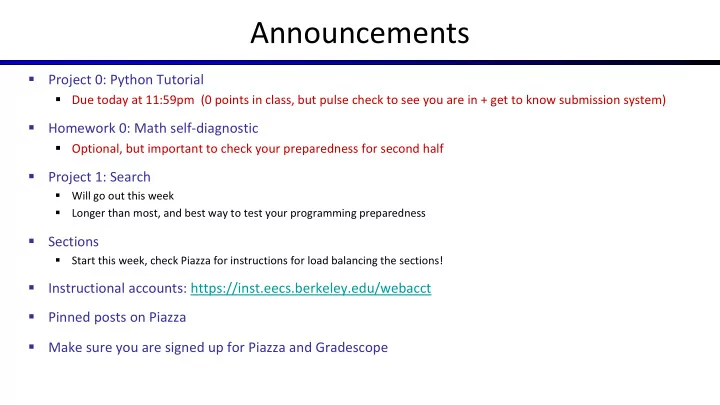
SLIDE 1 Announcements
- Project 0: Python Tutorial
- Due today at 11:59pm (0 points in class, but pulse check to see you are in + get to know submission system)
- Homework 0: Math self-diagnostic
- Optional, but important to check your preparedness for second half
- Project 1: Search
- Will go out this week
- Longer than most, and best way to test your programming preparedness
- Sections
- Start this week, check Piazza for instructions for load balancing the sections!
- Instructional accounts: https://inst.eecs.berkeley.edu/webacct
- Pinned posts on Piazza
- Make sure you are signed up for Piazza and Gradescope
SLIDE 2 CS 188: Artificial Intelligence
Search
Instructors: Sergey Levine & Stuart Russell University of California, Berkeley
[slides adapted from Dan Klein, Pieter Abbeel]
SLIDE 3 Today
- Agents that Plan Ahead
- Search Problems
- Uninformed Search Methods
- Depth-First Search
- Breadth-First Search
- Uniform-Cost Search
SLIDE 4 Agents and environments
- An agent perceives its environment through sensors and acts upon
it through actuators
Agent ? Sensors Actuators Environment
Percepts Actions
SLIDE 5 Rationality
- A rational agent chooses actions maximize the expected utility
- Today: agents that have a goal, and a cost
- E.g., reach goal with lowest cost
- Later: agents that have numerical utilities, rewards, etc.
- E.g., take actions that maximize total reward over time (e.g., largest profit in $)
SLIDE 6 Agent design
- The environment type largely determines the agent design
- Fully/partially observable => agent requires memory (internal state)
- Discrete/continuous => agent may not be able to enumerate all states
- Stochastic/deterministic => agent may have to prepare for contingencies
- Single-agent/multi-agent => agent may need to behave randomly
SLIDE 7
Agents that Plan
SLIDE 8 Reflex Agents
- Reflex agents:
- Choose action based on current percept (and
maybe memory)
- May have memory or a model of the world’s
current state
- Do not consider the future consequences of
their actions
- Consider how the world IS
- Can a reflex agent be rational?
[Demo: reflex optimal (L2D1)] [Demo: reflex optimal (L2D2)]
SLIDE 9
Video of Demo Reflex Optimal
SLIDE 10
Video of Demo Reflex Odd
SLIDE 11 Planning Agents
- Planning agents:
- Ask “what if”
- Decisions based on (hypothesized)
consequences of actions
- Must have a model of how the world evolves in
response to actions
- Must formulate a goal (test)
- Consider how the world WOULD BE
- Optimal vs. complete planning
- Planning vs. replanning
[Demo: re-planning (L2D3)] [Demo: mastermind (L2D4)]
SLIDE 12
Video of Demo Replanning
SLIDE 13
Video of Demo Mastermind
SLIDE 14
Search Problems
SLIDE 15 Search Problems
- A search problem consists of:
- A state space
- A successor function
(with actions, costs)
- A start state and a goal test
- A solution is a sequence of actions (a plan) which
transforms the start state to a goal state
“N”, 1.0 “E”, 1.0
SLIDE 16
Search Problems Are Models
SLIDE 17 Example: Traveling in Romania
- State space:
- Cities
- Successor function:
- Roads: Go to adjacent city with
cost = distance
- Start state:
- Arad
- Goal test:
- Is state == Bucharest?
- Solution?
SLIDE 18 What’s in a State Space?
- Problem: Pathing
- States: (x,y) location
- Actions: NSEW
- Successor: update location
- nly
- Goal test: is (x,y)=END
- Problem: Eat-All-Dots
- States: {(x,y), dot booleans}
- Actions: NSEW
- Successor: update location
and possibly a dot boolean
- Goal test: dots all false
The world state includes every last detail of the environment A search state keeps only the details needed for planning (abstraction)
SLIDE 19 State Space Sizes?
- World state:
- Agent positions: 120
- Food count: 30
- Ghost positions: 12
- Agent facing: NSEW
- How many
- World states?
120x(230)x(122)x4
120
120x(230)
SLIDE 20 Quiz: Safe Passage
- Problem: eat all dots while keeping the ghosts perma-scared
- What does the state space have to specify?
- (agent position, dot booleans, power pellet booleans, remaining scared time)
SLIDE 21 Agent design
- The environment type largely determines the agent design
- Fully/partially observable => agent requires memory (internal state)
- Discrete/continuous => agent may not be able to enumerate all states
- Stochastic/deterministic => agent may have to prepare for contingencies
- Single-agent/multi-agent => agent may need to behave randomly
SLIDE 22
State Space Graphs and Search Trees
SLIDE 23 State Space Graphs
- State space graph: A mathematical
representation of a search problem
- Nodes are (abstracted) world configurations
- Arcs represent successors (action results)
- The goal test is a set of goal nodes (maybe only one)
- In a state space graph, each state occurs only
- nce!
- We can rarely build this full graph in memory
(it’s too big), but it’s a useful idea
SLIDE 24 State Space Graphs
- State space graph: A mathematical
representation of a search problem
- Nodes are (abstracted) world configurations
- Arcs represent successors (action results)
- The goal test is a set of goal nodes (maybe only one)
- In a state space graph, each state occurs only
- nce!
- We can rarely build this full graph in memory
(it’s too big), but it’s a useful idea
S
G d b p q c e h a f r Tiny state space graph for a tiny search problem
SLIDE 25 Search Trees
- A search tree:
- A “what if” tree of plans and their outcomes
- The start state is the root node
- Children correspond to successors
- Nodes show states, but correspond to PLANS that achieve those states
- For most problems, we can never actually build the whole tree
“E”, 1.0 “N”, 1.0
This is now / start Possible futures
SLIDE 26 State Space Graphs vs. Search Trees
S
a b d p a c e p h f r q q c
G
a q e p h f r q q c G a
S G
d b p q c e h a f r
We construct both
we construct as little as possible. Each NODE in in the search tree is an entire PATH in the state space graph.
Search Tree State Space Graph
SLIDE 27 Quiz: State Space Graphs vs. Search Trees
S
G b a
Consider this 4-state graph: How big is its search tree (from S)?
SLIDE 28 Quiz: State Space Graphs vs. Search Trees
S
G b a
Consider this 4-state graph:
Important: Lots of repeated structure in the search tree!
How big is its search tree (from S)? s b b G a a G a G b G … …
SLIDE 29
Tree Search
SLIDE 30
Search Example: Romania
SLIDE 31 Searching with a Search Tree
- Search:
- Expand out potential plans (tree nodes)
- Maintain a fringe of partial plans under consideration
- Try to expand as few tree nodes as possible
SLIDE 32 General Tree Search
- Important ideas:
- Fringe
- Expansion
- Exploration strategy
- Main question: which fringe nodes to explore?
SLIDE 33 Example: Tree Search
S G
d b p q c e h a f r
SLIDE 34 Example: Tree Search
a a p q h f r q c
G
a q q p q a S G
d b p q c e h a f r f d e r
S
d e p e h r f c
G
b c s s d s e s p s d b s d c s d e s d e h s d e r s d e r f s d e r f c s d e r f G
SLIDE 35
Depth-First Search
SLIDE 36 Depth-First Search
S
a b d p a c e p h f r q q c
G
a q e p h f r q q c
G
a S G
d b p q c e h a f r q p h f d b a c e r
Strategy: expand a deepest node first Implementation: Fringe is a LIFO stack
SLIDE 37
Search Algorithm Properties
SLIDE 38 Search Algorithm Properties
- Complete: Guaranteed to find a solution if one exists?
- Optimal: Guaranteed to find the least cost path?
- Time complexity?
- Space complexity?
- Cartoon of search tree:
- b is the branching factor
- m is the maximum depth
- solutions at various depths
- Number of nodes in entire tree?
- 1 + b + b2 + …. bm = O(bm)
… b 1 node b nodes b2 nodes bm nodes m tiers
SLIDE 39 Depth-First Search (DFS) Properties
… b 1 node b nodes b2 nodes bm nodes m tiers
- What nodes DFS expand?
- Some left prefix of the tree.
- Could process the whole tree!
- If m is finite, takes time O(bm)
- How much space does the fringe take?
- Only has siblings on path to root, so O(bm)
- Is it complete?
- m could be infinite, so only if we prevent
cycles (more later)
- Is it optimal?
- No, it finds the “leftmost” solution,
regardless of depth or cost
SLIDE 40
Breadth-First Search
SLIDE 41 Breadth-First Search
S
a b d p a c e p h f r q q c
G
a q e p h f r q q c
G
a
S
G d b p q c e h a f r Search Tiers Strategy: expand a shallowest node first Implementation: Fringe is a FIFO queue
SLIDE 42 Breadth-First Search (BFS) Properties
- What nodes does BFS expand?
- Processes all nodes above shallowest solution
- Let depth of shallowest solution be s
- Search takes time O(bs)
- How much space does the fringe take?
- Has roughly the last tier, so O(bs)
- Is it complete?
- s must be finite if a solution exists, so yes!
- Is it optimal?
- Only if costs are all 1 (more on costs later)
… b 1 node b nodes b2 nodes bm nodes s tiers bs nodes
SLIDE 43
Quiz: DFS vs BFS
SLIDE 44 Quiz: DFS vs BFS
- When will BFS outperform DFS?
- When will DFS outperform BFS?
[Demo: dfs/bfs maze water (L2D6)]
SLIDE 45
Video of Demo Maze Water DFS/BFS (part 1)
SLIDE 46
Video of Demo Maze Water DFS/BFS (part 2)
SLIDE 47 Iterative Deepening
… b
- Idea: get DFS’s space advantage with BFS’s
time / shallow-solution advantages
- Run a DFS with depth limit 1. If no solution…
- Run a DFS with depth limit 2. If no solution…
- Run a DFS with depth limit 3. …..
- Isn’t that wastefully redundant?
- Generally most work happens in the lowest
level searched, so not so bad!
SLIDE 48 Cost-Sensitive Search
BFS finds the shortest path in terms of number of actions. It does not find the least-cost path. We will now cover a similar algorithm which does find the least-cost path.
START
GOAL
d b p q c e h a f r 2 9 2 8 1 8 2 3 2 4 4 15 1 3 2 2
SLIDE 49
Uniform Cost Search
SLIDE 50 Uniform Cost Search
S
a b d p a c e p h f r q q c
G
a q e p h f r q q c
G
a Strategy: expand a cheapest node first: Fringe is a priority queue (priority: cumulative cost) S G
d b p q c e h a f r
3 9 1 16 4 11 5 7 13 8 10 11 17 11 6 3 9 1 1 2 8 8 2 15 1 2 Cost contours 2
SLIDE 51 …
Uniform Cost Search (UCS) Properties
- What nodes does UCS expand?
- Processes all nodes with cost less than cheapest solution!
- If that solution costs C* and arcs cost at least ε , then the
“effective depth” is roughly C*/ε
- Takes time O(bC*/ε) (exponential in effective depth)
- How much space does the fringe take?
- Has roughly the last tier, so O(bC*/ε)
- Is it complete?
- Assuming best solution has a finite cost and minimum arc cost
is positive, yes!
- Is it optimal?
- Yes! (Proof next lecture via A*)
b C*/ε “tiers” c ≤ 3 c ≤ 2 c ≤ 1
SLIDE 52 Uniform Cost Issues
- Remember: UCS explores increasing cost
contours
- The good: UCS is complete and optimal!
- The bad:
- Explores options in every “direction”
- No information about goal location
- We’ll fix that soon!
Start Goal … c ≤ 3 c ≤ 2 c ≤ 1 [Demo: empty grid UCS (L2D5)] [Demo: maze with deep/shallow water DFS/BFS/UCS (L2D7)]
SLIDE 53
Video of Demo Empty UCS
SLIDE 54
Video of Demo Maze with Deep/Shallow Water --- DFS, BFS, or UCS? (part 1)
SLIDE 55
Video of Demo Maze with Deep/Shallow Water --- DFS, BFS, or UCS? (part 2)
SLIDE 56
Video of Demo Maze with Deep/Shallow Water --- DFS, BFS, or UCS? (part 3)
SLIDE 57 The One Queue
- All these search algorithms are the
same except for fringe strategies
- Conceptually, all fringes are priority
queues (i.e. collections of nodes with attached priorities)
- Practically, for DFS and BFS, you can
avoid the log(n) overhead from an actual priority queue, by using stacks and queues
- Can even code one implementation
that takes a variable queuing object
SLIDE 58 Search and Models
models of the world
actually try all the plans
- ut in the real world!
- Planning is all “in
simulation”
good as your models…
SLIDE 59
Search Gone Wrong?
SLIDE 60
Example: Pancake Problem
Cost: Number of pancakes flipped
SLIDE 61
Example: Pancake Problem
SLIDE 62 Example: Pancake Problem
3 2 4 3 3 2 2 2 4
State space graph with costs as weights
3 4 3 4 2
SLIDE 63 General Tree Search
Action: flip top two Cost: 2 Action: flip all four Cost: 4 Path to reach goal: Flip four, flip three Total cost: 7
SLIDE 64 Uniform Cost Search
- Strategy: expand lowest path cost
- The good: UCS is complete and optimal!
- The bad:
- Explores options in every “direction”
- No information about goal location
Start Goal … c ≤ 3 c ≤ 2 c ≤ 1
SLIDE 65
Informed Search
SLIDE 66 Search Heuristics
- A heuristic is:
- A function that estimates how close a state is to a goal
- Designed for a particular search problem
- Examples: Manhattan distance, Euclidean distance for
pathing
10 5 11.2
SLIDE 67
Example: Heuristic Function
h(x)
SLIDE 68
Example: Heuristic Function
Heuristic: the number of the largest pancake that is still out of place
4 3 2 3 3 3 4 4 3 4 4 4
h(x)
SLIDE 69
Greedy Search
SLIDE 70
Example: Heuristic Function
h(x)
SLIDE 71 Greedy Search
- Expand the node that seems closest…
- What can go wrong?
SLIDE 72 Greedy Search
- Strategy: expand a node that you think is
closest to a goal state
- Heuristic: estimate of distance to nearest goal for
each state
- A common case:
- Best-first takes you straight to the (wrong) goal
- Worst-case: like a badly-guided DFS
… b … b [Demo: contours greedy empty (L3D1)] [Demo: contours greedy pacman small maze (L3D4)]
SLIDE 73
Video of Demo Contours Greedy (Empty)
SLIDE 74
Video of Demo Contours Greedy (Pacman Small Maze)